


 Back
Back





2025 Supreme(Kar) 2789
IN THE HIGH COURT OF KARNATAKA AT BENGALURU
UMESH M.ADIGA, J.
Raghavendra S/o Shyamushettigar – Appellant
Versus
Shoukath S/o Abdul Wazid – Respondent
Miscellaneous First Appeal Nos. 640 of 2021, Miscellaneous First Appeal No. 681 of 2020
Decided On : 07-11-2025
For the Appellant : M.V. Maheswarappa
For the Respondent: B.C. Seetharam Rao
The claimant must provide clear evidence of the accident involving the offending vehicle to establish liability for compensation under motor vehicle legislation.
Headnote:(A) Motor Vehicles Act, 1988 - Section 166 - The claimant failed to establish the occurrence of an accident involving the offending motorcycle, leading to permanent disability; the Tribunal's findings were found erroneous due to the lack of reliable evidence. (Paras 3, 24).
(B) Burden of Proof - In claims for compensation, the claimant bears the burden of proving the involvement of the vehicle in the accident, and discrepancies in statements may undermine claims. (Paras 21, 22).
(C) Liability - Respondent No.3 (insurer) was found not liable due to the claimant's inability to prove the nexus between the accident and the injuries sustained. (Paras 24).
Facts of the case:
The claimant, while riding as a pillion, sustained injuries leading to permanent disability following an alleged collision with an offending motorcycle, which was disputed by the insurer.
Findings of Court:
The occurrence of the accident and liability of the insurer were doubted; the complaint was lodged significantly after the event.
Issues: Whether the claimant proved the involvement of the offending vehicle in the accident and if there was a basis for greater compensation.
Ratio Decidendi: The court found that the claimant's evidence was inconsistent and unreliable, leading to a conclusion that the claim was fabricated.
Result: MFA.No.681/2020 is allowed; MFA.No.640/2021 is dismissed; the original award is set aside.
| Table of Content |
|---|
| 1. proceedings relate to two appeals concerning compensation. (Para 1 , 2 , 6 , 7) |
| 2. claimant's version of the accident is inconsistent. (Para 3 , 4 , 12 , 18) |
| 3. medical records suggest claimant's account is unreliable. (Para 11 , 14 , 15 , 16) |
| 4. tribunal's findings are deemed erroneous, needing correction. (Para 21 , 22 , 23) |
| 5. claim dismissed due to lack of proof. (Para 24) |
JUDGMENT :
UMESH M. ADIGA, J.
1. Both these appeals arise out of the judgment and award dated 03.09.2019 in MVC.No.90/2015 passed by the I Additional Senior Civil Judge and C.J.M. & Additional Mact-VII, Shivamogga (for short 'Tribunal').
2. MFA.No.681/2020 is filed by the insurer and MFA.No.640/2021 is filed by the claimant. Hence, both the appeals are taken up together for disposal.
3. The brief facts of the case are that, on 15.09.2013 at about 1.30 p.m., the claimant was traveling as a pillion rider on his motor cycle bearing registration No.KA-14-CE-2854 and his friend one Annappa was riding it. They met with an accident opposite to Eshwara Temple, Arakere, Shivamogga, due to rash and negligent riding of the motor cycle bearing registration No.KA-14-EB-7825 (for short offending vehicle). As a result, both the rider and the pillion rider fell down and sustained injuries. The claimant being pillion rider suffered permanent disability due to the injuries sustained in the accident. With these reasons, he prayed to award compensation of Rs.28,00,000/-.
4. Respondent No.1 was the rider, respondent No.2 was the owner and respondent No.3 was the insurer of the offending motor cycle. Respondent No.3 denied the contentions of the claim petitioner. It also filed additional objections contending that the offending vehicle was falsely implicated in this case to claim compensation. It denied its liability to pay the compensation. With these reasons, prayed to dismiss the claim petition.
5. From the rival contentions of the parties, the Tribunal framed necessary issues, for its determination.
6. The claimant to prove his case examined two witnesses as PW-1 and CW-1 and marked 16 documents, as Exs.P-1 to P-16. The respondent examined one witness as RW-1 and marked document as Ex.R1.
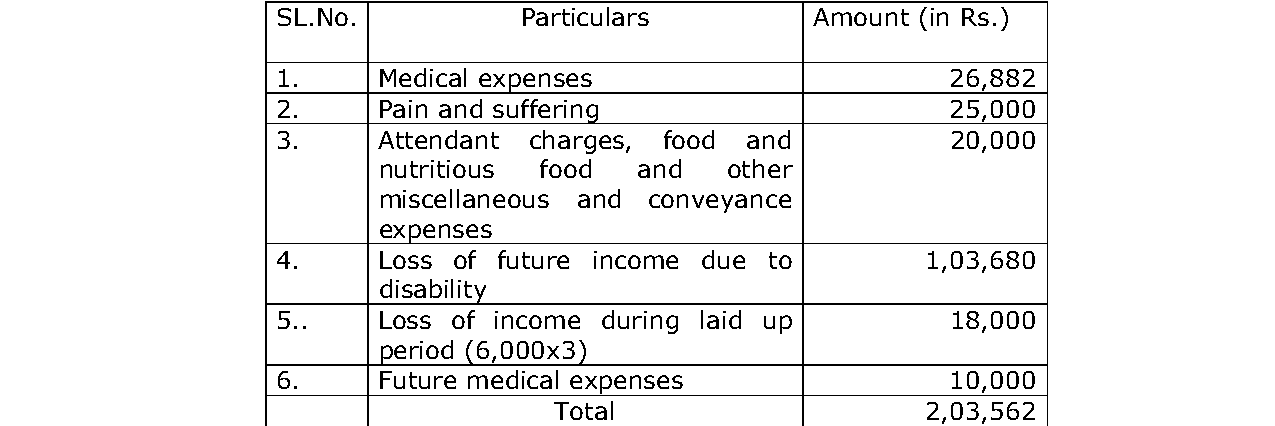
7. The Tribunal after hearing both the parties held that accident occurred due to the rash and negligent riding of the offending motor cycle by its rider and awarded following amount of compensation:
8. The Tribunal also held that respondent Nos.2 and 3 are jointly and severally liable to pay the compensation.
9. Heard the arguments of learned counsel appearing for both the sides.
10. The following point emerges for my determination:
i. Whether accident occurred due to involvement of the offending vehicle as contended in the petition?
ii. Whether claimant is entitled to enhancement of compensation?
iii. What order?
11. PW-1 is the alleged victim of the accident. In his evidence, he has reiterated the petition averments and he has produced the documents at Exs.P1-P16. The petitioner also examined the medical officer as CW-1 and 3 documents were marked as CWs-1 to 3. CW-1 corroborated the evidence of PW-1 in respect of injuries and permanent disability suffered by PW-1.
12. PW-1, in his cross-examination, stated that he was a pillion rider on his own motorcycle, which was being ridden by his brother-in-law, Annappa. The accident occurred in front of Sahyadri Narayana Hrudayalaya Hospital of Arakare Village. Initially, PW-1 stated that Annappa did not sustain any injuries; but, he later stated that Annappa suffered minor injuries. PW-1 further stated that immediately after the accident, he was taken to Sahyadri Narayana Hrudayalaya Hospital by an auto driver, and he informed the doctor about the manner in which the accident occurred and how he sustained his injuries. PW-1 admitted that the accident occurred due to a collision between two vehicles. He also mentioned that he got discharged from Narayana Hospital against medical advice. Later that night, he was shifted to Wenlock Hospital at Man












