


1. Writ petition challenging order directing plaintiff to pay court fee on market value in partition suit. (Para 1 , 4 , 5 )
 Back
Next 





2026 Supreme(Kar) 645
IN THE HIGH COURT OF KARNATAKA AT DHARWAD
SACHIN SHANKAR MAGADUM, J.
Shri. Manohar S/o Gavind Shahapurkar - Appellant
Vs.
Shri. Shivaji S/o. Govind Shahapurkar - Respondent
Writ Petition No. 123552 Of 2020 (GM-CPC)
Decided On : 17-07-2026
Important Points
In partition suits, court fee valuation is determined by plaint averments. Constructive joint possession is presumed for all co-owners unless ouster is proven after trial; isolated admissions or registered sale deeds by one co-parcener cannot justify ad valorem fees at an interlocutory stage.
Subject
Civil Law - Court Fees and Valuation
Act Referred
Headnote
(A) Court Fees and Suits Valuation Act - Section 35(1) and 35(2) - Partition suit - Determination of court fee - Valuation has to be determined primarily on the basis of the averments contained in the plaint and the relief claimed, and not on the basis of the defence set up in the written statement or isolated admissions elicited during cross-examination at an interlocutory stage. (Paras 8, 12, 15)
(B) Joint possession - In a suit for partition among co-parceners or co-owners, possession of one co-owner is, in law, possession of all. The law presumes constructive joint possession of every co-owner unless there is clear plea and proof of ouster, hostile assertion of exclusive title, or complete exclusion from enjoyment of the property. (Para 9)
(C) Alienation by co-parcener - A registered sale deed executed by one co-parcener in favour of a stranger purchaser does not, by itself, extinguish the constructive possession of the remaining non-alienating co-parceners. The purchaser merely steps into the shoes of the vendor and acquires only such undivided interest as the vendor possessed. (Paras 10, 13, 20)
(D) Legislative Intent - The distinction between Section 35(1) and 35(2) is substantive; Section 35(2) is a beneficial statutory protection intended to preserve the right of non-alienating co-parceners to seek partition without being burdened by prohibitive ad valorem court fees. (Paras 19, 23)
Facts of the case:
A suit for partition and separate possession was instituted alleging that the suit schedule property, though purchased in the name of one family member, was acquired from the joint family nucleus and the plaintiff continued to be in joint possession. During trial, the defendants filed an application seeking rejection of the plaint, contending that the plaintiff was not in possession of the property. The Trial Court, relying on certain admissions during cross-examination and a registered sale deed in favour of a third party, directed the plaintiff to pay court fee on the market value of the property under Section 35(1) of the Act.
Findings of Court:
The Trial Court erred in deciding a disputed question of possession at an interlocutory stage based on isolated admissions and a registered conveyance. The issue of whether the plaintiff was excluded from joint possession is a matter of fact that requires adjudication through a full-fledged trial.
Issues: Whether the Trial Court was justified in directing the plaintiff to pay court fee under Section 35(1) of the Act, solely on the basis of the plea of the contesting defendants and certain admissions elicited during the cross-examination of the plaintiff.
Ratio Decidendi: In partition suits, the court must presume constructive joint possession of all co-owners unless ouster is legally established. The determination of whether a suit falls under Section 35(1) or 35(2) must be based on the plaint's allegations. A registered sale deed executed by one co-parcener does not automatically prove the exclusion of other co-parceners. Consequently, the plaintiff is entitled to the benefit of the fixed court fee under Section 35(2) until a finding of exclusion is recorded after evidence.
Result: Writ petition allowed; order of the Trial Court quashed and set aside.
Legal Category Hierarchy
Advocates:
Advocate Appeared:
For the Appellant :Y Sri S.B. Rawoot, Advocate
Table of Contents
2. Defendants contended plaintiff not in possession, hence court fee under Section 35(1). Plaintiff asserted joint possession, hence fixed court fee under Section 35(2). (Para 5 )
3. Question of valuation must be determined from plaint averments, not defence or isolated admissions in cross-examination. (Para 6 , 8 , 9 , 10 , 11 , 12 , 13 , 14 , 15 , 16 , 17 , 18 , 19 , 20 , 21 , 22 , 23 , 24 , 25 , 26 , 27 , 28 , 29 , 30 )
4. In a partition suit, court fee is determined by plaint assertions of joint possession; ouster requires full trial, not interlocutory inference. (Para 9 , 10 , 11 , 12 , 13 , 14 , 15 , 16 , 17 , 29 , 30 , 31 )
5. Writ petition allowed; impugned order quashed; trial to proceed; question of court fee left open for final disposal. (Para 1 , 32 )
6. On what basis is the question of court fee in a partition suit determined?
Primarily on plaint averments and relief claimed, not on defence set up in written statement or isolated admissions in cross-examination. (Para 8 , 9 , 12 , 15 )
7. Does a registered sale deed by one co-parcener extinguish the constructive possession of other co-parceners?
No. The purchaser acquires only the vendor's undivided interest; constructive possession of remaining co-parceners persists until ouster is proved in trial. (Para 10 , 13 , 20 , 21 )
8. When can a court direct payment of ad valorem court fee under Section 35(1) of the Karnataka Court Fees Act?
Only after a definitive finding, based on full evidence, that the plaintiff was excluded from possession as on the date of suit. (Para 11 , 17 , 29 , 30 )
9. What is the legislative intent behind Section 35(2) of the Karnataka Court Fees Act?
To protect non-alienating co-parceners from prohibitive court fee by permitting fixed fee when they assert joint possession despite alienations by other members. (Para 19 , 20 , 21 , 22 , 23 )
10. Can an interlocutory application for rejection of plaint on court fee grounds be decided based on admissions in cross-examination before trial?
No. Such admissions must be appreciated with entire evidence at final adjudication; premature determination on court fee is legally impermissible. (Para 6 , 14 , 18 , 30 )
ORDER :
(PER: HON'BLE MR. JUSTICE SACHIN SHANKAR MAGADUM)
The present writ petition is directed against the order passed by the Court below on I.A. No.XII, whereby the application filed by the defendants seeking rejection of the plaint on the ground that the suit is not properly valued for the purpose of payment of court fee came to be allowed, and the plaintiff was directed to pay court fee on the market value of the suit property.
2. Though respondent Nos.5 and 13 remain unserved, this Court is satisfied that the petition can be taken up for final disposal. Respondent No.5 is one of the legal representatives of defendant No.2 and the remaining legal representatives are already served and are represented. There is, therefore, effective representation of the estate, and respondent No.5 can be safely presumed to have constructive notice of the present proceedings. Insofar as respondent No.13 is concerned, he is only a subsequent purchaser and the controversy involved in the present writ petition is confined to the question relating to valuation of the suit and payment of court fee. Hence, his presence is not necessary for adjudication of the issues involved in the present petition.
3. Heard the learned counsel appearing for the petitioner. Perused the impugned order and the material placed on record. This Court finds it apposite to refer to the family tree, the same is extracted as under:
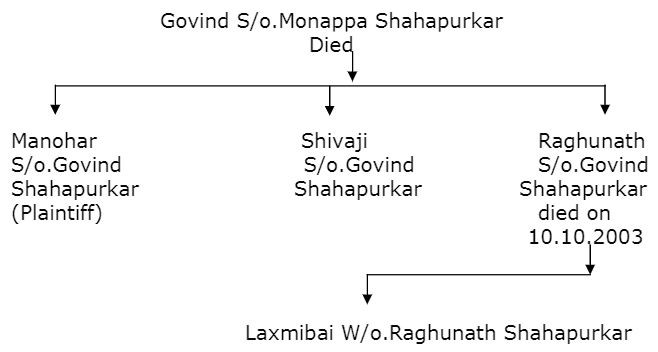
4. The petitioner has instituted the suit seeking partition and separate possession by specifically pleading that the suit schedule property, though purchased in the name of one Raghunath under a registered sale deed dated 1967, was in fact acquired by the propositus of the family from and out of the joint family nucleus. It is the specific case of the plaintiff that the property was purchased by utilizing the proceeds derived from the sale of ancestral properties and, therefore, notwithstanding the purchase standing in the name of Raghunath, the property continued to retain the character of joint family property. The plaintiff has further asserted that Raghunath was only acting as the Karta of the joint family and was holding the property for and on behalf of all the coparceners.
5. During the course of trial, certain admissions were elicited in the cross-examination of the plaintiff. Relying upon those answers, the legal representatives of Raghunath filed I.A. No.XII contending that the plaintiff was admittedly not in possession of the suit property and, therefore, the suit ought to have been valued under Section 35(1) of the Karnataka Court Fees and Suits Valuation Act, 1958 (for short, ‘the Act’) by paying court fee on the market value of the property. Accepting the said contention, the Trial Court has held that the plaintiff is not in joint possession of the suit schedule property and has consequently directed payment of court fee on the market value of the property.
6. The approach adopted by the Trial Court, in the considered opinion of this Court, cannot be sustained. Once the trial has commenced and the parties have entered upon evidence, the question relating to valuation of the suit cannot be determined solely on the basis of certain answers elicited during cross-examination. The so- called admissions extracted in the impugned order merely indicate that the property stood in the possession of Raghunath for a considerable period after its purchase. Such statements, by themselves, cannot lead to an inference that the plaintiff has been excluded from possession or that the joint possession pleaded in the plaint stands disproved.
7. The principal question that arises for consideration is “whether the Trial Court was justified in directing the plaintiff to pay court fee under Section 35(1) of the Act, solely on the basis of the plea of the contesting defendants and certain admissions elicited during the cross-examination of the plaintiff?”.
Findings on point for consideration:
8. The suit on hand is one for partition and separate possession. The f









