
 Back
Back





IN THE HIGH COURT OF BOMBAY
S.M.Modak, J.
Prashant Gopalrao Chandane - Appellant
Versus
State of Maharashtra - Respondent
Criminal Appeal No. 584 of 1998
Decided On : 15-12-2023
PREVENTION OF CORRUPTION ACT - CORRUPTION AND FALSE EVIDENCE - PC Act, Sec. 7, Sec. 13(1)(d), Sec. 13(2); IPC, Sec. 193; Cr.P.C., Sec. 344 - The court discussed the provisions of the Prevention of Corruption Act, 1988, particularly Sections 7 and 13, which address bribery and corruption. It also examined Section 344 of the Code of Criminal Procedure, which pertains to the punishment for giving false evidence. The court emphasized that for a conviction under Section 344, it must be proven that the witness knowingly gave false evidence, and that the trial court must be satisfied that it is necessary to try the witness summarily. The court found that the trial court failed to establish that the appellant had willfully given false evidence, leading to the decision to set aside the conviction.
Fact of the Case:
The appellant, a contractor, lodged a complaint against Dattajirao Patil, an Assistant Engineer, for demanding a bribe. The trial court acquitted Patil due to insufficient evidence but subsequently convicted the appellant for giving false evidence under Section 344 of the Cr.P.C. after he resiled from his statement during cross-examination.
Finding of the Court:
The court found that the trial court did not establish that the appellant had willfully given false evidence. It noted that the trial court's acquittal of the accused was based on the improbability of the prosecution's case and that the appellant's change in testimony did not meet the threshold for conviction under Section 344.
Issues: Whether the appellant willfully gave false evidence and whether the trial court properly exercised its discretion under Section 344 of the Cr.P.C.
Ratio Decidendi: The court held that for a conviction under Section 344 of the Cr.P.C., it must be proven that the witness knowingly gave false evidence, and the trial court must be satisfied that it is necessary to try the witness summarily. The court found that the trial court's failure to establish these elements warranted the reversal of the conviction.
Final Decision: The appeal was allowed, and the conviction of the appellant under Section 344 of the Cr.P.C. was set aside.
JUDGMENT/ORDER
1. Heard learned Advocate for the Appellant/convicted Accused who is de-facto Complainant in case under the provisions of the Prevention of Corruption Act, 1988 ["PC Act"] and learned APP.
2. If an Accused is acquitted on account of lapses in investigation and lacunae in the evidence, Court cannot be blamed. However, when case results into acquittal due to ignorance of the Judicial Officer, it pains us. Similar thing has happened in this case. On one hand, by accepting the defence raised by the original Accused, trial Court acquitted Accused but on same evidence, convicted the Complainant.
3. In fact, this Appellant was instrumental in launching the prosecution under the provision of Sec. 7 and Sec. 13(1) (d) read with Sec. 13(2) of the PC Act against one Dattajirao Vasantrao Patil and Special Case No. 2 of 1993 was initiated in Court of Special Judge - Kolhapur. However, when the question of giving evidence had arisen, this Appellant has cleverly supported the case of the prosecution while giving examination-in-chief. However, when he was cross-examined by Accused Dattajirao V. Patil, he deposed that in fact he owes the amount to the Accused and whatever amount he has parted away on the date of the trap on 15/5/1992 was not towards the illegal gratification, but it was towards repayment of the loan.
4. When the trial Court appreciated the evidence in the said case, it has given benefit of doubt to said Dattajirao Patil. It is for the various reasons including the present Appellant and the panch witnesses not supporting the prosecution witness and defects in sanction. The said Accused was acquitted vide judgment dtd. 5/1/1998. It is placed on record. However, while acquitting the Accused, the trial Court on 5/1/1998 was pleased to issue show cause notice to the present Appellant by calling his explanation as to why he should not be punished under Sec. 193 of the Indian Penal Code, 1860 ["IPC"].
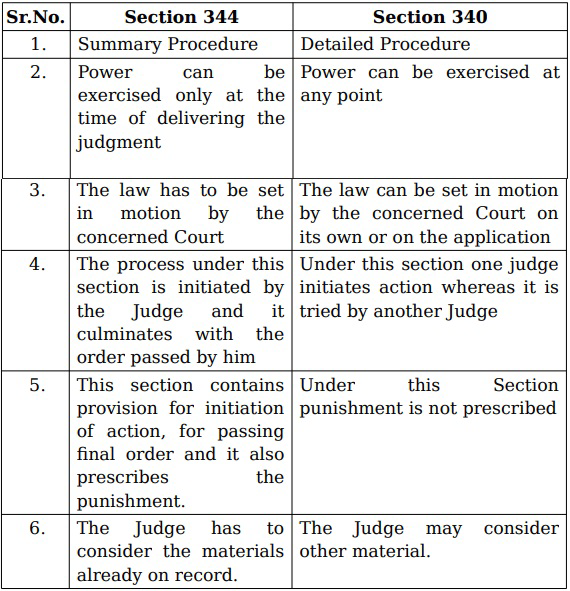
5. Show cause notice was issued on 7/1/1998. When the present Appellant gave an explanation to the show cause notice, the trial Court as per order dtd. 12/5/1998 has directed the Appellant to appear before him on 5/6/1998 for the purpose of explaining particulars of the offence punishable as per Sec. 344(1) of the Code of Criminal Procedure ["Cr.P.C."]. (at page No. 20 of the paper book). The particulars were explained on 17/6/1998 (at page No.7). Thereafter, after hearing both the sides, the trial Court was satisfied that wilfully and deliberately, the present Applicant has given false evidence and accordingly convicted him on 17 th June 1998 for simple imprisonment for one month and fine of Rs.250.00. Punishment is prescribed under Sec. 344 of Cr.P.C. The correctness of the said judgment is challenged by way of this Appeal. Submissions
6. I have heard learned Advocate Shri.Sarkar for the Appellant and learned APP. Learned Advocate Shri.Sarkar invited my attention to the evidence given by this Appellant and findings of the trial Court. Mr.Sarkar relied upon the following two judgments :-
a) Sanjay S/o Baburao Gitte Vs. The State of Maharashtra, Criminal Appeal No. 307 of 201 6 : 5/5/201 7 : Bombay High Court (Bench at Aurangabad).
b) Shri Manikrao s/o Shivram Wagh Vs. The State of Maharashtra, Criminal Appeal No. 699 of 2 006 : 16thFebruary, 2 019 : Bombay High Court (Bench at Nagpur).
7. Whereas, according to the learned APP, when the Complainant was knowing that he owes the amount to Mr.Patil, then why he has approached Anti Corruption Bureau and why he led them to organize the trap and persuaded them to conduct investigation and to file charge-sheet. According to him, this is an afterthought to help the Accused and decision of the trial Court does not require interference. Judgments
8. It is true that in the case of Sanjay Gitte (supra), the learned Single Judge of this Court has also dealt with similar controversy. While acquitting the Accused for matrimonial offence, the learned Sessions Judge held that the Appellant t
AI


Point of law: So far as the presumption under Section 20 of the PC Act is concerned, it trite that even the presumption under Section 20 of the PC Act can be drawn only after demand for and acceptanc....

The competency of an accomplice as a witness, the need for corroborative evidence, and the court's discretion in imposing a lenient view for delay in the case.
The prosecution must prove the initial demand and acceptance of illegal gratification beyond reasonable doubt, and the burden of proof rests on the prosecution.


The demand for illegal gratification is essential to constitute an offence under the Prevention of Corruption Act, and mere recovery of tainted money is insufficient to establish guilt without proof ....
The main legal point established in the judgment is the requirement for the prosecution to prove demand and acceptance of illegal gratification beyond reasonable doubt, the presumption of innocence i....



An indispensable Tool for Legal Professionals, Endorsed by Various High Court and Judicial Officers
Please visit our Training & Support
Center or Contact Us for assistance

Scan Me!
India’s Legal research and Law Firm App, Download now!


For Daily Legal Updates, Join us on :



 Back to top


