
 Back
Back





IN THE HIGH COURT OF BOMBAY
Sharmila U. Deshmukh, J.
Rajaram Appa Patil , Deceased Legal Heirs & Ors. - Appellants
Versus
Nitin Anandrao Patil & Ors. - Respondents
Second Appeal No. 484 of 2013 Along with Second Appeal No. 465 of 2013
Decided On : 12-06-2024
Certainly. Based on the provided legal document, the key points are as follows:
The court affirmed the validity of the earlier partition conducted in 1959, establishing that the properties were divided among the family members at that time (!) (!) .
The decree in RCS No. 61 of 1978 was deemed collusive because essential parties, including the plaintiff Nitin, were not adequately represented, rendering the decree not binding on him (!) (!) (!) .
The evidence, including documentary records such as mutation entries and revenue records, supports the conclusion that the family properties were partitioned in 1959, with clear intent to separate interests, which was corroborated by conduct and subsequent dealings of the parties (!) (!) (!) (!) (!) .
The earlier decree in RCS No. 61 of 1978, which declared a different share for the parties, was obtained by collusion and is not binding on the plaintiff Nitin, who was not a necessary party and was improperly represented (!) (!) (!) (!) .
The claim of Dhondubai, the wife of Rajaram, for a share in the properties was rejected because she had not claimed her rights during the proceedings of RCS No. 61 of 1978 and her rights were barred by finality of that decree (!) (!) (!) .
The legal principles regarding the effect of mutation entries, oral and written agreements, and conduct of the parties were applied to determine that a valid partition occurred in 1959, which severed the joint family status (!) (!) (!) (!) (!) (!) .
The court emphasized that the burden of proof regarding the existence of a partition rests on the party claiming it, and the cumulative evidence must establish the intention to separate (!) (!) (!) .
The appellate court's findings, based on appreciation of evidence, were upheld, and its conclusion that the partition of 1959 was valid and binding was affirmed, with the findings of fact being conclusive unless demonstrably perverse (!) (!) .
The doctrine of promissory estoppel was considered inapplicable to the case, especially in the context of legal provisions governing the rights of family members and the effect of prior decrees (!) .
The court dismissed the appeals, affirming that the earlier partition was valid, and the decree in the earlier suit was collusive and not binding on the plaintiff Nitin, who was not a proper party in the earlier proceedings (!) .
The court extended the interim relief in favor of the appellant for a specified period, maintaining the status quo pending final orders (!) .
These points collectively highlight the court's reasoning in affirming the validity of the 1959 partition, rejecting the collusive decree of 1978, and denying the claim of Dhondubai for a share in the properties.
| Table of Content |
|---|
| 1. overview of appeals regarding partition. (Para 1 , 2 , 3) |
| 2. details of the family structure and initial suit properties. (Para 4 , 5 , 6 , 7 , 8) |
| 3. remand back to trial court on key legal issues. (Para 20 , 21 , 22) |
| 4. exploration of the significance of joint family structure under hindu law. (Para 25 , 66) |
| 5. court’s affirmation of prior partition and its implications for current claims. (Para 39 , 40 , 72) |
| 6. evaluation of partition under hindu law. (Para 41) |
| 7. final determination on binding nature of decrees. (Para 74) |
| 8. judgment dismissal and order of stay extension. (Para 77 , 78 , 79) |
JUDGMENT
Sharmila U. Deshmukh, J. - Both the Second Appeals arise out of common judgment dated 4th May 2013 passed in Regular Civil Appeal No.21 of 2002 and Regular Civil Appeal No.131 of 2002. Regular Civil Appeal No.21 of 2002 was filed by the Defendant Nos.6 to 15 and Regular Civil Appeal No.131 of 2002 was filed by the Defendant Nos.1 and 3 to 5 challenging the judgment and decree dated 3rd November 2001 passed by Trial Court in Regular Civil Suit No.42 of 1990 decreeing the suit for partition and separate possession. Both appeals were heard together with consent of the parties as they arise out of common judgment and are being disposed of by this common judgment.
FACTUAL MATRIX:
2. For better understanding of the relationship of parties interse the genealogy chart tendered at the time of hearing is reproduced hereunder:
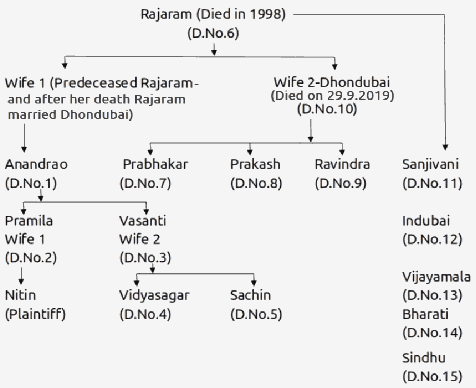
3. Regular Civil Suit No. 42 of 1990 was filed by Nitin i.e son of Anandrao seeking partition and separate possession of the suit properties.
PROCEEDINGS IN TRIAL COURT:
PLAINT:
4. In RCS No.42 of 1990 filed by Nitin seeking partition, initially the daughters of Rajaram were not impleaded and after the death of Rajaram during the pendency of proceedings, the daughters of Rajaram i.e. Defendant Nos 11 to 15 came to be impleaded. The suit properties described in the plaint are 9 landed properties bearing Gat No. 303, 305, 370, 590(A), 590(B),597, 599, 606 and 610 situated at Mouje Minve Khurdh, Taluka :Bhudargad, Dist: Kolhapur.
5. It was contended that the suit properties were ancestral properties in which the plaintiff along with Defendant No.1 and Defendant No.2, i.e., his parents have undivided share. The Defendant No.1 had deserted the Plaintiff and the Defendant No.2 and was residing with Defendant No.3 Vasanti who was not his legally wedded wife. Defendant Nos.4 and 5 are their illegitimate children and do not have any right in the suit properties. After setting out relationship between the parties, it was pleaded that Prabhakar-Defendant No. 7, was born on 22nd December 1953, Prakash @ Vijaykumar- Defendant No.8 was born on 30th July 1965 and Ravindra-Defendant No.9 was born on 2nd October 1969.
6. Prior to 25th October 1959, Defendant Nos.1, 6 and 7, i.e., Anandrao, Rajaram and Prabhakar were coparceners and Rajaram was head of family. On 15th October 1959, there was partition of the joint family and Rajaram gave Vardi application to the revenue authorities for mutating revenue records of the joint family properties as per ownership possession and Mutation Entries Nos.508, 507 and 443 came to be effected. The Defendant Nos.1, 6 and 7 acquired separate ownership rights in respect of their separate properties. Subsequently, consolidation scheme was implemented in the village and lands of Anandrao, Prabhakar and Rajaram were converted into Gat Numbers. The suit properties are the ownership properties of Defendant no.1.
7. The properties which are stated to have been allotted to the share of Anandrao, Rajaram and Prabhakar are given in tabular form for ease of reference by this Court :
Properties allotted to: | Gat Nos : |
Rajaram | Gat No. 285, 299, 308, 310, 321, 346, 363, 365, 387A, 387B, 387C, 374, 365 and Survey Nos. 81/2 and 88/1 |
Prabhakar | Gat Nos. 439, 443, 446 and 487. |
Anandarao | Gat No. 303, 305, 370, 590(A), 590(B),597, 599, 606 and 610 |
8. Since the birth of Plaintiff in the year 1963, the suit properties are
AI

The amendment to Section 6 of the Hindu Succession Act establishes that daughters are coparceners with equal rights in ancestral property, and oral partitions are not sufficient without formal docume....

The main legal point established in the judgment is that unless prior partition is established, there shall be a presumption that the property is joint family property, and a family arrangement in th....

The burden of proof in establishing joint family property and partition lies with the party alleging its existence. The court also emphasized the entitlement of daughters to share in joint Hindu fami....

The court confirmed the status of joint family properties, ruling prior partition claims insufficiently proven, which allowed plaintiffs' partition suit to proceed despite earlier suit dismissal on n....
In disputes regarding partition of joint Hindu family property, the burden of proof lies on the party asserting partition, and the presumption of jointness remains unless clear evidence to the contra....

A partition deed long acted upon by all parties through possession and alienation is binding and cannot be reopened by descendants, especially when the original parties to the partition accepted the ....



An indispensable Tool for Legal Professionals, Endorsed by Various High Court and Judicial Officers
Please visit our Training & Support
Center or Contact Us for assistance

Scan Me!
India’s Legal research and Law Firm App, Download now!


For Daily Legal Updates, Join us on :



 Back to top


