
 Back
Back





IN THE HIGH COURT OF JUDICATURE AT BOMBAY
Sandeep V. Marne, J.
Shridhar Kashinath Bhagat - Petitioner
Versus
Sub-Divisional Officer at Panvel and Ors. - Respondents
Writ Petition No.3140 Of 2024, Writ Petition No.3141 Of 2024, Writ Petition No.3142 Of 2024, Writ Petition No.3143 Of 2024
Decided On : 12-08-2024
Nuisance - Stone Crushing Plants - Code of Criminal Procedure, 1973 - Sections 133, 135, 138, 139, 142 - The court interpreted the provisions of Section 133, emphasizing the need for a conditional order before final orders can be made, and clarified that the closure order was a temporary measure pending further investigation.
Fact of the Case:
Petitioners, operating stone crushing plants, challenged closure orders issued under Section 133 of the Code of Criminal Procedure, 1973, citing compliance with environmental regulations and lack of evidence for public nuisance.
Finding of the Court:
The court found that the Sub-Divisional Magistrate's order was not a final order but a temporary measure pending expert investigation into potential risks posed by the stone crushing operations to public safety and infrastructure.
Issues: Whether the closure order under Section 133 was valid without a prior conditional order and whether the operations of the stone crushing plants constituted a public nuisance.
Ratio Decidendi: The court held that a conditional order is necessary under Section 133 before a final order can be made, but the closure order was justified as a precautionary measure pending further investigation.
Result: The Writ Petitions are dismissed.
JUDGMENT:
Sandeep V. Marne, J.
1. These Petitions are filed by Petitioners, who operate stone crushing plants and are aggrieved by orders dated 28 June 2024 passed by the Sub- Divisional Officer-cum-Sub-Divisional Magistrate, Panvel, under provisions of Section 133 of the Code of Criminal Procedure, 1973 (the Code) directing closure of their crusher plants.
2. Brief facts leading to filing of the present Petitions are that Petitioners claim to be owners and occupants of various lands at Village -Jasai, Taluka - Uran, District-Raigad. Maharashtra Pollution Control Board (MPCB) has granted ‘Consent to Operate’ in favour of Petitioners for manufacture of Asphalt Mix Plant, crushing and washing sand, stone metal, crushed stone and grit powder, etc, which are commonly referred to as ‘stone crushing plants’ in the present order.
3. According to Petitioners, MPCB is the principal regulator tasked with overseeing and managing pollution control efforts relating to their stone crushing plants. Petitioners claim to have acquired various other permissions and NOCs required for operation of stone crushing plants. They also have been issued mining licenses under the provisions of Maharashtra Minor Mineral Extraction (Development and Regulation)Rules, 2013. Petitioners have given details of various permissions, licenses and NOCs, issued by various statutory authorities in the Petitions.
4. Petitioners’ stone crushing plants are located near Mumbai Trans Harbour Sea Link named as ‘Atal Setu’. According to Petitioners, location of their plants near Mumbai Trans Harbour Sea Link does not cause any hazard as Petitioners are not permitted to use blasting or explosives and that they use various suppression systems to prevent air and sound pollution. According to Petitioners, no public nuisance is therefore caused by reason of operation of crushing plants by them.
5. Mumbai Trans Harbour Sea Link was inaugurated for public use in January 2024. Commissioner, Mumbai Metropolitan Region Development Authority (MMRDA) wrote to Collector, Raigad, bringing to his notice operation of various mining and quarry works in the villages of Uran and Panvel Talukas and their effect on the Trans Harbour Link. It appears that that orders were issued on 23 January 2024 for closure of stone crushing plants. According to Petitioners, inspection was conducted on their stone crushing plants by MPCB and a report was submitted to Sub-Divisional Officer, Panvel. It appears that after receipt of letters from MPCB, the Sub-Divisional Officer, Panvel wrote to the Respondent No.5-Maharashtra State Electricity Distribution Co. Ltd. (MSEDC) for reconnection of electricity supply in respect of the plants and also instructed the Circle Officer, Jasai, to remove the seal on the plants. After MPCB’s recommendations, the plants were restarted.
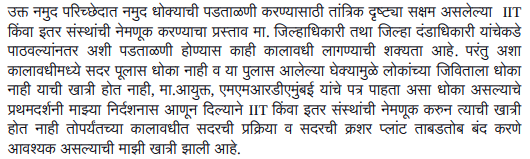
6. In the above background, notices were issued by Sub-Divisional Officer-cum-Sub-Divisional Magistrate, Panvel on 27 May 2024 to Petitioners calling them upon to show cause as to why they should not be injuncted from operating the stone crushing plants. In the said show cause notices it was stated that operation of stone crushing plants as well as blasting activities were endangering the structural stability of Mumbai Trans Harbour Sea Link in addition to causing destruction of the environment. It was stated that food mall is proposed near the toll plaza and regular blasting activities would endanger the bridge as well as buildings. The show cause notices referred to letters of Commissioner, MMRDA dated 14 December 2023, 10 April 2024 as well as Collector’s letter dated 5 May 2024. Petitioners were called upon to remain present for hearing on 10 June 2024. Petitioners submitted their written submissions/ replies to the show cause notices. The Sub-Divisional Magistrate proceeded to pass orders on 28 June 2024 under provisions of Section 133 of the Code ordering stoppage of Petitioners’ crushing plants till the time committee constituted for examining t
AI
A conditional order under Section 133 of the Code of Criminal Procedure is essential before final orders can be issued, but temporary measures can be taken to ensure public safety pending investigati....


The court emphasized that a conditional order under Section 133 of Cr.P.C. is mandatory for initiating proceedings, and failure to comply renders subsequent actions invalid.
Section 152 BNSS requires proper conditional order, evidence inquiry before absolutism; spot inspection invalid substitute. Cannot compel private land use for public projects without acquisition; pro....

Public nuisance requires substantial proof of injury to the community; judicial discretion in abating nuisance is contingent upon credible evidence.

The main legal point established in the judgment is the scope and procedure of Sec. 133 of Cr.P.C. in addressing public nuisance and the requirement for recording reasons for administrative decisions....
The court established that the exercise of power under Section 133 of the Cr.P.C. is justified in cases of imminent danger to public safety, and such powers can be exercised even in the context of pr....

Proceedings under Section 133 Cr.PC require evidence of public nuisance; private disputes cannot be adjudicated under this provision.


The supervisory jurisdiction of the High Court under Article 227 does not allow it to act as an appellate court; it corrects errors only when a grave injustice occurs due to procedural violations.



An indispensable Tool for Legal Professionals, Endorsed by Various High Court and Judicial Officers
Please visit our Training & Support
Center or Contact Us for assistance

Scan Me!
India’s Legal research and Law Firm App, Download now!


For Daily Legal Updates, Join us on :



 Back to top


