Back
Back





2024 Supreme(Bom) 881
IN THE HIGH COURT OF JUDICATURE AT BOMBAY BENCH AT AURANGABAD
VIBHA KANKANWADI, ABHAY S. WAGHWASE, JJ.
Ramrao S/o Govindrao Dhakane – Appellant
Versus
The State of Maharashtra – Respondent
Criminal Application No.3086 of 2023
Decided on : 20-09-2024
Advocate Appeared:
For the Appellant :Mr. Ajinkya Reddy Advocate
For the Respondent:Dr. Kalpalata Patil-Bharaswadkar, Mr. Abhijit G. Choudhari Advocate
IMPORTANT POINT
A conviction under IPC Section 306 requires clear evidence of intent to instigate suicide, which was not present in this case.
Headnote:
Quashing - FIR - IPC Section 306 - The court discussed the essential ingredients of abetment under IPC Section 306, emphasizing the necessity of intent and instigation for a conviction, ultimately leading to the quashing of the FIR due to lack of evidence.
Fact of the Case:
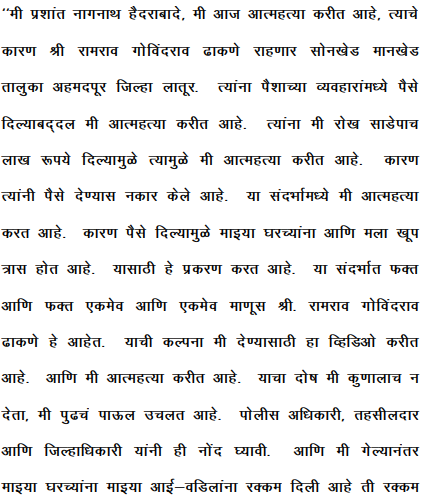
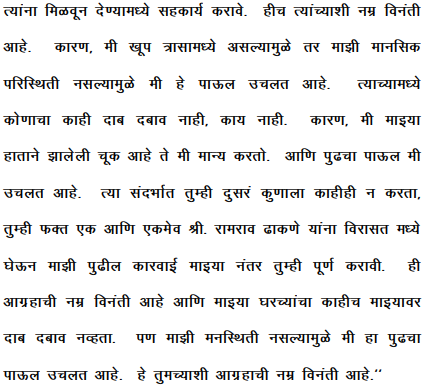
The applicant sought to quash an FIR for abetment of suicide under IPC Section 306, following the suicide of Prashant, who had financial dealings with the applicant. Prashant's suicide note implicated the applicant, but also indicated no external pressure.
Finding of the Court:
The court found insufficient evidence to establish that the applicant had the intent to instigate Prashant's suicide, noting that the suicide note contained contradictory statements regarding responsibility.
Issues: Whether the applicant's actions constituted abetment of suicide under IPC Section 306.
Ratio Decidendi: The court reiterated that for a conviction under IPC Section 306, there must be clear evidence of intent to instigate or aid the suicide, which was absent in this case.
Result: The FIR and proceedings against the applicant were quashed.
JUDGMENT :
[PER SMT. VIBHA KANKANWADI, J.] :
1. Heard finally with the consent of the learned Advocates for the rival parties.
2. Present Application has been filed under Section 482 of the Code of Criminal Procedure for quashing the First Information Report (for short “the FIR”) vide Crime No. 111 of 2022 registered with Chakur Police Station, Taluka-Chakur, District- Latur and the proceedings in R.C.C. No.38 of 2023 pending before the learned Judicial Magistrate First Class, Chakur, District-Latur for the offence punishable under Section 306 of the Indian Penal Code. The said FIR came to be registered upon the report given by respondent No.2. Respondent No.2 is the father of deceased Prashant.
3. Heard learned Advocate Mr. Reddy for the applicant, learned APP Dr. Bharaswadkar for respondent No.1 and learned Advocate Mr. Choudhari for respondent No.2.
4. Perusal of the FIR lodged by respondent No.2 and the statements of the witnesses would show that deceased Prashant was residing at Ahmedpur, whereas respondent No.2 was residing at Hali (Khurdali), Taluka-Chakur, District-Latur. Deceased Prashant was working with one Vyankatesh Lab. Five months prior to the FIR on 2nd April 2022, all of a sudden Prashant came to Hali and disclosed to the informant that he would be shifting to Pune and would do job at Pune. However, thereafter also deceased used to go to Ahmedpur after about 8 to 15 days, from Pune and then used to come to Hali. He used to be appearing annoyed and restless, therefore, the informant by taking him in confidence asked as to what was the problem. Then Prashant disclosed that he had developed friendly relationship with the applicant who is the owner of shoe shop by name “Sitak”. There were financial transactions between Prashant and applicant. The applicant had taken amount around Rs.5,50,000/- from Prashant. He told that he had given his own amount of Rs.2,50,000/- which he had saved from his salary and rest was collected by him from his friends to give it to the applicant. However, later on the applicant has sold the shoe shop because he has become bankrupt and then he has switched off his mobile phone. The friends from whom Prashant had taken amount on loan, were asking for the refund and therefore, he was worried. The family members of the applicant persuaded Prashant by saying that they will find out some solution. Respondent No.2 had taken list of the names of the friends from whom Prashant had taken amount. Respondent No.2 went to Ahmedpur along with Prashant and personally returned amount of Rs.3,00,000/- to those friends and disclosed that unless he is consulted, nobody should give amount to Prashant. Inquiry was made in respect of applicant, whereupon it was revealed that he has duped many persons like Prashant and he is absconding. Prasant thereafter went to Pune. Prashant then came to Hali on 22nd March 2022 around 3.00 p.m. and told that he is coming from Ahmedpur and met the applicant around 7.00 a.m. When Prashant asked the applicant to return the amount, applicant threatened him and told arrogantly that he would return the amount within four days and will not abscond. However, Prashant was not satisfied taking into consideration the past experience of the applicant. Respondent No.2 still felt that Prashant was not having peace in mind and was under tension. He was preferring to be alone and used to go to field alone. Around 4.00 p.m. on 30th March 2022, when respondent No.2 returned to house, his wife disclosed that Prashant has gone to the field alone. Around 4.23 p.m. he gave phone call to Prashant and told that he has returned home and would come to the field. Thereafter respondent No.2 went to field around 5.00 p.m. and at that time he found that Prashant has committed suicide by hanging himself to Neem tree. Respondent No.2 then called his relatives and Sarpanch was also called. Police were invited. After drawing panchnama, the postmortem was conducted and then last rites were performed. They found