
 Back
Back





IN THE HIGH COURT OF BOMBAY
GAURI GODSE, J
SUNIL ANNA KAKADE AND ORS. - Appellant
Versus
LAXMI BALU KAKADE AND ORS. - Respondent
SA/405/2015
Decided On : 03-03-2025
(A) Hindu Succession Act, 1956 - Sections 15 and 40 - Tenancy Act, 1948 - Section 32M - Partition and separate possession - Plaintiffs claimed one-fourth share in ancestral property, which was contested by defendants asserting prior partition and self-acquisition - First Appellate Court granted partition, leading to Second Appeal by defendants - Substantial questions of law framed regarding the validity of prior partition and entitlement of shares - Court found no valid partition by metes and bounds and upheld the First Appellate Court's decree for partition. (Paras 2, 24, 32)
(B) Joint Family Property - Presumption of joint family property until proven otherwise - The court reaffirmed that joint family property remains undivided unless a valid partition is established. (Paras 20, 24)
Facts of the case:
The suit was filed for partition of ancestral properties by plaintiffs claiming shares through their deceased father, Waman, who had two wives. The defendants contended that prior partition had occurred and the properties were self-acquired. (Paras 1-5)
Findings of Court:
The court confirmed that the properties were joint family properties and that no valid partition had been established, thus entitling the plaintiffs to their shares. (Paras 24, 32)
Issues: The court addressed whether the Appellate Court erred in disregarding the alleged prior partition and the entitlement of shares to the parties involved. (Paras 2, 24)
Ratio Decidendi: The court ruled that the absence of evidence for a partition by metes and bounds and the presumption of joint family property necessitated granting partition to the plaintiffs. (Paras 24, 32)
Result: Second Appeal dismissed; Cross Objection allowed with modifications to the share distribution. (Paras 32)
JUDGMENT :
1. This Second Appeal is preferred by the original defendants to challenge the judgments and decrees passed by the First Appellate Court granting partition and separate possession to the plaintiffs. Respondents had filed a suit for partition and separate possession, claiming one-fourth share in the suit property. The suit was dismissed. The first appeal preferred by the plaintiffs is allowed, and the suit is decreed granting one-third share to plaintiff no.1, legal heirs of deceased Nana and defendant no. 1 each excluding the land already sold by defendant no. 1 to defendant no. 2 to the extent of 2 anas 4 paise out of suit land bearing Gat No. 70A. Being aggrieved by the decree for partition and separate possession the defendants filed the present Second Appeal. Being aggrieved by the determination of shares and exclusion of the land given to defendant no. 2, plaintiffs have filed cross-objections.
2. By order dated 22nd March 2024, the Second Appeal is admitted on the following substantial questions of law:
(I) Whether it was permissible for the Appellate Court to disregard the partition between the parties for the reason that the partition was an unequal partition?
(II) Whether the Appellate Court committed an error in law by ignoring the subsequent conduct of the parties dealing with their individual shares and alienating the same in favour of the third parties which indicated the clear intention of severance of joint status?
(III) Whether the alienation of the properties as individual properties subsequent to the Mutation Entry- Exh.“37”supports the theory of previous partition ?
3. By order dated 26th September 2024 following substantial questions of law were framed in the cross objection:
(I) Whether defendant no. 2 would be entitled to get any share in the suit property?
(II) Whether the First Appellate Court erred in excluding the area from Gat No. 70A to an extent of 2 annas 4 paise on the ground that it was sold by defendant no.1 to defendant no.2 in as much as it was never the case of defendants that the said area sold to defendant no.2?
(III) Whether the area to an extent of 2 annas and 4 paise out of Gat No. 70A can be excluded on the ground as pleaded by defendant no.1, stating that by consent the said share was given to defendant no.2, as she had contributed towards amount of purchase price paid at the time of issuing 32M certificate in the name of defendant no.1?
Facts in brief:
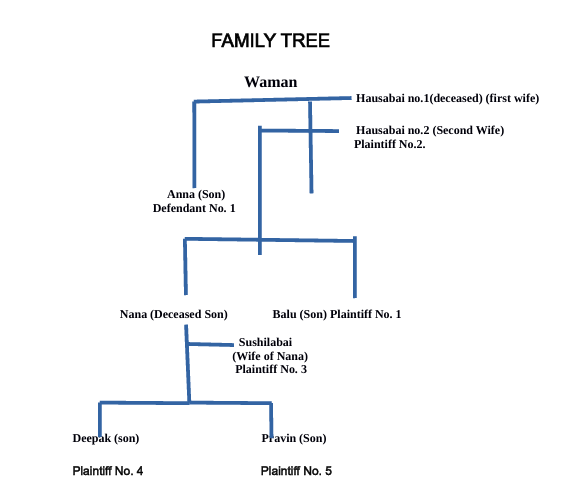
4. The suit was filed for partition and separate possession with respect to Gat No. 46 (old Survey No. 14) and half share of Gat No. 70A (old Survey No. 24, 30 and 31). The plaintiffs are claiming partition and separate possession through Waman. Waman had two wives, both by the name of Hausabai. After the demise of the first wife, Waman married Hausabai (plaintiff no.2). Waman had one son, Anna (Defendant no. 1), from his first wife. Waman had two sons from his second wife, Nana and Balu (Plaintiff no.1). Nana expired in 1984. Nana’s wife, Sushilabhai (Plaintiff no.3) and their sons are plaintiff nos. 4 and 5. Plaintiffs claimed that the suit properties were ancestral joint family properties of Waman, and thus, plaintiffs claimed one-fourth share in the suit properties. Plaintiff no. 2, i.e. Waman’s second wife, expired during the pendency of the suit. Since her heirs and legal representatives were already on record, her name was deleted in the trial court.
5. There is no dispute that the common ancestor of the parties was Waman, who had two wives. The relationship between the parties is not in dispute. The dispute between the parties is whether the suit properties are self-acquired properties of defendant no. 1- Anna, or is it the ancestral property through the common ancestor Waman?
Submissions on behalf of the Appellants (Original defendants)
6. Learned counsel for the appellants submitted that;
a) Waman died sometime in the year 1942. Gat No. 70A was the self-acquired property of Anna. There was a partition between the parties, and pla
The court upheld the presumption of joint family property, ruling that no valid partition had been established, thus entitling the plaintiffs to their shares.

Joint family property is presumed until proven otherwise; prior partition must be established by metes and bounds to be valid.

Ancestral properties must be proven to remain joint family properties post-partition; otherwise, they are deemed separate and not subject to partition claims.
The court affirmed that items 1 and 2 of suit properties are ancestral, and items 3 to 11 are self-acquired, highlighting the plaintiffs' burden to prove family property claims.

The presumption of joint family property necessitates proof of individual ownership; without such proof, a child has a right to claim share in ancestral property.

The sale deed executed without legal necessity and consideration does not bind the joint family properties, affirming the plaintiffs' entitlement to a share.



An indispensable Tool for Legal Professionals, Endorsed by Various High Court and Judicial Officers
Please visit our Training & Support
Center or Contact Us for assistance

Scan Me!
India’s Legal research and Law Firm App, Download now!


For Daily Legal Updates, Join us on :



 Back to top


