


 Back
Back





2025 Supreme(Bom) 697
IN THE HIGH COURT OF JUDICATURE AT BOMBAY
HON'BLE SHRI JUSTICE SANDEEP V. MARNE
Surya Corporation - Appellant
Versus
Competent Authority The District Deputy Registrar Of Co-operative Societies - Respondent
WRIT PETITION NO.13437 OF 2024
Decided On : 20-02-2025
Advocate Appeared:
Mr. Girish Rao i/by Lex Consultus, Advocate for the Petitioners.
Mr. Mandar Limaye, Advocate for the Respondent No.3.
The Competent Authority cannot issue a Corrigendum that materially alters a previous order without proper jurisdiction and adherence to natural justice principles.
Headnote:
(A) Jurisdiction of Competent Authority - The issue pertains to the authority's jurisdiction to issue a Corrigendum for correcting the area in a unilateral deemed conveyance certificate. The court referenced the judgment in Kashish Park Reality Private Limited, which established that a Corrigendum can only correct typographical or clerical errors and cannot alter substantive rights. (Paras 2, 6, 10-12, 21-27)
(B) Natural Justice - The issuance of the Corrigendum without notice to affected parties violates principles of natural justice and is arbitrary. (Paras 24, 27)
(C) Review Powers - The court clarified that the Competent Authority lacks the power to review its orders unless expressly conferred by statute. (Paras 15, 22)
Facts of the case:
The petition challenges a Corrigendum issued by the Competent Authority that altered the area conveyed to a cooperative society, increasing it significantly without proper jurisdiction or notice to the petitioners.
Findings of Court:
The Corrigendum was set aside as it constituted a substantive change rather than a mere correction, violating the petitioners' rights.
Issues: The main issues included the authority's jurisdiction to issue a Corrigendum and adherence to natural justice principles.
Ratio Decidendi: The court held that the Competent Authority cannot issue a Corrigendum that materially alters a previous order without proper jurisdiction and notice.
Result: The Corrigendum dated 15th March 2021 and the subsequent Deed of Conveyance were set aside.
Based on the provided legal document, the key legal principles and findings are as follows:
-
Jurisdiction of the Authority: The Competent Authority does not have the jurisdiction to issue a corrigendum that results in a substantial and material change to a previous order unless such authority is expressly conferred by law. Corrections are limited to clerical or typographical errors and cannot alter substantive rights or the original order's core content (!) (!) (!) .
-
Nature of Corrigendum: A corrigendum is meant to correct obvious clerical or arithmetical errors, not to effectuate a review or substantive change in the original order. Issuing a corrigendum that materially alters the original decision exceeds the inherent powers of the authority and is impermissible (!) (!) (!) .
-
Principles of Natural Justice: The issuance of a corrigendum must adhere to principles of natural justice, including providing notice to affected parties and recording reasons for the correction. Failure to do so renders the corrigendum arbitrary, unfair, and violative of constitutional rights (!) (!) (!) .
-
Recording of Reasons: Orders that prejudicially affect rights must be supported by clear, cogent, and succinct reasons. Lack of reasons in the corrigendum leads to a miscarriage of justice and renders the order unsustainable (!) (!) .
-
Material and Substantive Changes: When a corrigendum results in a significant change in the land conveyed—such as increasing the area substantially beyond the scope of a correction—it is considered beyond the permissible correction of an obvious error. Such actions are unlawful unless challenged through proper legal proceedings, not via a corrigendum (!) (!) .
-
Functionality of the Authority: Once an order of conveyance is passed, the authority generally becomes functus officio and cannot review or alter its order unless explicitly authorized by law. Any attempt to do so without legal basis is invalid (!) (!) .
-
Legal Recourse: If a corrigendum is improperly issued, affected parties retain the right to challenge the original order or the subsequent conveyance through appropriate legal channels. They should not rely solely on a corrigendum to rectify substantive errors (!) (!) .
-
Overall Conclusion: Corrigenda that go beyond correcting clerical or obvious errors and instead effect substantial changes in rights or land conveyance are unlawful. Proper legal procedures must be followed for such corrections, including providing notice and reasons, and respecting the authority's jurisdiction limits (!) .
In summary, the authority's power to issue corrigenda is limited to minor, clerical corrections. Any correction that significantly alters rights, land area, or substantive terms without following proper procedures is invalid, and affected parties have the right to challenge such orders through appropriate legal avenues.
JUDGMENT :
1. Rule. Rule is made returnable forthwith. With the consent of the learned counsel appearing for parties, the petition is taken up for hearing and disposal.
2. The issue that arises for consideration in the present petition is whether the Competent Authority has jurisdiction to issue a Corrigendum for correction of area indicated in the certificate of unilateral deemed conveyance. The issue appears to be squarely answered by the judgment of Coordinate Bench of this Court in Kashish Park Reality Private Limited and Anr. Vs. The State of Maharashtra and Ors., [Order dated 11 December 2020 in Writ Petition (St.) No.93044 of 2020 and other connected petitions.] The petition could have accordingly been disposed of by following the ratio of that judgment. However, reliance is sought to be placed on Order passed by me in Jaywant Ramchandra Keni Vs. The Competent Authority, [Writ Petition (L) No.8893 of 2023 decided on dated 19 January 2024] in support of contention that this Court has recognized jurisdiction of the Competent Authority to correct the area in the certificate of unilateral deemed conveyance by issuing a Corrigendum. In that view of the matter, it is considered expedient to set right the position so as to avoid confusion regarding the issue and achieve better clarity.
3. The Petition arises out of challenge to the Corrigendum dated 15th March 2021 issued by the Competent Authority and District Deputy Registrar, Co-operative Societies, Thane correcting the area of land conveyed in favour of Respondent No.3-Society vide Certificate of unilateral deemed conveyance dated 22nd February, 2021. By Certificate dated 22nd February 2021, the Competent Authority had directed conveyance in favour of Respondent No.3-Society of land admeasuring 335.60 sq. meters (plinth area) and constructed portion admeasuring 4698.35 sq. meters and proportionate undivided share in the sanctioned layout corresponding to the built-up area of Society’s building. By the Corrigendum dated 15th March 2021, the Competent Authority has now conveyed in favour of Respondent No.3-Society the land admeasuring 4584.00 sq. meters. Following comparative table would present the difference in area conveyed by the original Certificate dated 22nd February 2021 and Corrigendum dated15th March 2021:

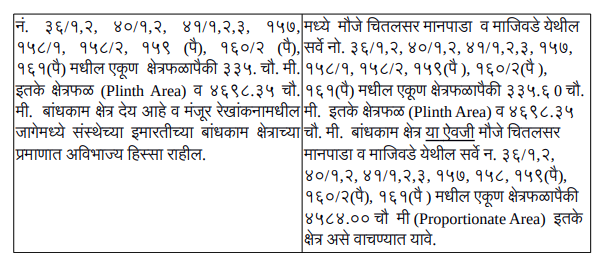
4. Thus, what is done by the Competent Authority is that instead of plinth area of 335.60 sq. meters + built-up area 4698.35 sq. meters + proportionate share in the layout corresponding to built-up area, Respondent No.3-Society is now conveyed land admeasuring 4584.00 sq. meters by way of the impugned Corrigendum. The issue is whether the Competent Authority has jurisdiction to do so.
5. I have heard Mr. Girish Rao, learned counsel appearing for Petitioner and Mr. Mandar Limaye, learned counsel appearing for Respondent No.3 -Society.
6. The issue of jurisdiction of the Competent Authority to either review its order or to issue a corrigendum has already been decided by the Coordinate Bench of this Court in Kashish Park Reality Private Limited (supra) in which it is held in paragraph Nos. 10 to 27 as under:
“10. The principal challenge in the Petitions is to the legality of Corrigenda, all dated 06/08/2020, issued by Respondent No.2-Competent Authority. Before adverting to the facts, it would be apposite to understand the meaning of the word ‘Corrigendum’. The word ‘Corrigendum’ is stated to have been derived from a Latin word corriggere which means “to correct”. In Oxford Advance Learners Dictionary (7th Edition) the word ‘Corrigendum’ is explained as “something to be corrected, specially a mistake in a printed book”. In The Concise English Dictionary the meaning of ‘Corrigendum’ is stated to be “ an error needing correction, specially in a book. The meaning of the word ‘Corrigendum’ as explained in Black’s Law Dictionary (8th Edition) and B Ramnath Ayars’s Advanced Law Lexicon is “an error in a printed work discovered after the work has gone to press.
11. In Parvati Devi












