Back
Back





2025 Supreme(Bom) 1107
IN THE HIGH COURT OF JUDICATURE AT BOMBAY
GAURI GODSE, J.
Shamgonda Shidgonda Patil (Since Deceased through Legal Heirs): Sumitra Shamgonda Patil and Ors. – Appellants
Versus
Shivgonda Babgonda Patil (Since Deceased through Legal Heirs) and Ors. - Respondents
Second Appeal No. 374 of 1995 With Civil Application No. 1383 of 2013
Decided On : 14-08-2025
For the Appellants : Mr. Drupad Patil a/w. Mr. Rugwed R. Kinkar, Ms. Srushti Chalke, Mr. Namit Pansare and Mr. Ajay Jaybhay.
For the Respondents: Mr. Umesh Mankapure a/w. Ms. Rati S. Sinhasane and Mr. Nilesh Wable, Mr. Mrinal Shelar, Mr. Dheeraj Patil.
The court ruled that a partition deed lacking the consent of all heirs is invalid, and claims based on unacted documents do not preclude rightful claims for partition. The suit is within limitation as the joint family status remains unaltered.
Headnote:(A) Code of Civil Procedure, 1908 - Section 100 - Hindu Minority and Guardianship Act, 1956 - Partition and separate possession - The judgment dismissing the suit for partition was challenged on grounds of incorrect genealogy, errors in facts, and the validity of a partition deed - The courts erred in disregarding the amended genealogy and failed to reevaluate the validity of the agreement for partial partition dated 16th December 1974, which was never acted upon - The original documents were not acted upon and the joint family status was upheld - The plaintiffs were entitled to partition and separate possession of the joint family properties. (Paras 1, 2, 24, 34, 50)
(B) Partition Documents - Validity - The document dated 2nd February 1957 could not substantiate complete partition due to the absence of consent from all rightful heirs involved - The courts below relied on this document which was proven to be unacted upon and thus the second appeal overturns previous rulings based on this finding. (Paras 26, 34)
(C) Limitation - The court addressed the limitation concerning the original partition claims, affirming that the claim is valid as the joint family properties remain undivided and that the suit was not barred by limitation as the plaintiff was a minor when the original document was executed. (Paras 45, 50)
| Table of Content |
|---|
| 1. challenge to partition suit (Para 1 , 4) |
| 2. validity of partition agreements involving minors and necessity for fairness. (Para 2 , 3) |
| 3. arguments on partition document validity (Para 5 , 6 , 7 , 8 , 9) |
| 4. challenges against unregistered documents and issues of proof. (Para 10 , 18) |
| 5. considerations of guardian's authority (Para 14 , 15 , 19) |
| 6. court's clarifications on family properties (Para 22 , 23 , 24 , 25) |
| 7. conclusive evidence favors joint family property over individual claims. (Para 48) |
| 8. conclusion on partition decree (Para 49 , 50) |
JUDGMENT :
GAURI GODSE, J.
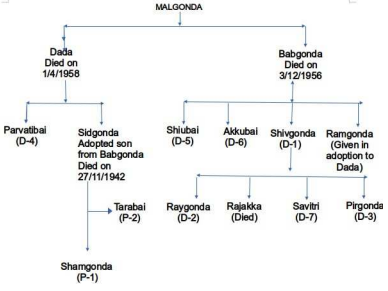
1. This second appeal is on behalf of the original plaintiffs to challenge the concurrent judgments and decrees dismissing the suit for partition and separate possession. They prayed for effecting partition and separate possession as per the agreement for partial partition dated 16th December 1974, and for a decree for partition in respect of the remaining joint family properties. The plaintiffs in the alternative prayed that if the partial partition is not accepted, a decree for partition of all the suit properties be granted for ½ share to the plaintiffs.
2. The second appeal is admitted vide order dated 27th July 1995 on the following substantial questions of law :
“e. Both the courts below erred in holding that the genealogy was incorrect. On the contentions raised by the respondent nos. 1 to 3, the female members of both the branches were brought on record by amendment granted by the court. Thus, when the female members were brought on record with the leave of the court, the court cannot go behind its own order and hold that the genealogy was incorrect. The appellants submit that all the members of both the branches were brought on record and none remained to be added and as such the genealogy as amended ought to have been accepted as correct. The finding given by the trial court at issue no.6 is therefore wrong;
f. The impugned judgment and decree by the trial court contained full of mistakes and misstatements of facts which the lower appellate court failed to consider. For instance, in para 9 of the impugned judgment and decree of the trial court, it is mentioned that Malgonda had 3 sons (i) Dada (ii) Babgonda and (iii) Ramgonda which is not the case of anyone. Dada and Babgonda were the only two sons of Malgonda. This is a wrong theory introduced by the trial court without any pleading or evidence;
h. Both the courts below erred in treating the document (at Exhibit-151 below) as a legal and complete partition deed between the two branches. This document shows that Dada alone separated from the joint family by taking 2 annas share towards his share with a direction that Shamgonda should be given 1/3rd in place of his ½ share and 2/3rd share to Shivgonda’s branch. There is no reason propounded as to why Shamgonda’s share be reduced to 1/3rd from his ½ share to which he is legally entitled;
k. Both the courts failed to appreciate the contentions of the appellants that the said document at Exhibit-151 below was illegal, inter alia for the following reasons:
i. It is a sham and bogus document got executed by an unauthorized person and without any considera-tion;
ii. The said document was never acted upon. Raygonda in his deposition (at Exhibit 270) states that the land mentioned in the said document was never given to Dada that Dada was never managing or culti- vating the said land; that he entirely was dependent on the second branch in his old age and after the death of Dada, the said land or any part thereof was never given as sharer or successor in Dada’s branch.
These facts will go to show that the said document (at Exhibit-151 below) or the arrangement arrived at thereunder was never acted upon in any manner.”
3. In view of the proviso to sub-section (5) of Section 100 of the Code of Civil Procedure, the following additional substantial questions of law are framed vide order dated 2nd January 2025 :
(I) In view of the cause of action pleaded by the p