
 Back
Back





IN THE HIGH COURT OF ORISSA AT CUTTACK
A.C.BEHERA, J.
Kailash Chandra Mohanty & Another - Appellants
Versus
Debendranath Kanungo & Others - Respondents
SA No.101 of 2000
Decided On : 20-09-2024
| Table of Content |
|---|
| 1. background and structure of the case (Para 1 , 2 , 3 , 4 , 6) |
| 2. defendants' claims against the plaintiffs (Para 7 , 8 , 9 , 12) |
| 3. trial court's decision on the first appeal (Para 10 , 11 , 13) |
| 4. substantial question of law for the 2nd appeal (Para 14 , 15) |
| 5. analysis of co-ownership and validity of sale deed (Para 16 , 17 , 18 , 19 , 20 , 21) |
| 6. divisibility of immovable property and final considerations (Para 22 , 23) |
| 7. final judgment and decree summary (Para 24) |
Judgment :
A.C. Behera, J.
This Second Appeal has been preferred against the confirming judgment.
2. The appellants in this Second Appeal were the defendant Nos.4 and 5 before the Trial Court in the suit vide T.S. No.52 of 1987 and appellants before the 1st Appellate Court in the first appeal vide T.A. No.39 of 1992.
The respondent Nos.1 and 2 in this 2nd Appeal were the plaintiffs before the Trial Court in the suit vide T.S. No.52 of 1987 and respondent Nos.1 and 2 before the 1st Appellate Court in the 1st appeal vide T.A. No.39 of 1992.
The respondent Nos.3, 4 and 5 in this 2nd Appeal were the defendant Nos.1, 2 and 3 before the Trial Court in the suit vide T.S. No.52 of 1987 and respondent Nos.3, 4 and 5 before the 1st Appellate Court in the 1st appeal vide T.A. No.39 of 1992.
3. The suit of the plaintiffs (respondent Nos.1 and 2 in this 2nd Appeal) vide T.S. No.52 of 1987 before the Trial Court against the defendants (appellants and respondent Nos.3 to 5 in this 2nd appeal) was a suit for partition, declaration and confirmation of possession.
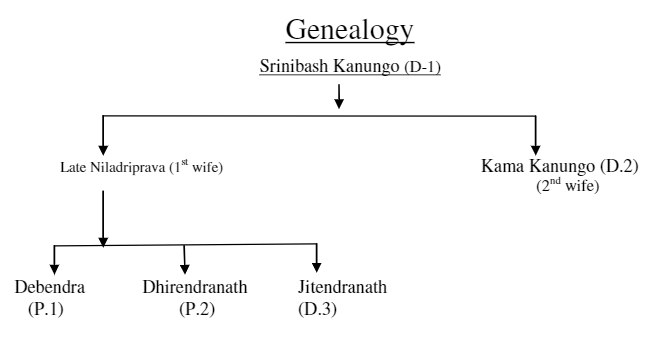
4. The case of the plaintiffs was that, their father is defendant No.1. The defendant No.2 is the second wife of defendant No.1. They (plaintiffs) and defendant No.3 are the three sons of the defendant No.1 (Srinibas Kanungo) through his 1st wife.
5. In order to have a better appreciation and so also for an instant reference, the aforesaid genealogy stated by the plaintiffs in their plaint is depicted hereunder:-
6. According to the plaintiffs, the defendant Nos.4 and 5 are the strangers to their family. The properties described in Schedule “A” of the plaint is their joint and undivided properties. The properties described in Schedule “B” of the plaint is the part of Schedule “A” properties.
The suit properties i.e. the properties described in Schedule “A”, which includes Schedule “B” properties are their joint family properties, because, the said properties were allotted in favour of their father i.e. defendant No.1 through a registered deed of partition dated 20.01.1950 between him and his other co-sharers. For which, the properties described in Schedule “A” (those were allotted in favour of the defendant No.1 through the aforesaid registered deed of partition dated 20.01.1950) are their joint and undivided properties. So, the said properties described in Schedule “A” are liable for partition.
When, the defendant No.1 married for the 2nd time to the defendant No.2 i.e. Kama Kanungo, then, he (defendant No.1) started selling their joint properties gradually at the instance of the defendant No.2 and lastly the defendant No.1 came from his native village and stayed at Konark with the defendant No.2. The defendant No.1 sold the Schedule “B” properties illegally through a void sale deed dated 05.11.1985 in favour of the defendant Nos.4 and 5 without the consent and knowledge of the plaintiffs. For which, the said sale deed dated 05.11.1985 executed by the defendant No.1 in respect of the Schedule “B” properties in favour of the defendant Nos.4 and 5 is illegal, inoperative, invalid and void, because, there was no legal necessity in their family for selling the Schedule “B” properties to the defendant Nos.4 and 5. For which, without getting any way, the plaintiffs approached the Civil Court by filing the suit vide T.S. No.52 of 1987 praying for partition of their legitimate shares from the suit properties and to declare that, the sale deed dated 05.11.1985 executed by the defendant No.1 in favour of the defendant Nos.4 and
AI
The sale of a co-owner's undivided interest is valid, but a sale deed executed without legal necessity or co-owner consent is void.

Previous family partition and lack of joint family status preclude the plaintiff from claiming coparcenary rights under Hindu law amendments.
A co-owner can validly sell their share in joint properties, and the sale deed cannot be declared void if it is within the extent of the seller's interest.


Bona fide purchasers must act in good faith and with reasonable inquiry to gain protection under ownership claims; mere ignorance of actual ownership is not sufficient.

Joint ownership claims persist until partition; rights in a partition suit are not bound by limitation, and the burden to prove legal necessity for property transfer lies with the transferee.
Widow's remarriage does not strip her of inheritance rights, and married daughters have equal entitlement to family property under the amended Hindu Succession Act.

The court reaffirmed that a sale deed executed for family and legal necessity by a joint family member is binding, barring challenge by family members after significant delay without sufficient cause....

Point of law: A daughter of a coparcener by birth becomes a coparcener in her own right in the same manner as the son. She has the same rights in the coparcenary property as she would have had if she....



An indispensable Tool for Legal Professionals, Endorsed by Various High Court and Judicial Officers
Please visit our Training & Support
Center or Contact Us for assistance

Scan Me!
India’s Legal research and Law Firm App, Download now!


For Daily Legal Updates, Join us on :



 Back to top


