
 Back
Back





IN THE HIGH COURT OF JUDICATURE AT BOMBAY
G.S. KULKARNI, ADVAIT M. SETHNA, JJ.
Manoj Madhav Limaye – Appellant
Versus
State of Maharashtra – Respondent
Writ Petition No. 10684 of 2018, Interim Application Nos. 438, 7703 of 2023
Decided On : 10-12-2025
JUDGMENT :
G.S. KULKARNI, J.
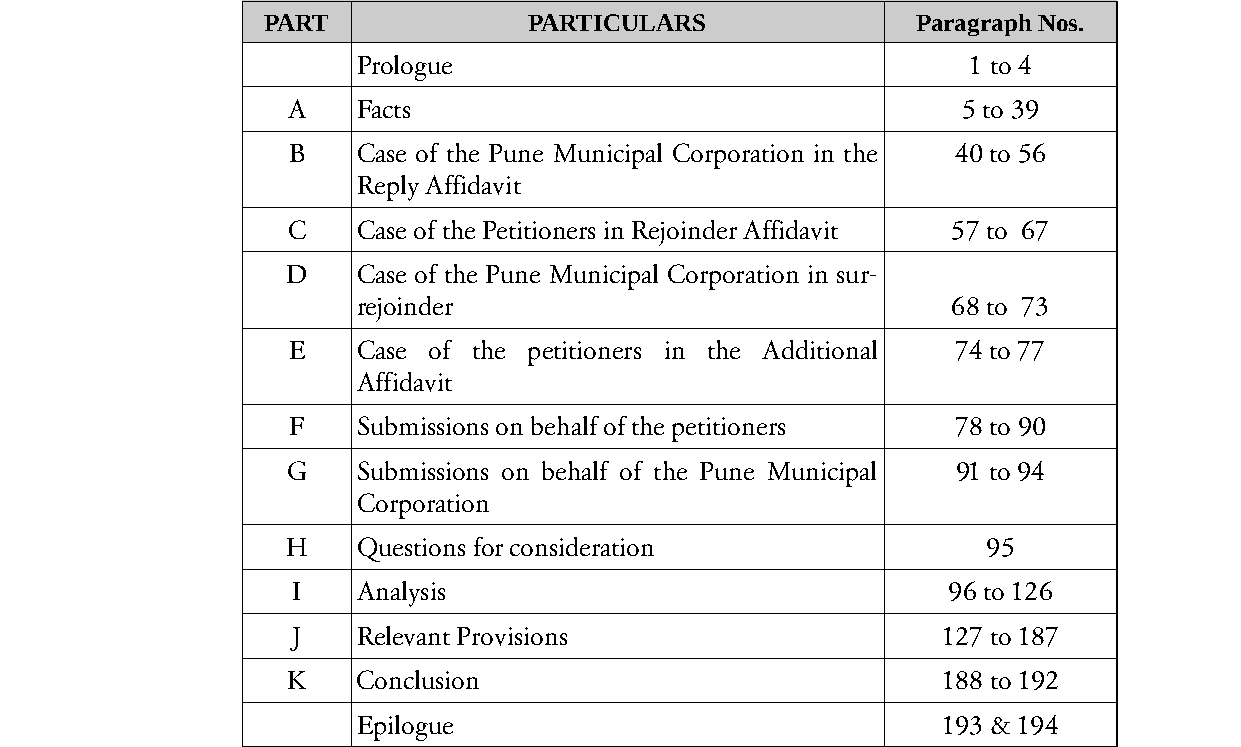
1. As this is a large batch of petitions, we have attempted to consolidate the bulk of pleadings and submissions, hence, for convenience, we have divided this judgment into parts. Some prolix was unavoidable.
Prologue
1. In this batch of petitions, the petitioners along with their association, have mounted a challenge to the levy of license fee by municipal corporations on sky-signs and hoardings in grant and renewal of such licenses. It needs no elaboration that in the contemporary times, the landscape of sky-signs and hoardings has undergone a profound transformation. It is no more painted metal boards, the outdoor advertisement is now characterized by dynamic high resolution electronic screens, allowing an unprecedented campaign flexibility. Multiple advertisements on a single hoarding throughout the day have become the new norm, unlike a single advertisement of the bygone era. This transformation has induced significant changes in the regulatory control and the safety mandates, owing to the increasing scale and complexity of the sky-signs and hoarding structures. Such changes include special norms and conditions on structural stability requiring reports from certified engineers, a meticulous licensing regime, visual and traffic safety norms requiring varying ‘luminance and size ratio’ depending on the location of the sky-signs, the drivers’ safety perspective, environmental and social impact, the burden on the city’s energy consumption, carbon footprints, visual clutter and light pollution, affecting the mental concentration of the public at large. Thus, the control and regulation of sky-signs and hoardings in the modern times is a significant challenge for the municipal bodies who are caught between a balance to be brought about by such high technological advancements, in discharging their civic obligations coupled with the onerous responsibility of safeguarding and preserving public interest, which includes adhering to the safety norms, aesthetics, environmental norms and other sustainable practices, so as to ensure that the sky-signs integrate safely and harmoniously into the urban landscape and not create a public torture and an eyesore. It is with such perspective, the regulation and control of sky-signs and hoardings assumes significant dimensions and responsibility of the municipal authorities.
2. On the aforesaid conspectus, as to what is before the Court in the present proceedings needs to be stated. The challenge in these petitions is to the demand/levy of fees for grant and/or renewal of licenses being issued by the municipal corporations(s) under Section 244 read with Section 386(2) of the Maharashtra Municipal Corporation Act, 1949 (for short “MMC Act”) [earlier titled as the “Bombay Provincial Municipal Corporation Act, 1949] for display of sky-signs and hoardings. The challenge is mounted primarily on the authority, power and jurisdiction of the Municipal Corporation to levy license fees inter alia on the ground that the license fee is in fact a tax being levied without authority of law. It is also on the ground that with the introduction of the Goods and Service Tax Laws, there is no authority to levy advertisement tax. Also, there are other grounds of challenge. The Municipal Corporations against whom these petitions are filed are primarily the Pune Municipal Corporation against whom twenty six petitions are filed and one petition each filed against Nashik, Thane and the Kolhapur Municipal Corporations.
3. As this batch of petitions raises similar questions of law and fact, hence, they are being decided by this common judgment.
4. We may also, at the outset, observe that against the respondent-Pune Municipal Corporation, twenty six writ petitions have been filed. Each of these petitions has reply affidavits. The bulk of the proceedings is substantially large. Although at the cost of some verbosity so as to deal with the case of the parties in a consolidated manner including on their p

Sub-section (2) of section 479 upheld; Commissioner’s power to fix advertisement license fees with Corporation sanction not excessive delegation, as guidelines exist in statute, policy, and democrati....

Municipal Boards must justify licence fees based on actual services rendered; excessive fees may be deemed an illegal tax.

It is now well settled that the expression “fee” is also comprehended in the expression “tax” for the purpose of Article 265 and even for the collection of a “fee”, authority of law (i.e. legislative....

(1) Levy of tax on advertisement(s) – Imposition of royalty cannot be equated with imposition of tax/levy – Royalty and tax cannot be equated – Royalty and tax are not one and same.(2) Estoppel – Con....
License fees can be regulatory rather than tied directly to specific services, requiring reasonable correlation with total expenses incurred.

Amendments to municipal fee structures were quashed for failing to rectify judicially identified legal flaws, emphasizing the principle of quid pro quo in administrative fees.

The court established that the imposition of delay fees by circular without statutory authority contradicts the principles of law, rendering such fees arbitrary and illegal.

The Central Government is empowered under Section 211 of the Motor Vehicles Act to levy additional fees for delayed applications related to driving licenses and vehicle registrations, which are not p....



An indispensable Tool for Legal Professionals, Endorsed by Various High Court and Judicial Officers
Please visit our Training & Support
Center or Contact Us for assistance

Scan Me!
India’s Legal research and Law Firm App, Download now!


For Daily Legal Updates, Join us on :



 Back to top


