


 Back
Back





2026 Supreme(Bom) 54
IN THE HIGH COURT OF JUDICATURE AT BOMBAY
REVATI MOHITE DERE, SANDESH D. PATIL, JJ.
Vishal Ganesh Kasabe – Appellant
Versus
State of Maharashtra – Respondent
CRIMINAL APPEAL NO. 1745 OF 2019
Decided On : 02-01-2026
For the Appellant : Mr Akshay Bankapur
For the Respondent: Mrs P. P. Shinde, Addl. P.P.
The court held that in criminal cases, especially those relying on circumstantial evidence, the prosecution must prove guilt beyond reasonable doubt, which was not met in this instance.
Headnote:(A) Indian Penal Code - Section 302 and Section 34 - Conviction and sentence of life imprisonment set aside - Prosecution failed to establish beyond reasonable doubt the involvement of the Appellant in the crime, as the key witnesses were inconsistent, and motive was not proven - FIR did not name the Appellant, with the prosecution relying on inconsistent testimonies and circumstantial evidence which lacked cogency. (Paras 1, 27, 28)
Facts of the case:
The case stemmed from a fatal assault on Jitendra where the Appellant was implicated by witness statements that were later found inconsistent. The FIR did not contain the Appellant's name initially, raising doubts about his involvement.
Findings of Court:
The court noted significant inconsistencies in witness testimony and established that the evidence presented was insufficient to sustain a conviction against the Appellant due to the absence of clear links.
Issues: The main issues were whether the prosecution provided sufficient evidence to prove the Appellant's involvement in the murder and the credibility of key witness accounts.
Ratio Decidendi: The court concluded that the evidence relied upon was not definitive or conclusive enough to establish guilt beyond a reasonable doubt, aligning with established legal principles regarding circumstantial evidence outlined in prior judgments.
Result: Appeal allowed; the conviction quashed and the Appellant acquitted.
Key Points: - The court held that prosecution must prove guilt beyond reasonable doubt in circumstantial evidence cases, which was not met. [p_?] - Conviction under IPC 302 read with 34 acquitted due to inconsistent witness testimony and lack of proven motive; reliance on circumstantial evidence insufficient. (!) (!) (!) - Appeal allowed; judgment and order convicting under 302/34 quashed; appellant acquitted and to be released. (!) (!) - First Information Report did not name the appellant; subsequent supplementary statement disclosed appellant’s involvement. (!) (!) - Key witnesses PW-1 and PW-3 had inconsistencies; certain hostsilities and 164 CrPC statements questioned. (!) (!) (!) - Medical and recovery evidence (blood-stained clothes) deemed insufficient alone to sustain conviction. (!) (!) - Case relies on Sharad Birdhichand Sarda principles for caution in circumstantial evidence. (!) - Appellant’s clothes and seizure details: discrepancies noted between seized articles and witnesses. (!) (!) - Outcome: acquittal of the appellant for offence under Section 302 read with 34 IPC; entitlement to release if not required in other cases. (!)
How to determine guilt beyond reasonable doubt in a murder case relying on circumstantial evidence?
What is the consequence when key witnesses are inconsistent and motive is not proven?
What are the appellate outcomes when a conviction under IPC 302/34 is found not to be supported by cogent evidence?
| Table of Content |
|---|
| 1. summary of charge and conviction against appellant. (Para 1 , 2 , 3 , 4) |
| 2. list of prosecution witnesses relevant for the case. (Para 5 , 6) |
| 3. assessment of evidence on jitendra's death. (Para 7) |
| 4. arguments presented by appellant and prosecution. (Para 8 , 9) |
| 5. testimonies of prosecution witnesses regarding incident. (Para 10 , 11 , 12 , 13 , 14) |
| 6. testimony of deceased's mother and its hearsay nature. (Para 15 , 16) |
| 7. court's critical analysis of key evidence presented. (Para 17 , 18 , 19 , 20) |
| 8. evaluation of circumstantial evidence supporting prosecution. (Para 21 , 22 , 23 , 24) |
| 9. legal principles governing circumstantial evidence. (Para 25 , 26) |
| 10. conclusion reversing conviction and acquitting appellant. (Para 27 , 28 , 29) |
JUDGMENT :
Sandesh D. Patil, J.
1. The present appeal is directed against the Judgment and Order dated 23rd October 2019 passed by the learned Additional Sessions Judge, Pune in proceeding bearing Session Case No. 751 of 2013, by which the learned Additional Sessions Judge convicted the Appellant under Section 302 read with 34 of the INDIAN PENAL CODE (hereinafter referred as “IPC”) and sentenced him to suffer imprisonment for life and to pay fine of Rs. 5,000/-(Rupees Five Thousand Only). The appellant was however acquitted of the offence punishable under Section 120 B of the IPC.
2. The present Appellant is Original Accused No.2 (Vishal Ganesh Kasabe). By the impugned Judgment and Order, the Appellant, as well as Lallya @ Vishal Ravindra Dadar (Original Accused No.1), were convicted for the offence punishable under section 302, read with 34 of the IPC. Both, the Appellant as well as Lallya @ Vishal Ravindra Dadar (hereinafter referred to as Accused No. 1) have preferred separate appeals against the impugned Judgment and Order before this Court. By a separate order dated 26th November 2025, we have de-tagged the appeal of the accused No.1, Lallya @ Vishal Ravindra Dadar, since the said accused is absconding. Accordingly, the said appeal bearing No. 1725 of 2019 preferred by Lallya @ Vishal Ravindra Dadar is adjourned sine die.
PROSECUTION CASE :
3. It is the prosecution case, that on 2nd June, 2013,while returning home, Jitendra was assaulted by accused No.1 – Lallya, and others, including the appellant ; that Jitendra on way to the Hospital disclosed the names of the assailants to PW 3 Laxmi Gaikwad and PW 4 Deepak Kamble, who in turn informed the incident to Rajan (Jitendra’s brother). On learning of the incident, Rajan Gaikwad lodged an FIR as against Lallya Dadar for the offence punishable under Section 302 of IPC. The appellant was named by the complainant in his supplementary statement. During the course of investigation the appellant was arrested. After investigation police filed chargesheet against accused including the appellant in the Court of the learned JMFC, Pune. Since the offence under Section 302 of IPC was triable by the Sessions Court, the case was transferred to the Court of Sessions, Pune, for trial.
4. The learned Sessions Judge, Pune, framed charge against the appellant to which he pleaded not guilty and claimed to be tried. During the trial, accused Nos. 3 and 4 expired. Hence, the trial proceeded only against accused Nos. 1, 2, and 5. As far as accused No.5 is concerned, he was acquitted by the Learned Sessions Judge.
WITNESSES EXAMINED BY THE PROSECUTION
5. The prosecution, in order to prove its case, examined the following witnesses:-
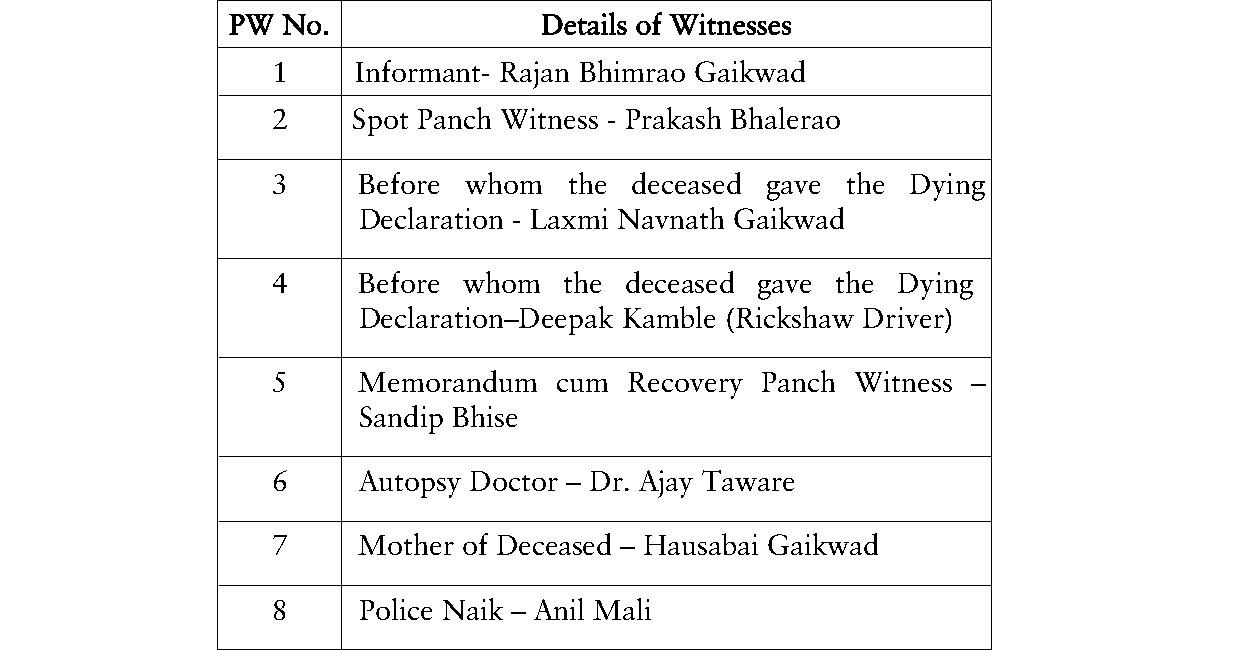
| 9 | Nodal Officer of Vodafone Idea Cellular Ltd. – Dattram Angre |
| 10 | Nodal Officer of Reliance Co. – Rajesh Gaikwad |
| 11 | PI - Shivaji Berde (conducted further investigation and filed chargesheet) |
| 12 | PI – Madhukar Salunke (conducted preliminary investigation) |
6. Although, the prosecution examined as many as 12 witnesses, it is not necessary to discuss the evidence of all the witnesses. The only witnesses who are relevant for the purpose of deciding the appeal against the appellant are PW-1, Rajan Gaikwad, who is the brother of the deceased and












