Back
Back





2023 Supreme(Ori) 597
IN THE HIGH COURT OF ORISSA AT CUTTACK
S. Talapatra, Savitri Ratho, JJ.
Tunu @ Chereng Munda - Appellant
Versus
State of Orissa - Respondent
Jail Criminal Appeal No.13 of 2009
Decided On : 17-05-2023
For the Appellant :Mr. R.D. Nayak, Advocate (Amicus Curiae)
For the Respondent:Mr. J. Katikia, Additional Government Advocate
Court overturned murder conviction citing doubts about witness credibility, lack of corroborating evidence, and reliance on confession without independent corroboration.
Headnote:(A) Indian Penal Code, 1860 - Section 302 - Murder conviction challenged - The appellant was convicted of murder for the death of Jayadev Mahanta, committed by stabbing him multiple times - Court critically examined evidence from witnesses, especially the identification of the appellant and the validity of confessions made under police custody - The court questioned the reliance on witness testimonies, noting discrepancies and lack of corroborative evidence - The lower court's conviction was overturned on grounds of benefit of doubt. (Paras 1-18)
(B) Evidence - Witness Identification - The court emphasized that witness credibility is paramount and any inconsistencies or lack of corroboration significantly undermine the prosecution's case - Identification must be proved beyond reasonable doubt. (Paras 16-17)
(C) Confessions - The court emphasized that statements made in police custody cannot solely establish guilt without supporting evidence. (Paras 15-16)
(D) Principle of Benefit of Doubt - The benefit of the doubt goes to the accused if the evidence does not convincingly establish guilt. (Para 18)
| Table of Content |
|---|
| 1. details of conviction and charges against the appellant. (Para 1 , 2 , 3 , 4 , 5) |
| 2. arguments questioning witness reliability and prosecution's evidence. (Para 6 , 7 , 8 , 9 , 10) |
| 3. court's analysis of evidence leading to doubts in prosecution case. (Para 11 , 12 , 13 , 14 , 15 , 16 , 17) |
| 4. conclusion and order for appeal's allowance. (Para 18 , 19 , 20) |
JUDGMENT :
S. Talapatra, J.
This is a prisoner’s appeal, filed by the convict from the jail. The judgment and order of conviction and sentence dated 29.08.2008 delivered in S.T. Case No.9/42 of 2007 by the Adhoc Additional Sessions Judge, (Fast Track), Champua are under challenge in this appeal. The Appellant has been convicted under Section 302 of the IPC for committing murder of one Jayadev Mahanta on 28.09.2006 at about 3 a.m.
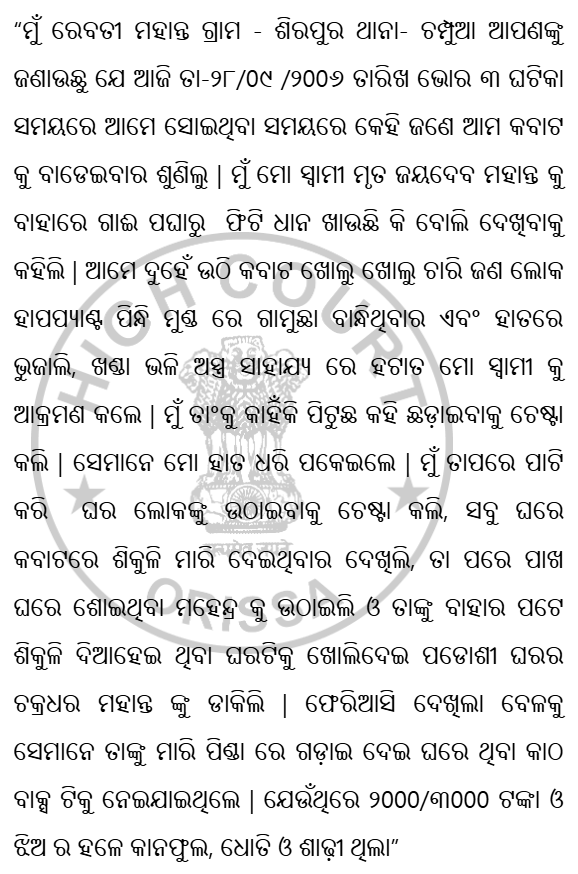
2. Briefly stated, the case of the prosecution, as projected during the trial, is that in order to take revenge on Jayadev Mahanta (hereinafter referred to as the deceased), Chereng Munda @ Tunu along with other accused persons, namely, Naba Mohakud, Krushna Sardar and Govinda @ Buturu Munda armed with the weapons, went to the house of the deceased at Sirapur at the time of occurrence. They knocked on the door of the bedroom of the deceased. The deceased along with his wife Rebati Mahanta was sleeping. Having registered the knock when they opened the door, the Appellant and his associates caught hold of Jayadev and assaulted him by a sharp cutting weapon. The deceased received serious bleeding injuries. The deceased fell down near his door and died instantaneously. The Appellant and his associates had left the place in the immediate aftermath of the occurrence. But, it has been stated that they had taken away a wooden box containing money, gold ornaments, clothes and articles made of bell-metal. After taking out the valuable materials from the said wooden box, they had thrown it at a place, at a small distance from the house of the deceased.
3. Immediately after the occurrence, the information was lodged at Champu P.S. by Rebati Mahanta, wife of the deceased. Based on the said F.I.R. (Ext.3), the Officer-in-charge (P.W.9) registered the Champua P.S. Case No.134/2006 under section 302/394 of the IPC and took up the investigation. At the beginning of the investigation, he examined the informant, sent the requisition to the S.P. Keonjhar for sending a Scientific Team and Dog Squad in order to gather physical clues from the spot. After the spot verification, the District Scientific Officer, Keonjhar and the dog-handler, prepared their respective reports (Exts.12 and 18). Those reports were handed over to P.W.9 (the Investigating Officer). P.W.9 conducted the inquest over the dead body of the deceased and prepared the inquest report (Ext.4). He had seized the sample earth and blood stained earth from the spot by preparing the seizure list (Ext.5). Thereafter, he sent the dead body for postmortem examination by the challan (Ext.9) to the S.D. Hospital, Champua. One constable, namely, Trilochan Mahanta guarded the dead body till it reached the said hospital. P.W.11, Dr. S.K. Sahoo of the said hospital carried out the postmortem examination. During the investigation, P.W.9 seized the stolen articles, i.e. one wooden box, four old sarees, three old Dhotis, one Kansa bellmetal Bela, one Kansa Nota along with one Lathi thrown by the Appellant and his associates by preparing the seizure list (Ext.10). He had released those articles except the lathi in zima to the informant. P.W.2 executed the zimanama (Ext.11). After postmortem examination, he had seized wearing apparels of the deceased viz, one lungi (M.O.X) along with the Command Certificate issued to the constable, Trilochan Mahanta by preparing the seizure list (Ext.13). P.W.9 had arrested the Appellant and according to P.W.9, he had confessed his guilt in presence of witnesses. According to P.W.9, the said confession, revealed that, there was a village meeting 15 to 20 days prior to the occ