
 Back
Back





IN THE HIGH COURT OF JUDICATURE AT BOMBAY
SUMAN SHYAM, M. M. SATHAYE, JJ.
The Commissioner, Tribal Development Maharashtra State and Anr. – Petitioners
Versus
Shri Badashaha Dagadu More – Respondent
Writ Petition No. 12394 of 2015
Decided On : 23-12-2025
| Table of Content |
|---|
| 1. background of the case and respondent's promotion. (Para 1 , 2) |
| 2. charges against the respondent. (Para 3 , 4) |
| 3. tribunal's view on negligence and punishment. (Para 5) |
| 4. limits of court’s interference in penalties. (Para 6 , 7 , 10) |
| 5. finding on the nature of the respondent's conduct. (Para 8 , 9) |
| 6. conformance with established legal principles. (Para 11) |
| 7. conclusion and dismissal of the writ petition. (Para 12 , 13) |
JUDGMENT :
Suman Shyam, J.
1. This Writ Petition, jointly filed by the Commissioner, Tribal Development, Maharashtra as well as the Additional Commissioner, Tribal Development, Thane as Petitioners Nos.1 and 2, is directed against the judgment and order dated 30th March, 2015 passed in Original Application (OA) No.81 of 2012, whereby, the order of dismissal from service of the sole Respondent was set aside on the ground of disproportionate punishment and the matter was remanded to the disciplinary authority to impose one of the minor punishments prescribed under Rule 5(1)(i) to (vi) of Maharashtra Civil Services (Discipline and Appeal) Rules, 1979, after giving proper opportunity of being heard to the Respondent. The facts and circumstances of the case giving rise to filing of the Writ Petition, shorn of unnecessary details, may be noted as hereunder.
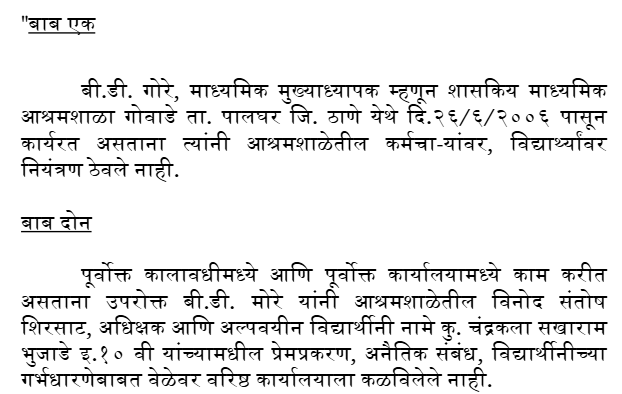
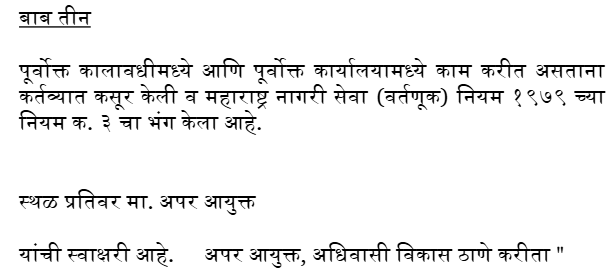
2. The sole Respondent herein was promoted to the post of Head Master of Government Secondary School (Ashram Shala), Gowade, Taluka-Palghar, District-Thane on 23rd June,1995. The said school was involved in imparting education to tribal students. There were separate hostel facilities both for the boys and girls which were run under the direct control and supervision of the respective Superintendents. One Vinod Shirsat was the Superintendent of Boys Hostel where as Ms. Meena S. Sankhe was the Superintendent of the Girls Hostel. Sometime in the year 2008, the fact of carnal relationship between the Superintendent of boys hostel viz. Vinod Shirsat with a teenaged inmate of the Girls hostel came to light. In the year 2009 the girl became pregnant and then Ms Sankhe took her to a private hospital for sonography. The incident had attracted lot of attention and created a furor in the society. This Court also took suo-moto cognizance of the incident and issued certain directions in suo-moto Writ Petition No.1420 of 2008. An FIR was registered and three accused persons were subjected to prosecution in Sessions Case No.28 of 2009 ( State of Maharashtra Vs. Vinod and two others ). The Respondent herein was the accused No.2. The main accused was Vinod S. Shirsat (accused No.1) i.e. the Superintendent of the Boys hostel who was charged with offence committed under Section 376(2)(c) read with Section 417 of the INDIAN PENAL CODE (IPC). Ms. Meena S. Sankhe, the Superintendent of the Girls hostel was the accused No. 3. The charge against the Respondent (accused No.2) and Ms. Sankhe (accused No.3) was under Section 202 of the IPC for intentional omission to give information about an offense. A Departmental Enquiry was therefore, initiated against the Respondent and co-accused by serving memorandum of charge dated 9th February, 2009. As many as three charges were brought against the Respondent. On conclusion of the departmental proceedings, the Enquiry Officer submitted report dated 6th April, 2009 by concluding that all the three charges brought against him have been proved. The copy of the enquiry report was forwarded to the Respondent, so as to enable him to submit his say. Thereafter, by the order dated 13th May, 2009 issued by the Petitioner No.2, the Respondent was dismissed from service. The order of dismissal from service was challenged by the Respondent by filing statutory appeal before the Petitioner No.1. In the meantime, the learned Sessions Judge, Palghar had passed judgment and order dated 6th October, 2009 in Sessions Case No.28 of 2009 granting acquittal to all the three accused persons including the present Respondent. The State has filed Criminal Appe
AI
The disciplinary authority's dismissal of an employee was found to be shockingly disproportionate to the proven misconduct, warranting judicial intervention and re-evaluation of punishment.

The court affirmed that the disciplinary authority's decision, supported by a fair inquiry process, is not subject to re-evaluation by the court unless it is shockingly disproportionate.

The court ruled that dismissal for negligence was shockingly disproportionate to the charges, emphasizing the need for fair assessment in disciplinary proceedings.

(1) Question of quantum of punishment in disciplinary matters is primarily for disciplinary authority and jurisdiction of High Courts under Article 226 of Constitution or of Administrative Tribunals ....

The unexplained delay in disciplinary proceedings and the non-speaking nature of orders can vitiate the proceedings and be contrary to the principles of natural justice.

The main legal point established in the judgment is the principle of proportionality in imposing disciplinary action, the requirement for clear and specific charges in a domestic inquiry, and the sco....

The court established that adherence to procedural requirements in disciplinary actions, as outlined in the relevant rules, is essential for the validity of imposed penalties against police officers.


The tribunal's decision to remand for lesser punishment was justified based on the principle of proportionality in disciplinary actions.



An indispensable Tool for Legal Professionals, Endorsed by Various High Court and Judicial Officers
Please visit our Training & Support
Center or Contact Us for assistance

Scan Me!
India’s Legal research and Law Firm App, Download now!


For Daily Legal Updates, Join us on :



 Back to top


