
 Back
Back





IN THE HIGH COURT OF JUDICATURE AT BOMBAY
SUMAN SHYAM, SHYAM C. CHANDAK, JJ.
Anuj Arjun Pawar – Appellant
Versus
The State of Maharashtra and Anr. – Respondents
Criminal Appeal No. 68 of 2020 With Criminal Appeal No. 102 of 2020 With Criminal Appeal No. 1777 of 2019
Decided On : 24-12-2025
Certainly. Based on the provided legal document, here are the key points:
The appeals were filed against a judgment which convicted the accused of serious offenses, including murder and gang rape, based largely on circumstantial evidence (!) (!) .
The trial court's findings indicated that the prosecution had established a chain of circumstantial evidence linking the accused to the crime, including evidence of sexual assault, homicidal death by throttling, and disappearance of evidence by throwing the body into a well (!) (!) (!) (!) (!) .
The prosecution relied on testimonies, forensic reports, mobile call records, and recovery of articles from the scene to establish guilt beyond reasonable doubt (!) (!) (!) (!) (!) .
The defense challenged the reliability of witness testimonies, the validity of circumstantial evidence, and the sufficiency of forensic and DNA evidence, asserting that crucial links in the chain of evidence were weak or unreliable (!) (!) (!) (!) (!) (!) (!) .
The court critically examined the evidence, noting inconsistencies, unexplained delays, and suspicious conduct of witnesses, which cast doubt on the prosecution’s case (!) (!) (!) [p
| Table of Content |
|---|
| 1. summary of the appeals and initial court findings. (Para 1 , 2) |
| 2. factual background of the crime leading to the trial. (Para 5 , 9) |
| 3. testimonies and evidence presented during the prosecution's case. (Para 10 , 11 , 12) |
| 4. arguments by the defense challenging the prosecution evidence. (Para 13 , 14 , 15) |
| 5. court analysis of the evidence and witness testimonies. (Para 17 , 18 , 19 , 20) |
| 6. discussion of the relationship between the victim and the accused. (Para 26 , 28 , 29 , 30) |
| 7. importance of circumstantial evidence and reasonable doubt. (Para 56) |
| 8. final judgment and the basis for acquittal of the accused. (Para 59 , 60) |
JUDGMENT:
SHYAM C. CHANDAK, J.
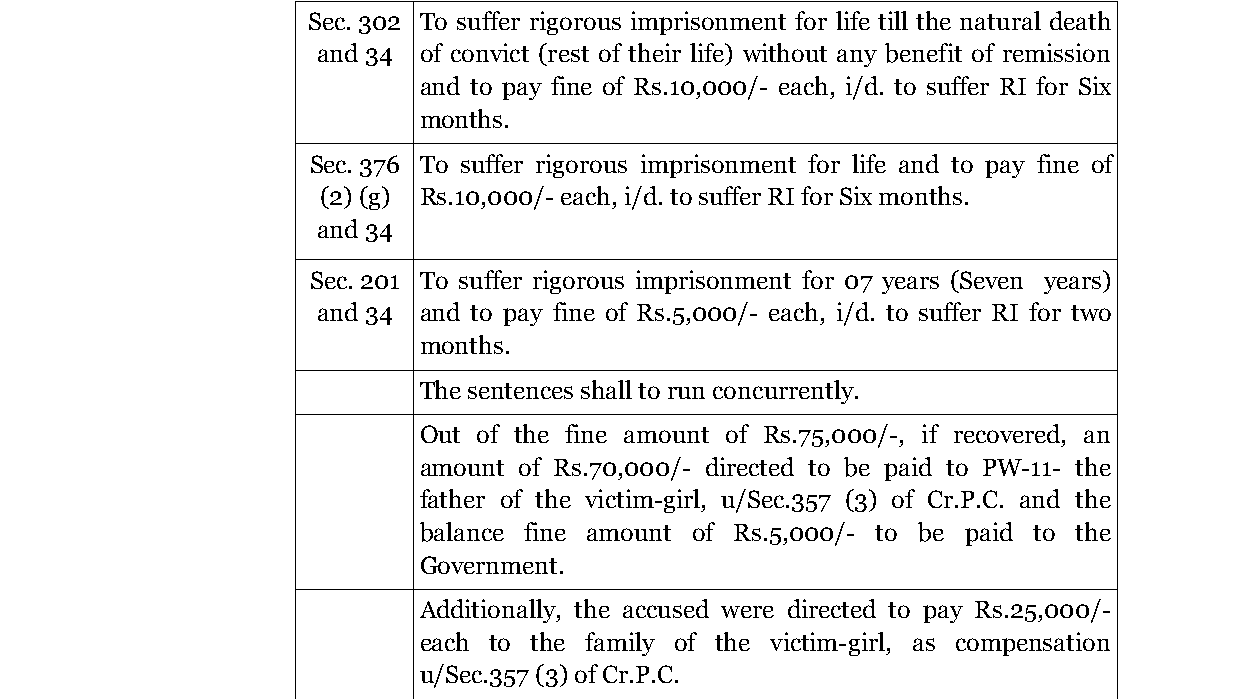
The aforesaid appeals have been filed against the common Judgment and Order dated 16/07/2019, passed in Sessions Case No.29/2013 by the learned Additional Sessions Judge, Sangli. Thereby, except for the charge of Sections 377 and 34 of the Indian Penal Code, 1860 (“IPC”), the Appellants have been held guilty and convicted of the charge under Sections 302, 376 (2) (g), 201 and 34 of IPC. Hence, the learned Judge sentenced them as under:-
2. The Appellants namely – Lakhya Sargar (Cril. Appeal. No.
102/2020); Anuj Pawar (Cril. Appeal. No. 68/2020); and Dadaso Athawale (Cril. Appeal. No. 1777/2019) and one Sagar Hattekar were the Original Accused Nos.1 to 4 respectively (“A-1, A-2, A-3 and A-4”, for short). A-4, Sagar Hattekar died in jail during the pendency of the trial. Hence, the proceedings abated against A-4 vide trial Court Order dated 31/01/2015. Thereafter, the charge was framed against A-1 to A-3 and, they faced trial.
3. Heard Mr. Jaiswal with Mr. Nitesh Nevshe, the learned Appointed Counsel appearing for A-1, Mr. Mane, the learned Counsel appearing for A-2, Mr. Shinde, the learned Counsel appearing for A- 3, Ms. Rane and Ms. Dabholkar, the learned APPs appearing for the Respondent–State and Mr. Rajput, the learned Appointed Counsel appearing for Respondent No.2.
4. Initially, the Appeals were heard and closed for judgement on 04/08/2025. However, it was not pointed out by the parties that, despite service, Respondent No.2, i.e., the first informant did not file his appearance. Consequently, there was no hearing on behalf of Respondent No.2, who is the father of the victim girl. Therefore, and looking at the nature of the offence, the Registry was directed to list the Appeals on 26/08/2025, under the caption ‘for directions’ when the Court passed an Order to appoint a ‘Legal Aid Counsel’ for Respondent No.2. Accordingly, Mr. Rajput, the learned Counsel was appointed to represent and espouse the cause of Respondent No.2. However, the assignment was changed w.e.f. 03.09.2025. Later on, the Appeals were again assigned to this Bench on 07/11/2025. Finally, the Appeals were heard on 27/11/2025 and again closed for passing Judgement.
5. The prosecution case, as unfolded from the record, is that, on 16/10/2012, the XYZ Police Station received an information that the dead body of a woman was lying in a well belonging to Mr. Taralekar, situated on the XYZ-Mayani road. At around 03:30 p.m., PW-19 Awghade, PHC, proceeded to the spot and recovered the dead body from the well. In the meantime, PW-11, i.e., the father of the victim arrived at the scene and identified the body as that of his daughter. 6. Then, at 05.15 pm, PW-11 filed a Report (Exh.77) as under :-
“That, I, SBC, R/o XYZ, state that I have been residing at the said address jointly with my mother, second wife, three children “S - 6yy”, “K - 4yy” and “P - 8mm” begotten from the second wife, my Son “M”/PW-1 and daughter “A” (the victim) both begotten from my first wife and “Sau. P” wife of son “M”.
Daughter “A”, aged 19 years, was employed in a cloth shop namely “.… ....”, at XYZ and her working timings were 9.30 am to 6.30 pm. She was studied up-to 11th Standard and she has been working there since last two months. On 12/10/2012, at about 9:30 a.m., she left home for her workplace. However, she did not return hom
AI
The prosecution failed to establish guilt beyond reasonable doubt due to inconsistent testimonies and weak circumstantial evidence.

The court confirmed death sentences for multiple accused involved in a brutal highway dacoity resulting in murder, emphasizing the need for severe punishment in heinous crimes.

(1) Section 34 IPC and 115 IPC would not go hand in hand.(2) Evidence is raw material which Judge or Adjudicator uses to reach a finding of fact – Courts can record order of conviction even in a case....


Circumstantial evidence, including recovery of crucial items, must be coherent and consistently point to guilt to meet the burden of proof required for conviction in murder cases.
Admissibility of electronic evidence – There is a complete procedure envisaged under Section 65-B(4) of Indian Evidence Act wherein production of certificate has been held to be mandatory with certai....

In cases involving murder during robbery, the court established criminal conspiracy and affirmed death sentences for the heinousness of the offences while highlighting the importance of both aggravat....



An indispensable Tool for Legal Professionals, Endorsed by Various High Court and Judicial Officers
Please visit our Training & Support
Center or Contact Us for assistance

Scan Me!
India’s Legal research and Law Firm App, Download now!


For Daily Legal Updates, Join us on :



 Back to top


