
 Back
Back





IN THE HIGH COURT OF JUDICATURE AT BOMBAY
ARIF S. DOCTOR, J.
Saurabh Arora - Petitioner
Versus
Deputy Controller of Patents & Anr. – Respondents
Comm. MISC. Petition No. 46 of 2025
Decided On : 10-03-2026
| Table of Content |
|---|
| 1. petition impugns dismissal of post-grant opposition using prior art d1. (Para 1 , 2 , 3 , 4) |
| 2. d1 meets s.25(2)(c) requirements; impugned order unreasoned lacking analysis. (Para 5 , 6 , 7 , 8 , 9 , 10 , 11 , 12) |
| 3. provisional without claims not prior claim under s.25(2)(c). (Para 13 , 14 , 15 , 16 , 17 , 18 , 19) |
| 4. appellate court may decide merits without remanding for reasons. (Para 20 , 21) |
| 5. non-speaking order mandates remand for technical claim comparison. (Para 22 , 23 , 24 , 25) |
| 6. unreasoned controller order invalid; lacks technical comparison under s.25(2)(c). (Para 26) |
| 7. impugned order set aside; remanded for fresh consideration. (Para 27) |
JUDGMENT :
ARIF S. DOCTOR, J.
1. The present Commercial Miscellaneous Petition impugns an Order dated 7th July 2023 (“impugned order”), by which Respondent No. 1, i.e., the Deputy Controller of Patents, has dismissed the post-grant opposition filed by the Petitioner in respect of Patent No. IN 283059 ("impugned patent") which was granted to Respondent No. 2.
Background and Challenge
2. The Petitioner’s post-grant opposition was under Section 25(2)(c) of the Patents Act 1970 ("the Patents Act”) and was based on an Indian Patent Application bearing no. 1249/DEL/2010, i.e., the prior art (“D1”) cited by the Petitioner (which was subsequently granted as Patent No.IN568478), of which the Petitioner was one of the inventors.
3. It is the Petitioner’s case that despite filing detailed pleadings in the opposition proceeding, the post-grant opposition proceedings came to be disposed of after five years on the sole ground that the prior art cited by the Petitioner cannot be considered as an “appropriate disclosure” as per the provisions of Section 25(2)(c) of the Patents Act for establishing priority.
4. It is the Petitioner's case that Respondent No. 1 has passed the impugned order without giving any reasons and without even considering or assessing the invention claimed in the impugned patent vis-à-vis the invention claimed in the prior art cited by the Petitioner.
Submissions on behalf of the Petitioner:
5. Mr. Kamod, learned counsel appearing on behalf of the Petitioner, at the outset invited my attention to Section 25(2)(c) of the Patents Act to point out that the post-grant opposition requires the following legal and technical requirements to be fulfilled in order to uphold an opposition to a patent, viz.
Legal Requirements:
i. that there is an invention for which an application for a patent has been made in India;
ii. that such prior art document must be published on or after the priority date of the claim of the impugned patent;
iii. the claim of the prior art document has a priority date that is earlier than that of the claim of the impugned patent;
Technical requirements:
iv. that the invention as claimed in the claims of the patent is ‘claimed in any claim’ of the patent application of the prior art document.
6. In the above context, Mr. Kamod then invited my attention to the following bibliographic particulars of the impugned patent and the prior- art document D1, which are as follows:
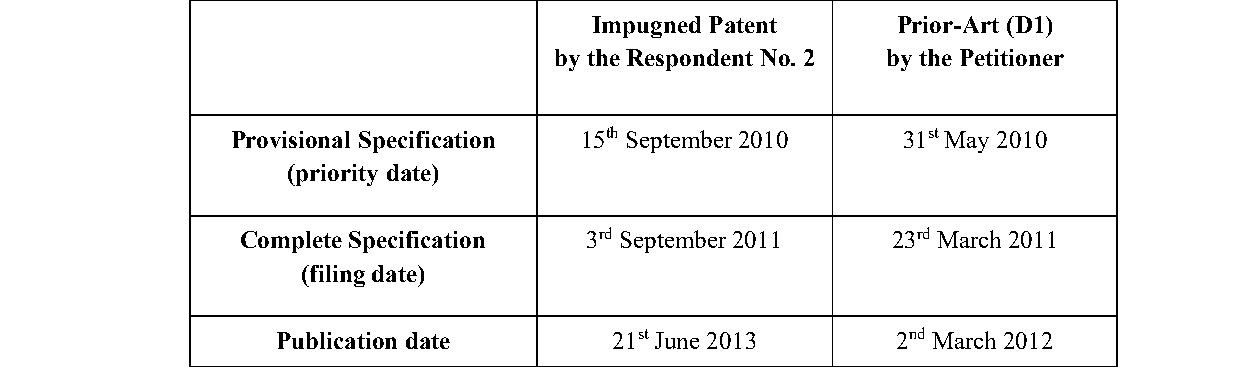
7. Mr. Kamod then invited my attention to Section 11(2)(a) of the Patents Act, to point out that where a complete specification is filed pursuant to a single application accompanied by a provisional specification, and the claim is fairly based on the matter disclosed therein, the priority date of such claim shall be the date of filing of the relevant provisional specification. Mr. Kamod therefore submitted that in the present case the priority date of D1 would be 31st May 2010, being the date on which the provisional specification in respect of D1 was filed. He then pointed out that the impugned order itself recorded that D1 had a priority date of 31st May 2010 and also notes that the claims are identical, neither of which was disputed by Respondent No. 2. He thus submitted that it was an undisputed position that D1 had a priority date earlier than that of the impugned patent.
8. Basis the above,
AI
Quasi-judicial orders under Patents Act dismissing post-grant oppositions must provide cogent reasons and technical analysis under Section 25(2)(c); unreasoned orders are set aside and remanded.

Patents Act requires adherence to procedures in post-grant oppositions, emphasizing natural justice and timely resolutions to prevent delays in patent adjudication.

Patent examination under Chapter IV (mandatory Section 14 hearing) and pre-grant opposition under Section 25(1) (Chapter V) are distinct parallel processes; refusal requires Section 14 hearing and Se....

The main legal point established in the judgment is that amendments made to patent claims at the instance of the Controller, pursuant to the directions of the Controller, do not violate the principle....

The recommendation of the Opposition Board is not binding, and a writ petition challenging it is not maintainable; objections can be raised during hearings before the Controller.

Procedural irregularities in patent opposition must respect principles of natural justice, and amendments to patent claims cannot broaden their scope.



An indispensable Tool for Legal Professionals, Endorsed by Various High Court and Judicial Officers
Please visit our Training & Support
Center or Contact Us for assistance

Scan Me!
India’s Legal research and Law Firm App, Download now!


For Daily Legal Updates, Join us on :



 Back to top


