
 Back
Back





Calcutta High Court
(In The Circuit Bench at Jalpaiguri)
DINESH KUMAR SHARMA, J.
Kunal Tamang & Anr. – Appellant
Versus
The State of West Bengal & Anr – Respondent
CRR 248 of 2025 With CRM (A) 459 of 2025
Decided On : 04-09-2025
| Table of Content |
|---|
| 1. challenge to proclamation order under section 82 cr.p.c. (Para 1 , 2 , 3) |
| 2. justification for issuing proclamation based on absconding. (Para 4) |
| 3. procedural safeguards required prior to issuing a proclamation. (Para 5 , 6 , 7 , 8) |
| 4. lack of evidence supporting the issuance of proclamation. (Para 9 , 10 , 11) |
| 5. order to set aside the proclamation and grant anticipatory bail. (Para 12 , 13) |
JUDGMENT :
DINESH KUMAR SHARMA, J.
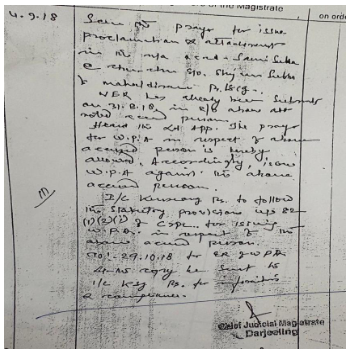
1. Present petition has been filed challenging the order dated 1st September, 218 and 4th September, 2018 in Sadar Police Station Case no. 213 of 2017 dated 13th October, 2017 under Sections 3 5 3 / 120B / 307 / 302 of the IPC read with Sections 25 / 25(1)(A) / 27 / 35 of the ARMS ACT and 3/4 of Explosive Substance Act. Vide the impugned order learned Chief Judicial Magistrate, Darjeeling, issued the proclamation under Section 82 Cr.P.C. against the petitioners.
2. Learned Senior Counsel for the petitioners submits that the impugned orders are liable to be set aside as the same are clearly in violation of Section 82 of the CRIMINAL PROCEDURE CODE , 1973. Learned Senior Counsel further submits that there is nothing on record to suggest that the learned Chief Judicial Magistrate had applied his mind before issuing the warrant of proclamation under Section 82 of the Cr.P.C.
3. Learned counsel for the State has vehemently opposed the petition. Learned counsel submits that the present case is of 2017 and the impugned orders were passed on 1st September, 2018 and 4th September, 2018. Learned counsel for the State further submits that the Investigating Officer had conducted several raids to arrest the accused persons but they were absconding. Learned counsel further states that present order was passed after around 1 ‰ years of the registration of the FIR, therefore, the Learned CJM must have considered that the petitioners are intentionally absconding.
4. Learned Chief Judicial Magistrate upon request of the Investigating Officer issued the proclamation under Section 82 Cr.P.C. Learned Counsel submits that the facts and circumstances itself shows that there were enough reasons to believe that the petitioners were absconding for avoiding their arrest. Learned counsel submits that merely on the technicalities the impugned orders may not be set aside.
5. Section 82 of the Cr.P.C. provides as under :
“82. Proclamation for person absconding. –
(1) If any Court has reason to believe (whether after taking evidence or not) that any person against whom a warrant has been issued by it has absconded or is concealing himself so that such warrant cannot be executed, such Court may publish a written proclamation requiring him to appear at a specified place and at a specified time not less than thirty days from the date of publishing such proclamation.
(2) The proclamation shall be published as follows:-
(i)(a) it shall be publicly read in some conspicuous place of the town or village in which such person ordinarily resides;
(b) it shall be affixed to some conspicuous part of the house or conspicuous place of such town or village;
(c) a copy thereof shall be affixed to some conspicuous part of the Court-house………..”
6. Bare perusal of Section 82 Cr.P.C. makes it clear that before issuing the proclamation under Section 82 Cr.P.C., the Court must have reason to belief that the person against whom said proclamation is being issued has absconded or concealing himself on account of which warrant could not be executed. The law provides that only after such reason to believe the Court may publish a written proclamation requiring the person to appear at a specified place and specified time not less than thirty days from the date of publishing such proclamation. The process of issuing the proclamation has been provided under Section 82 (2) of the Cr.P.C.
7. Thus, before issuing the proclamation under Section 82 Cr.P.C. the Court must follow the following procedure.
(i) That there is material on record that the person against whom t
AI
The issuance of a proclamation under Section 82 Cr.P.C. requires a documented reason to believe the accused is absconding, supported by material evidence, or it is legally unsustainable.


The court reaffirmed that failure to follow the mandatory 30-day notice under Section 82 Cr.P.C. when declaring an absconder invalidates the proceedings, emphasizing adherence to legal processes.

(1) Anticipatory bail – If anyone is declared as an absconder/proclaimed offender in terms of Section 82 Cr.P.C., he is not entitled to relief of anticipatory bail.(2) Anticipatory bail – When an app....

Proclamation and attachment – Essential ingredients for exercise of power is subjective satisfaction of court that warrantee is hiding himself to evade process of law – Mere absence from home cannot ....



An indispensable Tool for Legal Professionals, Endorsed by Various High Court and Judicial Officers
Please visit our Training & Support
Center or Contact Us for assistance

Scan Me!
India’s Legal research and Law Firm App, Download now!


For Daily Legal Updates, Join us on :



 Back to top


