
 Back
Back





IN THE HIGH COURT AT CALCUTTA
ANANYA BANDYOPADHYAY, J.
Tapan Chatterjee @ Tapan Kumar Chatterjee – Appellant
Versus
The State of West Bengal & Anr. – Respondent
C.R.A. 88 of 2009
Decided On : 02-09-2025
| Table of Content |
|---|
| 1. overview of the appeal and loans (Para 1 , 2 , 3 , 4 , 5) |
| 2. arguments against acquittal and evidential gaps (Para 6 , 7 , 8 , 9) |
| 3. judicial reasoning on part payments and cheque validity (Para 10 , 11 , 12 , 13 , 14 , 15 , 16 , 17 , 18) |
| 4. final dismissal of the appeal (Para 20 , 21 , 22 , 23) |
Judgment :
Ananya Bandyopadhyay, J.
1. The present appeal calls into question the judgment and order dated 27th November, 2008 passed by the Learned Chief Judicial Magistrate, Howrah in Complaint Case No. 668C of 2004, whereunder the accused/opposite parties have been acquitted of the offences under Section 138 and 141 of the Negotiable Instruments Act. The appellant contends that the acquittal is founded upon misappropriation of evidence disregard to statutory presumptions and reliance upon conjectural defence unsupported by any credible material.
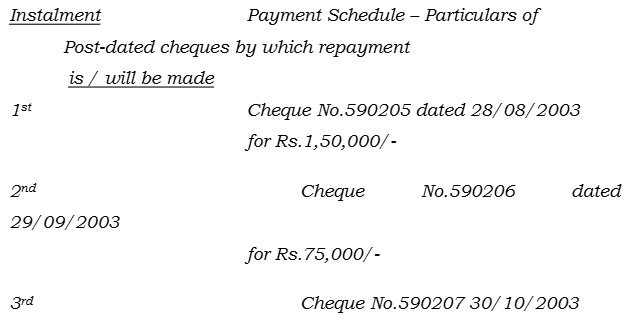
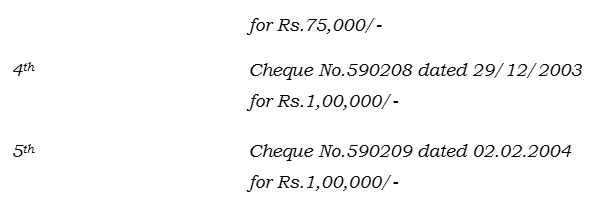
2. The narrative of the complaint and the sworn testimony of the appellant disclosed the appellant to have retired from service after discharging a long tenure in the State Bank of India. On receiving his retiral benefits, he extended financial assistance to the opposite parties, who were partners of a business firm with whom the appellant shared a cordial relation. An agreement dated 27th July, 2003 was executed whereby the appellant advanced Rs. 5,00,000/- to the said partners to enable them to meet their immediate working capital and sustain their enterprise. The disbursement was undertaken through five (05) cheques each being reflected with clarity in the records as follows:
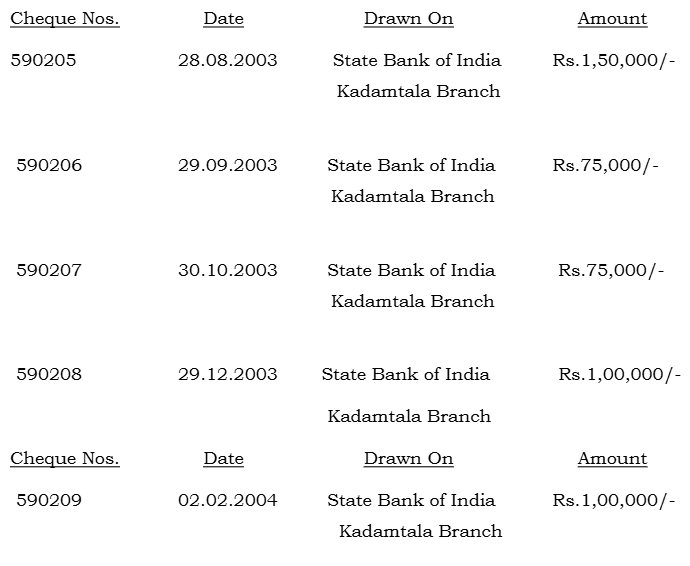
3. The appellant further averred, beyond the principal loan under the written agreement, an additional personal loan of Rs. 50,000/- was advanced by him to the opposite parties through cheque no. 590291. Out of the cheques issued under the arrangement only cheque no. 590205 amounting to Rs. 1,50,000/- was honoured. The remaining cheques did not meet with success. In particular cheques bearing nos. 590208 and 590209 when deposited for encashment on 3rd June, 2004 at the State Bank of India, Kadamtal Branch, were returned and paid on 7th June, 2004 with the endorsement “Exceeds Arrangement”.
4. Following such dishonour, the appellant personally sought clarification from the opposite parties. He claimed of assurances been extended that the entire sum would be cleared in cash on or before 14th April, 2004. No such payment, however, ensued. Consequently, the appellant, through Learned Counsel issued a statutory demand notice dated 22nd June, 2004 calling upon the opposite parties to remit Rs. 2,00,000/- representing the dishonour instruments. The notice was neither replied to nor complied with.
5. The complaint was then instituted upon examination of the appellant under Section 200 of the Criminal Procedure Code and upon perusal of the supporting documents, the Learned Magistrate took cognizance and summons the accuseds. They appeared, secured bail and entered a plea of non-guilty. During the interregnum of the proceedings one of the accused Kashinath Pollea expired and the case abated against him.
6. During trial, the appellant appeared as PW-1 and affirmed his version. He produced the agreement, the cheques in-question, the bank slip evincing dishonour and the statutory notice. His evidence sought to establish that the loans remain wholly unpaid except for the sum covered by cheque no. 590205. In defence, the accused persons asserted that the liability stood extinguished. They contended that a sum of Rs. 1,50,000/- had been repaid in cash to the appellant and the dishonoured cheques were not issued in discharge of any subsisting debt. The plea rested entirely on oral assertion. No receipt, acknowledgement, correspondence, banking traits evidencing the alleged repayment was furnished, nor did the accused persons attempt to demonstrate the cheques to have been issued for purposes other than acknowledged financial arrangement. There was not any explanation as to why no reply was furnished to the statutory dema
AI
Accused failed to rebut the presumption of debt under Section 139, leading to acquittal being upheld despite dishonoured cheques. Evidence must sufficiently support claims of payment to avoid prosecu....

Dishonour of cheque – If drawer of cheque pays a part or whole of sum between period when cheque is drawn and when it is encashed upon maturity, then legally enforceable debt on date of maturity woul....

A cheque that is dishonored must represent a legally enforceable debt at the time of presentation; part payments made prior to encashment must be accounted for, or the offence under Section 138 of th....


The presumption under Section 139 of the N.I. Act is attracted when the accused admits the issuance of the cheque and his signature upon the same. The accused can rebut this presumption either by eff....


The issuance of a cheque signifies a legally enforceable debt under Section 138 of the N.I. Act, and the burden to prove otherwise lies with the accused, not the complainant.

Presumption under Section 139 NI Act shifts burden to accused to rebut by probable defence; trial court erred in requiring complainant to prove debt, rendering acquittal perverse in appeal.

Point of law: Dishonour of cheque - Discrepancy in the amount - Discrepancy in the amount reflected in the cheque and the actual amount due by the accused, the accused cannot be proceeded under secti....



An indispensable Tool for Legal Professionals, Endorsed by Various High Court and Judicial Officers
Please visit our Training & Support
Center or Contact Us for assistance

Scan Me!
India’s Legal research and Law Firm App, Download now!


For Daily Legal Updates, Join us on :



 Back to top


