
 Back
Back





IN THE HIGH COURT OF CHHATTISGARH, BILASPUR
GOUTAM BHADURI, RADHAKISHAN AGRAWAL, JJ.
Dolnarayan S/o Late Ram Prasad Aghariya - Appellant
Versus
Teejmati Wd/o Lochan Prasad Aghariya – Respondent
FA No.79 of 2019 & FA No.674 of 2018
Decided on : 27-02-2024
oral partition - Property Dispute - [Indian Evidence Act, 1872, Section 114(e); Hindu Succession Act, 1956, Section 6] - The court discussed the evidence of oral partition and its legal implications. It highlighted the burden of proof on the proponent of oral partition and the need for contemporaneous public documents to support such claims. The court also emphasized the presumption of continuance of a joint family and the requirement for multiple factors to establish a partition. The judgment was influenced by the legal provisions of the Indian Evidence Act and the Hindu Succession Act, leading to the finding that the plaintiffs failed to prove the oral partition, resulting in the allowance of the appeals and setting aside of the impugned judgment and decree.
Fact of the Case:
The case involved a property dispute arising from an oral partition claim between the plaintiffs and the defendants. The plaintiffs alleged that the defendants sold a disputed property without proper rights due to an oral partition, while the defendants contested the claim.
Finding of the Court:
The court analyzed the evidence of oral partition, revenue records, and witness statements. It found that the plaintiffs failed to prove the oral partition, emphasizing the burden of proof and the need for contemporaneous public documents. As a result, the court allowed the appeals and set aside the impugned judgment and decree.
Issues: The key issues revolved around the validity of the oral partition claim, the burden of proof, and the evidentiary value of revenue records. The court also considered the rights of the parties in the disputed property and the implications of the alleged oral partition.
Ratio Decidendi: The court's decision was based on the failure of the plaintiffs to prove the oral partition, as required by legal principles and the burden of proof. It emphasized the need for contemporaneous public documents and the presumption of continuance of a joint family. The judgment was influenced by the legal provisions of the Indian Evidence Act and the Hindu Succession Act.
Final Decision: Both the appeals were allowed, and the impugned judgment and decree were set aside. No order was given as to costs, and a decree was to be drawn accordingly.
JUDGMENT :
Goutam Bhaduri, J.
1. Since both the appeals are arising out of same judgment and decree dated 31-10-2018 passed by the Second Additional District Judge, Raigarh, in civil suit No.A/50/2011 they are being heard and decided together by this common judgment.
2. FA No.674 of 2018 is preferred by the defendant No.1, who was purchaser and FA No.79 of 2019 is preferred by the defendantsNo.2 & 3 from whom the defendant No.1 purchased the part of property.
3. In order to appreciate the facts, it would be necessary to show the genealogical tree of the family, which is as under :
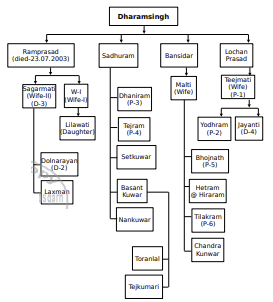
4. Dharamsingh had four sons namely; (i) Ramprasad, (ii) Sadhuram,(iii) Bansidar and (iv) Lochan Prasad. On the part of property the plaintiffs No.1 & 2 namely; Teejmati & Yodhram, respectively are claiming through Lochan Prasad. Plaintiffs No.3 & 4 namely; Dhaniram & Tejram, respectively are claiming through Sadhuram and plaintiffs No.5 & 6 namely; Bhojnath & Tilakram, respectively are claiming through Bansidar filed a suit on one side whereas the defendants No.2 & 3 namely; Dolnarayan & Sagarmati, respectively claiming through Ramprasad on the other side.
5. According to the plaint averments, the ancestors of the plaintiffs and the defendants No.2 to 4 had two set of lands, one is at village Chhuipali and another is at village Chhatamuda, District Raigarh, which were shown in Schedule A & B of the plaint. According to the plaintiffs, the oral partition was effected between the ancestors in respects of lands situated at village Chhuipali and at village Chhatamuda both. It is pleaded that it was in the knowledge of defendant No.2 (seller) and co-ownership was divided. Ramprasad, through whom defendants No.2 & 3 claimed their right, was given a larger chunk of land at village Chhuipali, as compared to area of land fallen to the share of other three brothers namely; Sadhuram, Bansidar and Lochan Prasad, therefore, they were given the lands at village Chhatamuda. The dispute is about land bearing kahsra No.246 situated at village Chhatamuda. According to the plaintiffs, Ramprasad did not get any land at village Chhatamuda and though the partition was admitted, but surreptitiously the legal heirs of Ramprasad got the land mutated in respect of village Chhatamuda and thereafter, on 20-11-2009 the defendants No.2 & 3 Dolnarayan & Sagarmati, sold the land bearing Khasra No. 246 area of 1.598 hectare to defendant No.1 Anubhav Builders. The plaintiffs stated that since they admitted the fact that Ramprasad did not get any land at village Chhatamuda and larger chunk was given at village Chhuipali and the names were mutated accordingly. Therefore, the sale deed executed in favour of the defendant No. 1 by two of the land holders would be non est and declaratory suit was filed for permanent injunction and declaration to the effect that the sale deed dated 20-11-2009 in respect of Khasra No. 246 admeasuring 1.598 Hectares be declared as null and void and in case the possession was not found they may be given the possession.
6. In the written statement the defendants No.2 & 3 namely; Dolnarayan and Sagarmati admitted the partition of land at village Chhuipali and Chhatamuda during the life time of their ancestors. It was stated, however, in such partition Khasra No. 246 admeasuring 1.598 Hectares, Ramprasad got the land at village Chhatamuda and he was in possession and after his death on 23.07.2003 the defendants No. 2 & 3 came into possession and till the date of sale they were in possession of the land. Consequently, the sale was defended.
7. The purchaser/defendant No.1 stated that after verification of revenue records they have purchased the land and since the names of defendant No.2 and 3 were mutated in respect of subject land they had purchased the same for valuable consideration.
8. During the course of trial, six witnesses were examined on behalf of the plaintiffs and on behalf of the defendants two witnesses were examined. Thereafter, on the basis of pleadings,
AI
The central legal point established in the judgment is the requirement for the proponent of oral partition to bear the burden of proof and provide contemporaneous public documents to support the clai....

A claim of partition in Hindu joint family property must be substantiated with credible evidence; conjecture does not suffice.

The main legal point established in the judgment is the requirement to prove every link in a genealogy when a case is based on it, and the court's reliance on documentary evidence and oral witnesses ....


The burden of proof in establishing the existence and extent of an oral partition lies with the party claiming such partition.
The main legal point established in the judgment is the requirement to prove right, title, and possession over acquired land under the Land Acquisition Act, and the relevance of Banatannama in determ....



An indispensable Tool for Legal Professionals, Endorsed by Various High Court and Judicial Officers
Please visit our Training & Support
Center or Contact Us for assistance

Scan Me!
India’s Legal research and Law Firm App, Download now!


For Daily Legal Updates, Join us on :



 Back to top


