
 Back
Back





HIGH COURT OF CHHATTISGARH AT BILASPUR
Rajani Dubey, Bibhu Datta Guru, JJ.
Shantibai (Died) Through Legal - Appellant
Vs.
Shambhu Prasad Gond (Died) Through Legal Heirs - Respondent
FA No. 503 of 2019
Decided On : 28-01-2025
(A) Civil Procedure Code, 1908 - Principles of res-judicata and limitation - The appeal challenges the dismissal of a suit for declaration of title and injunction over property based on conflicting Wills. The trial court found the appellant failed to prove the genuineness of the later Will and the agreement to sell. (Paras 1, 6, 21)
(B) Wills - Validity and execution - The court emphasized the necessity of proving the execution of a Will, including proper attestation and absence of suspicious circumstances. The appellant's evidence was deemed insufficient to establish the validity of the later Will. (Paras 19, 20)
Facts of the case:
The appellant claimed ownership of property through a later Will executed by Sita Bai, while the respondent relied on an earlier Will and probate issued in its favor. The trial court found the appellant's claims unsubstantiated.
Findings of Court:
The trial court's findings were based on a thorough examination of evidence, concluding that the appellant failed to prove her claims regarding the later Will and agreement.
Issues: The main issues included the validity of the Wills, the appellant's possession of the property, and the applicability of res-judicata.
Ratio Decidendi: The court upheld the trial court's findings, stating that the appellant did not meet the burden of proof required to establish the validity of her claims.
Result: Appeal dismissed.
Judgment :
(Rajani Dubey, J.)
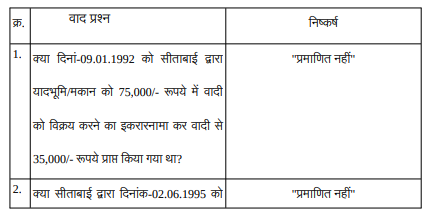
1. The instant appeal has been filed by the appellants challenging the judgment and decree dated 31.10.2019 passed by learned Additional District Judge, Bilaspur (C.G.) in Civil Suit No. 70-A/2017 whereby the learned trial Court dismissed the suit filed by the appellants for declaration of the title over the suit property and issuance of injunction. The parties to this appeal shall be referred herein as per their description before the learned trial Court.
2. There are no admitted facts in the present case.
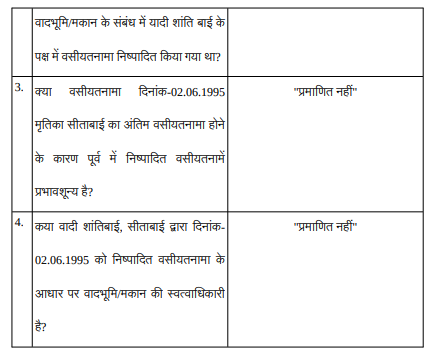
3. The pleadings made in the plaint by the plaintiffs, are that the plaintiff brought a suit for declaration of her title over the suit property situated at Shivghat, Old Sarkanda, Bilaspur, Tahsil & District Bilaspur (CG) bearing Khasra No. 1102/14, area 4 decimal, in which house of six rooms is built. In Revenue records, the possession is continued in the favour of Sita Bai. Before 15.06.1995, Sita Bai was living in one of the said six rooms and remained were given for the rent. In all of the remaining five rooms, one room was occupied by plaintiff (Shantibai) who has been living as tenant and all other four tenants had vacated their tenanted premises and have shifted themselves. At present plaintiff is the person who is in sole possession of the entire disputed property. On 27.04.1994, Sita Bai executed a Will in front of two witnesses, in favour of respondent No.1 (Shambhu Gond), appointing him the successor of the disputed land. On 12.05.2016, a probate was issued by District Judge, Bilaspur (C.O.), relating the said Will dated 27.04.1994. On the basis of said probate certificate dated 12.05.2016, relating to Will dated 27.04.1994, an application for mutation was submitted by Shambhu Prasad in the Court of Additional Tahsildar, Bilaspur, which was allowed on 29.10.2018 and the name of Shambhu Prasad was mutated in place of Chaitu. Due to need of money on 09.01 1992, Sita Bai executed an agreement on stamp paper to sell the disputed property to plaintiff, in front of two witnesses, for consideration amount of Rs. 75,000/- and out of which Rs. 35,000/- was received by Sita Bai and rest was to be received at the time of the registration of the sale deed. But due to good relation between Sita Bai and plaintiff and also because plaintiff along with her family had looked after Sita Bai, supported her during illness, incurred the medical expenses and the last rites were also performed by the plaintiff and expenses of the same were also incurred by her, leaving the rest consideration amount, Sita Bai executed another Will dated 02.06.1995, in favour of plaintiff appointing her successor of the disputed land, in front of two witnesses. The defendant is illegally interrupting in possession of the plaintiff upon the disputed property and taking benefit of his name, is also trying to alienate the property. On the basis of above mentioned averments, the plaintiff has requested reliefs to declare her the owner of the disputed property and to declare the Will dated 27.04.1994 null and void on the basis of final will dated 02.06.1995 and issuance of injunction restraining the defendant to interfere in the disputed property by any mode.
4. Vide his written statement, the defendant No.1 denied the plaint's averments and pleaded that, no cause of action arose in the year 2017, the suit filed is barred by limitation and prejudicial hence is not maintainable and is barred under the principles of res-judicata. According to defendant No. 1, before the demise of Sita Bai, there were six tenants. At present plaintiff along with his son is living only in two rooms as tenant, and is not in possession of entire suit property. Defendant No. 1 is the son of sister of Sitabai. During her life time, Sitabai duly executed Will dated 27.04.1994, relating to which, probate dated 12.05.2016, has also been issued by the District Judge, Bilaspur (CG). The probate confirms the execution of said Will dated 27.04.1994, by Sitabai in f

AI
The validity of a Will must be proven with clear evidence, including proper attestation and absence of suspicious circumstances; failure to do so results in dismissal of claims.

The validity of a will is undermined when it is executed under suspicious circumstances, necessitating the propounder to dispel these doubts for the document to be accepted legally.


The propounder of a Will must dispel any suspicious circumstances surrounding its execution to establish its validity.

The burden of proof lies with the propounder of a will to dispel any suspicious circumstances surrounding its execution, necessitating judicial satisfaction regarding the will's authenticity.

(1) Appellant has failed to make out a case for production of additional evidence.(2) It is well settled that the onus to prove a Will is on the propounder.(3) No assertion as to from which point of ....
The execution and validity of a Will require strict adherence to statutory provisions, including proper attestation, which was not proven in this case, rendering the claimed interests void.



An indispensable Tool for Legal Professionals, Endorsed by Various High Court and Judicial Officers
Please visit our Training & Support
Center or Contact Us for assistance

Scan Me!
India’s Legal research and Law Firm App, Download now!


For Daily Legal Updates, Join us on :



 Back to top


