
 Back
Back





HIGH COURT OF CHHATTISGARH AT BILASPUR
RAJANI DUBEY, SACHIN SINGH RAJPUT, JJ.
Vinod Nat, S/o Shri Ishwar Nat - Appellant
Versus
State of Chhattisgarh Through Police Station- Kawardha – Respondent
CRA No. 1035 of 2019
Decided on : 18-03-2025
(A) Code of Criminal Procedure, 1973 - Section 374(2) - Indian Penal Code, 1860 - Sections 363, 366, 376(3) - Protection of Children from Sexual Offences Act, 2012 - Section 6 - Appeal against conviction - The trial court convicted the appellant for kidnapping and sexual assault, sentencing him to 20 years for rape and lesser terms for other charges - The prosecution failed to prove the age of the prosecutrix as below 16 years, which is crucial for conviction under POCSO Act - The evidence presented was found unreliable and contradictory, leading to doubts about the prosecutrix's credibility. (Paras 1, 19, 20)
(B) Burden of Proof - The prosecution must prove the age of the victim beyond reasonable doubt to sustain a conviction under POCSO Act - The absence of reliable evidence regarding the victim's age and inconsistencies in witness statements led to the conclusion that the conviction could not be upheld. (Paras 10, 19)
Facts of the case:
The prosecutrix went missing on 26.07.2018, leading to a police investigation that resulted in the appellant's conviction based on the prosecutrix's statements and witness testimonies.
Findings of Court:
The trial court's conviction was overturned due to insufficient evidence regarding the age of the prosecutrix and the unreliability of witness testimonies.
Issues: The main issue was whether the prosecutrix was below 16 years of age at the time of the incident, which is essential for conviction under the POCSO Act.
Ratio Decidendi: The court emphasized that the prosecution must provide credible evidence of the victim's age, and the lack of such evidence, along with inconsistencies in witness statements, warranted the appellant's acquittal.
Result: Appeal allowed; the appellant is acquitted of all charges.
Judgment :
(Rajani Dubey, J.)
1. The present appeal under Section 374(2) of Code of Criminal Procedure has been filed against the the judgment of conviction and order of sentence dated 16.05.2019 passed by Special Judge, POCSO ACT, 2012, Fast Track Court, Kabirdham (C.G.) in Special Sessions Case No. 75/2018 whereby, the trial court has convicted the appellant under Sections 363, 366, 376(3) of IPC and Section 6 of POCSO Act, but keeping in view the provision of Section 42 of POCSO Act, appellant has been sentenced as under:-
| Conviction | Sentence |
| U/s 376(3) of IPC | R.I. for 20 years with fine of Rs.3000/- and in default of payment of fine, additional R.I. for 3 months |
| U/s 363 of IPC | R.I. for 4 years with fine of Rs.500/- and in default of payment of fine, additional R.I. for 1 month |
| U/s 366 of IPC | R.I. for 4 years with fine of Rs.500/- and in default of payment of fine, additional R.I. for 1 month |
2. Facts of the case, in nut shell, are that on 26.07.2018 at about 11:00 am, the prosecutrix left the house to go to school. She did not return home in the evening. When she was searched around, she could not be found. Complainant- Gendalal Gandharva informed about the prosecutrix being missing. On the basis of which, a case was registered at Police Station- Kawardha for the offence under Section 363 of the Indian Penal Code. Spot map was prepared. The age proof of the prosecutrix was collected. The prosecutrix was recovered from the possession of the accused/appellant. Medical examination of the prosecutrix was done. The accused/appellant was arrested and information about the arrest was given to his family. The statements of the witnesses were recorded. The statement of the prosecutrix recorded under Section 164 Cr.P.C. was registered in the Court. After completion of usual investigation, charge-sheet was filed before the learned trial Court against the accused/appellant for the offence punishable under Sections 363, 366, 376 of IPC and Section 4 of POCSO Act. Learned trial Court framed the charges against the appellant under Sections 363, 366, 376(2)(N) of IPC and Section 6 of POCSO Act to which, he abjured his guilt and prayed for trial.
3. So as to hold the accused/appellant guilty, the prosecution has examined as many as 12 witnesses. Statement of the accused/appellant was also recorded under Section 313 of the Cr.P.C. in which he denied the incriminating circumstances appearing against him and pleaded innocence and false implication in the case. However, he did not adduce any evidence in his defence.
4. Learned trial Court upon appreciation of oral and documentary evidence available on record, by its judgment dated 16.05.2019, finding evidence adduced by the prosecution trustworthy, convicted the the appellant under Sections 363, 366, 376(3) of IPC and Section 6 of POCSO Act and sentenced him as mentioned in para 1 of this judgment. Hence, this appeal.
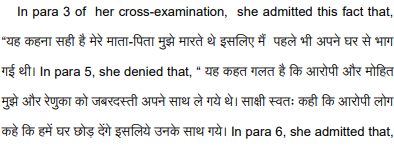
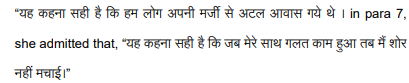
5. Learned counsel for the appellant submits that the impugned judgment and the findings contained therein are bad in law and on facts of the case. The learned trial Court has failed to see that the statements adduced by the prosecution witnesses are contradictory and such statements are not reliable and admissible under the law. The learned trial Court has not appreciated this fact that the prosecution has utterly failed to prove the age of the prosecutrix below 16 years. It is clear from statement of P.W.-1, who is friend of prosecutrix that she along with the prosecutrix went with the accused persons to Ghughari Road Atal Awas and they stayed there in the night. In cross examination, she denied to identify the accused persons. Therefore, the conviction of the appellant is illegal and against the law. The learned trial Court also did not appreciate the statement of Dr. Usha Singh (P.W.-12) who did not find any external or internal injuries over the body of the prosecutrix. Therefore, the prosecution has utterly failed to prove its case beyond reasonable doubt against the appellant. It is als
AI
The prosecution must prove the victim's age beyond reasonable doubt for a conviction under the POCSO Act, and inconsistencies in evidence can lead to acquittal.

The prosecution must provide conclusive evidence of a victim's age in POCSO cases; reliance on school records alone is insufficient without corroborative proof.
The prosecution failed to prove the prosecutrix's age under 18 years and her consent negated the charges of abduction and sexual assault.
The court ruled that the prosecutrix was above 18 years and a consenting party, negating the applicability of POCSO Act provisions.

The appeal was allowed as the prosecution failed to prove the prosecutrix's age and voluntary relationship negated the charges of abduction and rape.
The prosecution must provide conclusive evidence of a victim's age and lack of consent in sexual assault cases; insufficient evidence leads to acquittal.

Proof of minor status is essential under POCSO; without clear age determination, conviction cannot stand. The benefit of doubt must accrue to the accused when age is unproven.


The prosecution failed to prove the age of the prosecutrix, leading to the conclusion that the relationship was consensual, thus negating the charges of kidnapping and sexual assault.

The determination of the age of the prosecutrix, credibility of testimonies, and the presumption of a culpable mental state on the part of the accused in cases under the POCSO Act.



An indispensable Tool for Legal Professionals, Endorsed by Various High Court and Judicial Officers
Please visit our Training & Support
Center or Contact Us for assistance

Scan Me!
India’s Legal research and Law Firm App, Download now!


For Daily Legal Updates, Join us on :



 Back to top


