
 Back
Back





IN THE HIGH COURT OF CHHATTISGARH AT BILASPUR
RAVINDRA KUMAR AGRAWAL, J.
Pal Sai S/o Gyan Sai – Appellant
Versus
Girvar S/o Hawal Sai – Respondent
SA No. 204 of 2014
Decided On : 23-02-2026
| Table of Content |
|---|
| 1. the discretion in admitting second appeals. (Para 1 , 2) |
| 2. factual backdrop of ownership dispute. (Para 3) |
| 3. arguments regarding limitation and amendment of pleadings. (Para 4 , 5 , 6 , 10 , 11) |
| 4. principles involving amendments and limitation. (Para 12 , 13 , 14) |
| 5. conclusion and order of the court. (Para 17 , 18 , 19) |
JUDGMENT :
RAVINDRA KUMAR AGRAWAL, J.
1. This second appeal under Section 100 of the Code of Civil Procedure, 1908, has been preferred by the appellants/defendants calling in question the legality, validity and propriety of the judgment and decree dated 12.05.2014 passed by the learned 2nd Additional District Judge, Ambikapur, District Surguja (C.G.) in Civil Appeal No.50-A/2012, whereby the appeal preferred by the respondents/plaintiffs has been allowed and the judgment and decree dated 19.03.2012 passed by the learned Civil Judge Class- II, Sitapur, District Surguja in Civil Suit No.31-A/1989 (earlier Civil Suit No.12A/2007) dismissing the suit as barred by limitation has been set aside, and the respondents/plaintiffs have been held entitled to recovery of possession of the suit land as described in Schedule-B appended to the impugned judgment and decree. The appellants, being aggrieved by the reversal of the trial Court’s findings on limitation and possession, have raised various substantial questions of law relating to limitation, amendment of pleadings under Order VI Rule 17 CPC, accrual of cause of action, and the legality of the findings recorded by the first appellate Court.
2. The second appeal is admitted on 07.12.2015 on the following substantial question of law:-
“Whether the learned lower appellate Court was justified in reversing judgment and decree of the trial Court and grant decree in favour of plaintiff by holding that the suit was within limitation?”
3. The facts of the case as emerges from the pleadings of the case are that, the dispute in the present second appeal pertains to agricultural land admeasuring 9.75 acres situated in various Khasra numbers at Village Kerju, Tahsil Sitapur, District Surguja (C.G.) (hereinafter referred to as “the suit land”). The parties to the lis are closely related and are descendants of two real brothers, namely, Jagan Sai and Lagan Sai. The respondents/plaintiffs are the sons and legal representatives of Jagan Sai, whereas the appellants/defendants are the sons and legal representatives of Lagan Sai.
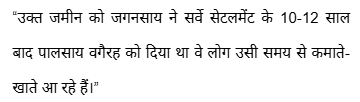
It is the case of the appellants/defendants that Jagan Sai died about 36 years prior to the institution of the suit and Lagan Sai died about 12 years prior to the Surguja Settlement operations. According to the plaintiffs, the suit land originally belonged to their predecessor-in-interest Jagan Sai and they are the title holders thereof. On the contrary, the case of the defendants is that their names were mutated in the revenue records in the year 1954-55 and they have been in continuous, open and peaceful possession of the suit land since then.
The respondents/plaintiffs instituted a civil suit on 22.06.1989 before the Court of Civil Judge Class-II, Ambikapur (now Sitapur), being Civil Suit No.31-A/1989, seeking declaration of title over the suit land and permanent injunction against the defendants. Notably, in the original plaint, no specific relief of recovery of possession was claimed, though it was alleged that the defendants were interfering with the land.
The appellants/defendants filed their written statement denying the plaint allegations in toto and contended that the suit was barred by limitation. It was specifically pleaded that the defendants were in possession since 1954-55 and their names had been duly recorded in the revenue records. It was further contended that the plaintiffs had no subsisting right, title or interest over the suit land and the suit was liable to be dismissed.
On the basis of pleadings, the learned trial Court framed four issues relating to title, possession, limitation and relief. By judgment and decree dated 12.02.199

AI
The appellate court upheld that plaintiffs' title validly established, and amendments to pleadings for possession did not change the suit's nature, ensuring compliance with statutory limitation.

The suit for possession based on title is governed by Article 65 of the Limitation Act, allowing 12 years from the date of adverse possession, not Article 58.


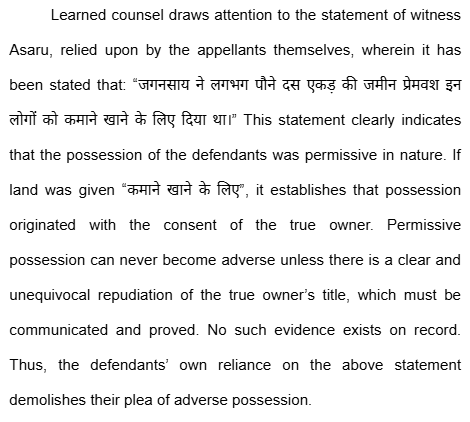
Possession must be open, continuous, and adverse to establish adverse possession; failure to prove this invalidates claims of ownership.



An indispensable Tool for Legal Professionals, Endorsed by Various High Court and Judicial Officers
Please visit our Training & Support
Center or Contact Us for assistance

Scan Me!
India’s Legal research and Law Firm App, Download now!


For Daily Legal Updates, Join us on :



 Back to top


