Back
Back





2026 Supreme(Chh) 55
HIGH COURT OF CHHATTISGARH AT BILASPUR
RAJANI DUBEY, AMITENDRA KISHORE PRASAD, JJ.
Ku. Durgesh Nandani, D/o. Brajmohan Duwa – Appellant
Versus
Neelam Sharma, Daughter of Late Brijmohan Dua and Wife of Shri Rajendra Sharma – Respondent
FA(MAT) No. 25 of 2019
Decided On : 14-01-2026
For the Appellant : Mr. B.P. Sharma along with Mr. K.N. Singh, Adv.
For the Respondent: Mr. H. V. Sharma, Adv., Mr. Sandeep Jha along with Ms. Gunjan Tiwari, Adv.
Legal admissions cannot override statutory presumptions of legitimacy; existing valid marriage negates claims of paternity without proper dissolution proof.
Headnote:(A) Indian Evidence Act, 1872 - Section 112 - Hindu Marriage Act, 1955 - Sections 5(i) and 11 - Declaration of paternity - Plaintiffs' suit dismissed on grounds of valid existing marriage and statutory presumption of legitimacy. Defendant admitted relationship but statutory provisions prevent overriding legitimacy. Court upheld trial court's findings and reasoning, affirming the dismissal of the appeal as it lacks merit. (Paras 21-22, 24, 27)
(B) Admission - An admission by a party does not negate the requirement of legal proof nor does it confer legal status contrary to statutory provisions. (Paras 21, 23)
Facts of the case:
Plaintiffs sought a declaration of paternity against defendant for two daughters, asserting a long-term relationship despite another marriage. Defendant admitted relationship but claimed marriage was never valid due to plaintiffs' mother's prior marriage.
Findings of Court:
Trial Court dismissed suit stating existing marriage impacted legitimacy and no proof of dissolution or divorce was provided. Court found admissions insufficient to override legal standards.
Issues: Whether the admission by defendant is adequate for legal recognition of paternity despite existing marriage.
Ratio Decidendi: Legal admissions cannot contravene statutory presumptions of legitimacy; plaintiffs failed to provide requisite proof under law.
Result: Appeal dismissed.
| Table of Content |
|---|
| 1. background of the case and assertions (Para 1 , 2) |
| 2. court's assessment and findings (Para 4 , 8 , 10 , 12 , 22 , 24 , 26) |
| 3. parties' claims and arguments (Para 5 , 6 , 7 , 13 , 19) |
| 4. legal principles regarding marriage and paternity (Para 15 , 16 , 21 , 23) |
| 5. decision and order of the court (Para 25 , 27 , 28) |
JUDGMENT :
Rajani Dubey, J.
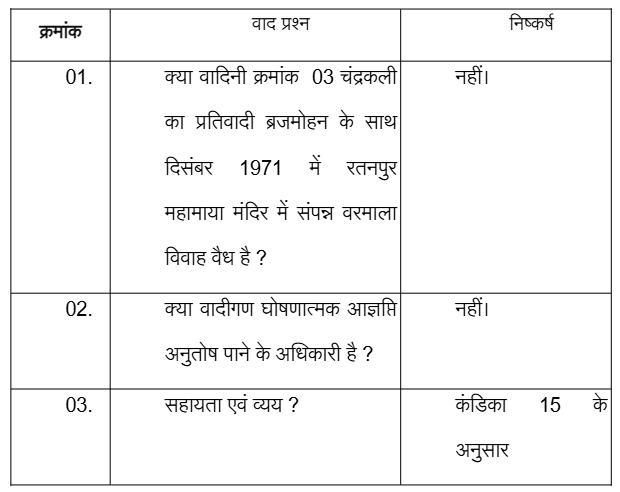
1. The present appeal has been preferred by the appellants against the judgment and decree dated 29.07.2019 passed by the learned Family Court, Bilaspur in Civil Suit No. 331-A/2019 whereby the suit instituted by the appellants/plaintiffs seeking a declaration of paternity against the defendant Brajmohan Duwa, was dismissed. For the sake of convenience, the parties shall hereinafter be referred to in accordance with their respective status before the learned Family Court.
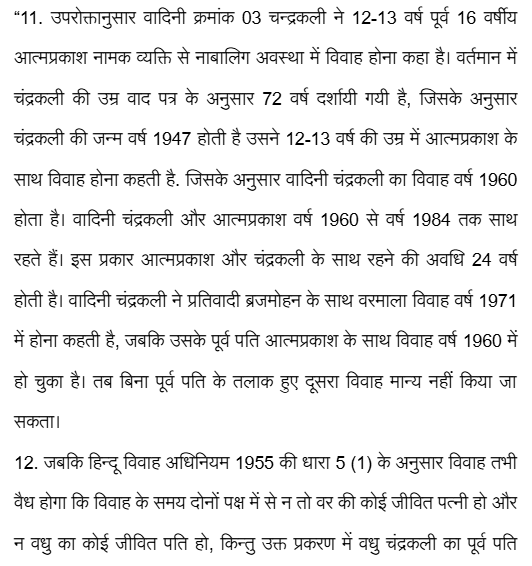
2. As pleaded in the plaint, it was averred that plaintiff No. 3, Chandrakali was married at the age of about 12–13 years to Atmaprakash who was approximately 16 years old at the time of marriage. From the inception of the marriage, Atmaprakash adopted a neglectful and indifferent attitude towards plaintiff No. 3, Chandrakali, and her family and led a detached life akin to that of a sanyasi, being inclined towards spiritual pursuits. In the year 1984, Atmaprakash deserted plaintiff No. 3 and the family, renounced worldly life by embracing asceticism and departed to an unknown place; since then, his whereabouts have remained untraced till date. It is further pleaded that during the period when Atmaprakash was residing in the matrimonial home, the defendant used to visit the house of plaintiff No. 3, and during such visits an intimate relationship developed between the defendant and plaintiff No. 3. As a result of the said relationship, plaintiff Nos. 1 and 2 were born to plaintiff No. 3 and the defendant. However, despite the aforesaid facts, from that time onwards, the name of Atmaprakash continued to be recorded as the husband of plaintiff No. 3 and the father of plaintiff Nos. 1 and 2 in the relevant records.
The plaintiffs further averred that the defendant was considered unmarried in the eyes of society. In the year 1971, the defendant came into close association with plaintiff No. 3, Chandrakali, and thereafter they started cohabiting in the nature of husband and wife. Since 1971, the defendant has been residing on Link Road. It was pleaded that the defendant, being a wealthy and respected person of the city, did not publicly acknowledge plaintiff No. 3 as his wife in order to safeguard his social reputation. At the relevant time, inter-caste relationships were socially frowned upon and not accepted; therefore, out of fear of social stigma, the defendant refrained from conferring the status of wife upon plaintiff No. 3. Nevertheless, it was asserted that plaintiff No. 3 and the defendant have been living together continuously since 1971 and were treated as husband and wife by all concerned.
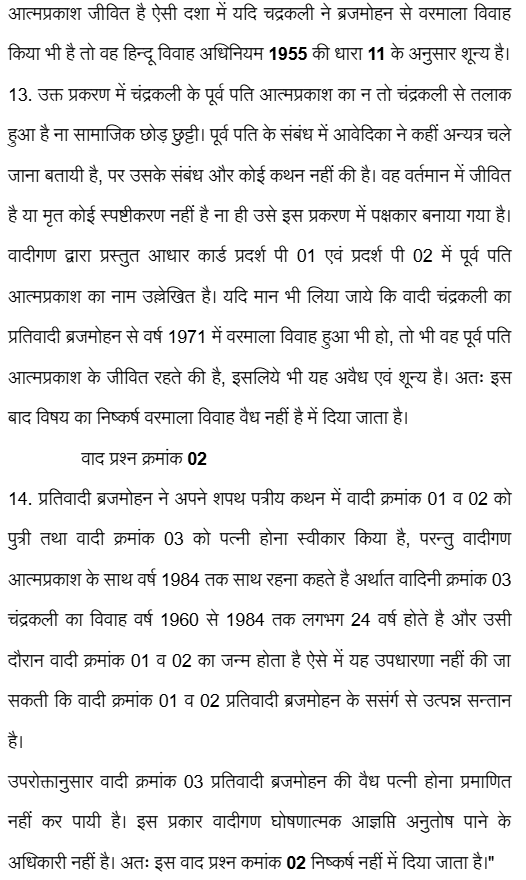
It was further pleaded that from the relationship between the defendant and plaintiff No. 3, plaintiff Nos. 1 and 2 were born, whose upbringing, maintenance and welfare were continuously taken care of by the defendant. Plaintiff No. 1 is unmarried and plaintiff No. 2 contracted a love marriage, in which the defendant extended full support and cooperation. It was alleged that the plaintiffs repeatedly requested the defendant to acknowledge plaintiff Nos. 1 and 2 as his daughters and plaintiff No. 3 as his wife and to confer legal status upon them; however, the defendant merely kept assuring them without formal recognition. Consequently, the plaintiffs prayed that plaintiff Nos. 1 and 2 be declared the daughters of the defendant and plaintiff No. 3 be declared his legally wedded wife.
3. In the written statement, the defendant stated that considering his advanced age, he does not desire any dispute and wishes to live the remainder of his life peacefully. The defendant expressed his willingness to accept all the claims made