
 Back
Back





HIGH COURT OF CHHATTISGARH AT BILASPUR
RAJANI DUBEY, AMITENDRA KISHORE PRASAD, JJ.
Arpit Kumar Agrawal, S/o. Sushil Kumar Agrawal – Appellant
Versus
Sarika Agrawal, W/o. Arpit Kumar Agrawal – Respondent
FA(MAT) No. 18 of 2024
Decided On : 14-11-2025
| Table of Content |
|---|
| 1. marriage was solemnized on 30.05.2009. (Para 1 , 2) |
| 2. details of allegations and defenses in divorce case. (Para 3 , 4) |
| 3. issues framed and consideration of evidence. (Para 5 , 9 , 10) |
| 4. cross-examination reveals both parties' separations. (Para 11 , 12 , 13) |
| 5. mental cruelty leads to irretrievable breakdown of marriage. (Para 14 , 15) |
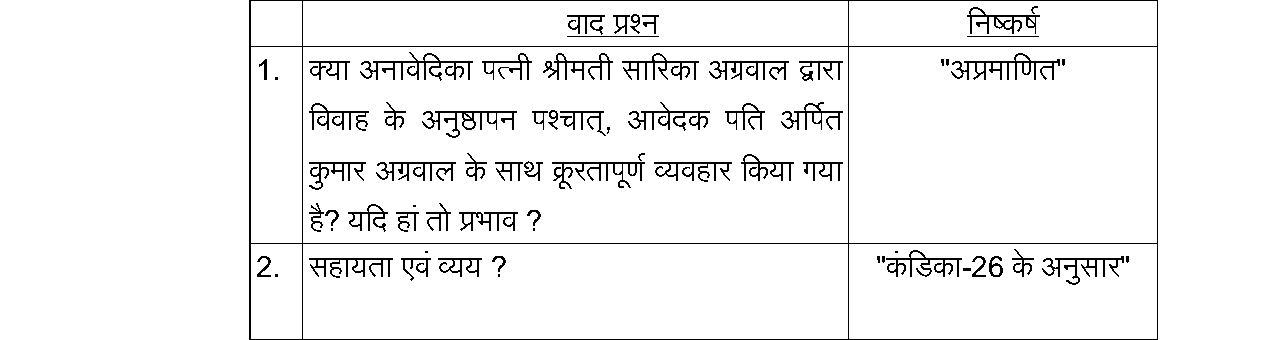
| 6. decree of divorce granted with permanent alimony. (Para 16 , 17 , 18 , 19) |
JUDGMENT :
Rajani Dubey, J.
1. This appeal under Section 19(1) of the Family Courts Act, 1984 has been preferred by the appellant/husband assailing the judgment and decree dated 13.12.2023 passed by the learned First Additional Chief Judge, Family Court, Raipur, District Raipur (C.G.) in Civil Case No. HMA/732/2019, whereby the learned Family Court has dismissed the application filed by the appellant/husband under Section 13(1)(i-a) of the Hindu Marriage Act, 1955 seeking dissolution of marriage. For the sake of convenience, the parties shall hereinafter be referred to in the same manner as they were arrayed before the learned Family Court.
2. Before learned trial Court, It is an admitted position between the parties that the marriage between the plaintiff and the defendant was solemnized on 30.05.2009 at Durg (Chhattisgarh) in accordance with Hindu rites and customs.
3. Plaintiff/husband filed application under Section 13(1) (i-a) of Hindu Marriage Act seeking decree of divorce before the Family Court on the ground that his marriage with the defendant/wife was solemnized on 30.05.2009 at Durg, Chhattisgarh, in accordance with Hindu rites and customs. The couple has no issue. The plaintiff, presently serving as ITI Manager at the Central Bank of India, Ambikapur, is the only son of his parents. After marriage, the defendant joined him at Hyderabad, where he was posted at the time, but within a month she returned to her parental home at Raipur. Thereafter, she used to visit occasionally but refused to cohabit or perform her marital obligations, citing excuses of ill- health and disinterest. It is further alleged that even after the plaintiff’s transfer to Ambikapur in 2013, the defendant stayed only for a few days and again declined to resume conjugal relations, stating that the marriage was forced upon her. She threatened to commit suicide if compelled to maintain physical relations. Despite several efforts by the plaintiff and his relatives since 2009 to persuade her to live with him, she continuously refused and has been residing at her parental home since May 2014, causing him mental and physical agony. The plaintiff/husband sent a notice on 30.01.2017, which was refused by the defendant/wife, and thereafter filed a petition for divorce under Section 13 of the Hindu Marriage Act, 1955, before the Family Court, Durg, which was later transferred to the Family Court, Raipur, pursuant to Transfer Petition No. 17/2017 before this Court. On these grounds, the appellant seeks a decree of divorce dissolving the marriage solemnized on 30.05.2009.
4. In her written statement, the defendant/wife has admitted the averments contained in paragraph 2.3 of the divorce petition and denied all other allegations. She has stated that she has already filed a petition under Section 9 of the Hindu Marriage Act, 1955, on 06.09.2018, seeking restitution of conjugal rights, which is presently pending. The defendant/wife has alleged that the plaintiff/husband being a devotee of Sadhvi Nirmala Devi, has been deeply involved in yoga practices since the time of marriage, due to which he has shown disinterest in marital relations and has never desired to have children. It is further alleged that the plaintiff/husband did not initially take her to Hyderabad after marriage and only did so at the insistence of his parents. Even thereafter, he expressed that the marriage was forced upon him and subjected her to mental and physical cruelty. He regularly visited Nirmala Devi’s ashram, returning home late at night, neglected her, and often h
AI
The court established that a long separation and refusal to cohabit amount to mental cruelty, justifying the dissolution of marriage under the Hindu Marriage Act.

Mental cruelty established through reckless allegations constitutes valid grounds for divorce under the Hindu Marriage Act.

Mental cruelty can be inferred from a spouse's persistent refusal to cohabit and disrespectful behavior, justifying divorce under the Hindu Marriage Act.

Trivial marital conflicts do not equate to legal cruelty; however, persistent destructive behavior affecting a spouse’s mental well-being can justify divorce under Section 13(1)(ia) of the Hindu Marr....


Mental cruelty is assessed based on its impact on the aggrieved spouse, with courts requiring evidence of unique personal circumstances to justify divorce under the Hindu Marriage Act.


(1) Cruelty may be mental or physical, intentional or unintentional – A dead marriage must be given a decent quietus.(2) A marriage which has broken down irretrievably, spells cruelty to both parties....
Cruelty and desertion established grounds for divorce under Hindu Marriage Act; applicant's claims of non-applicant's uncooperative behavior led to permanent breakdown of marriage.
Mental cruelty justifies divorce; unilateral refusal of cohabitation and long-term separation erode marital obligations under Hindu Marriage Act.



An indispensable Tool for Legal Professionals, Endorsed by Various High Court and Judicial Officers
Please visit our Training & Support
Center or Contact Us for assistance

Scan Me!
India’s Legal research and Law Firm App, Download now!


For Daily Legal Updates, Join us on :



 Back to top


