
 Back
Back





IN THE HIGH COURT OF CHHATTISGARH AT BILASPUR
RAJANI DUBEY, AMITENDRA KISHORE PRASAD, JJ.
Homeshwar Sahu @ Homesh Sahu S/o Urop Sahu – Appellant
Versus
State of Chhattisgarh – Respondent
CRA No. 1802 of 2019
Decided On : 17-10-2025
| Table of Content |
|---|
| 1. conviction details and context. (Para 1 , 2) |
| 2. arguments for appeal against conviction. (Para 3 , 4) |
| 3. examination of evidence and testimony. (Para 5 , 6 , 7 , 8 , 9 , 10 , 11 , 12 , 13 , 14 , 15 , 16 , 17) |
| 4. legal reasoning for acquittal. (Para 18 , 19 , 20) |
| 5. conclusion and order for release. (Para 21 , 22 , 23 , 24) |
JUDGMENT :
RAJANI DUBEY, J.
1. The present appeal is directed against the judgment of conviction and order of sentence dated 15.07.2019 passed by the learned Session Judge, Raipur in ST No.172/2017, whereby the appellant has been convicted under Sections 302, 307, 316 and 201 of IPC and sentenced to undergo life imprisonment with fine of Rs.1000/-, RI for 7 years with fine of Rs.1000/- RI for 5 year with fine of Rs.500/- and RI for 3 years with fine of Rs.500/- respectively, with default stipulations.
2. The prosecution case, in brief, is that the complainant Sushila Patel, mother of the deceased Karishma lodged a report at the police station concerned alleging that on 07.05.2007 she and her daughter came to Village Kurud and they called the appellant, upon which the appellant came there on motorcycle and took her daughter Karishma for treatment to a hospital, after some time he came back and took Sushila and on the away he assaulted her on her head, due to which she sustained severe injuries, thereafter a case was registered against the appellant and on the memorandum of the appellant, the dead body of the deceased Karishma was found. After investigation, charge sheet was filed before the Magistrate concerned. On the basis of the evidence adduced by the prosecution and material available on record, learned trial court convicted the accused/appellant, as mentioned in para 1 of the judgment.
3. Learned counsel for the appellant submits that the judgment passed by the learned Trial Court is contrary to law and material available on record. There are material omissions and contradictions in the statements of the prosecution witnesses. There was some dispute between the appellant and the complainant which was simple in nature. The memorandum and seizure witnesses have not supported the case of the prosecution and the appellant has been convicted only on the basis of conjectures and surmises. Apart from it, the medical report as well as the FSL report of the deceased also does not support the prosecution case. Therefore, the appeal deserves to be allowed. Reliance has been placed on the judgment rendered by the Hon’ble Supreme Court in the matter of Umesh Tukaram Padwal and another vs. State of Maharashtra , (2019) 3 SCC (Cri) 620 and the judgment rendered by this Court in the matter of Virendra Kumar Dhruve vs. State of C.G. 2024 (2) CGLJ 228.
4. Per contra, learned State counsel supports the impugned judgment and submits that the learned Trial Court has minutely appreciated the evidence available on record and has rightly convicted the appellant. He further submits that the dead body of the deceased Karishma was recovered pursuant to the memorandum statement of the appellant and the injured eye witness categorically stated against the appellant. Therefore, the appeal is liable to be dismissed.
5. Heard learned counsel for the parties and perused the material available on record.
6. It is clear from the record of the learned Trial Court that the learned Trial Court framed charges under Sections 302, 316, 307 & 201 of IPC against the appellant and after appreciation of oral and documentary evidence, the learned Trial Court convicted and sentenced the appellant, as mentioned in para 1 of the judgment.
7. Now the first question for consideration is whether the death of deceased Karishma was homicidal in nature or not?
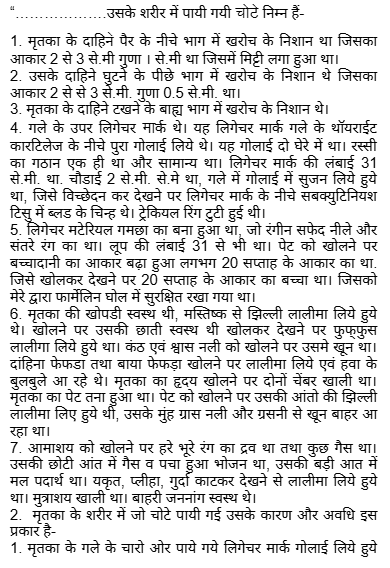
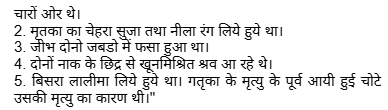
8. PW-3 Sushila Patel, mother of deceased, stated that Karishma was her daughter. She was working in mobile shop. Prior to the incident, she was ill then she took her to hospital thereafter she came to know that she is pregnant and when she enquired then she told the name of the accused and the a
AI
The mere recovery of a body from an accused's statement is insufficient for conviction under murder charges; corroborative evidence is essential.

Sections 26 of Indian Evidence Act, 1872 reads Confession by accused while in custody of police not to be proved against him.
Convictions under Section 302 of IPC require corroborative evidence, and in the absence of reliable evidence, guilt cannot be established beyond reasonable doubt.

Prosecution must prove guilt beyond reasonable doubt through a complete chain of circumstances; mere conjecture is insufficient for conviction.



(1) Section 34 IPC and 115 IPC would not go hand in hand.(2) Evidence is raw material which Judge or Adjudicator uses to reach a finding of fact – Courts can record order of conviction even in a case....

The judgment emphasizes the importance of circumstantial evidence and the burden of proof on the accused when certain facts are within their special knowledge. It also highlights the court's discreti....



An indispensable Tool for Legal Professionals, Endorsed by Various High Court and Judicial Officers
Please visit our Training & Support
Center or Contact Us for assistance

Scan Me!
India’s Legal research and Law Firm App, Download now!


For Daily Legal Updates, Join us on :



 Back to top


