
 Back
Back





HIGH COURT OF CHHATTISGARH AT BILASPUR
RAJANI DUBEY, AMITENDRA KISHORE PRASAD, JJ.
Hemant Kumar Baiga, S/o. Late Ramvuishal Baiga – Appellant
Versus
State of Chhattisgarh, through Station House Officer – Respondent
CRA No. 909 of 2019
Decided On : 18-11-2025
| Table of Content |
|---|
| 1. criminal appeal process overview and case background (Para 1 , 2 , 3 , 4 , 5) |
| 2. appellant's arguments against conviction (Para 6 , 7 , 8) |
| 3. court's examination of evidence and testimonies (Para 9 , 10 , 11 , 17 , 18) |
| 4. witness testimonies and circumstantial evidence (Para 12 , 13 , 14 , 15 , 16 , 22) |
| 5. principle of circumstantial evidence and legal standards (Para 23 , 24 , 26) |
| 6. final ruling and acquittal (Para 27 , 28) |
| 7. directions for compliance and bond issuance (Para 29 , 30) |
Judgment :
Rajani Dubey, J.
1. This criminal appeal under Section 374(2) of the Cr.P.C. is directed against the impugned judgment and order of sentence dated 22.05.2019 passed by Second Additional Sessions Judge, Surajpur, District Surajpur (C.G.). in S.T. No. 06/2019, whereby the appellant has been held guilty of commission of offence and sentenced as described below:-
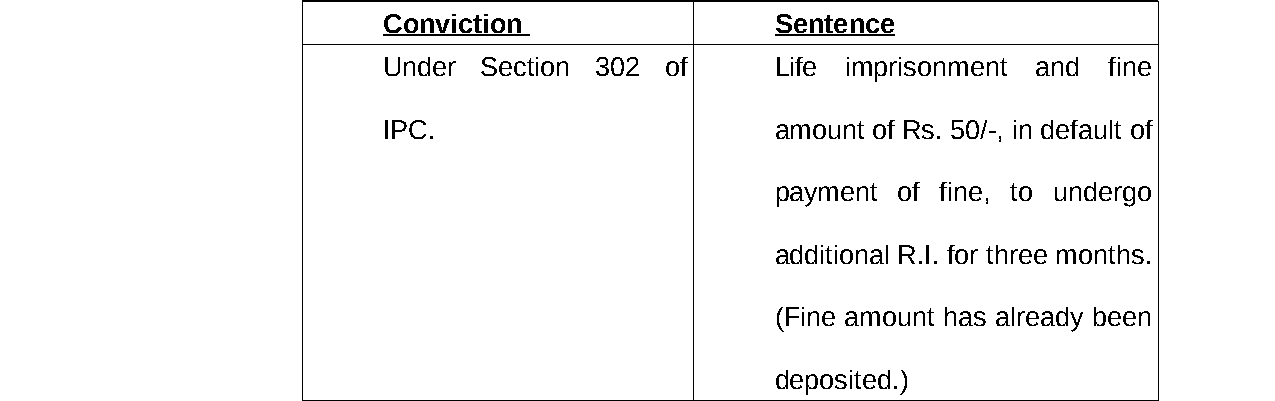
2. The case of the prosecution, as unfolded from the impugned judgment and the records of the case, is that on the intervening night of 03.12.2018 at between 11pm-12am at village Badkapara, Surajpur, someone with an intention of killing Lal Sai Bargah assaulted on his head with an iron axe “tangi”. Thereafter, a morgue intimation was lodged in the police of Police Station Surajpur by Ambika Prasad Bargah, in which it was alleged that on 04.12.2018 at about 6:00 a.m. one Golu Rajwade of his vicinity informed him that the body of his father was lying nearby the house of the appellant and thereafter, an F.I.R. was lodged against the unknown person vide crime no. 490/18 by the complainant Ambika Prasad Baiga and the case was taken up for investigation. Subsequently, the police investigated the matter and on the basis of memorandum statement the police arrested the appellant for the commission of the alleged offence. Thereafter, the matter was reported to the police of Police Station Surajpur, District Surajpur (C.G.) and they have registered the offence punishable under Section 302 of IPC against the unknown person.
3. After completion of due and necessary investigation, charge-sheet was led before the learned Chief Judicial Magistrate, Surajpur, District Surajpur (C.G.) who, in turn, committed the case for trial. On the basis of the material contained in the charge-sheet, learned trial Court framed charges against the appellant for alleged commission of offence under Sections 302 of IPC. The appellant having abjured guilt was subjected to trial.
4. In order to establish the charges against the appellant, the prosecution has examined as many as 16 witnesses. The statement under Section 313 of Cr.P.C. of the appellant has been recorded, in which he denied the incriminating charges leveled against him and pleaded his innocence that he has been falsely implicated in this case. However, 01 witness has been adduced by the appellant in his defence.
5. After hearing learned counsel for the respective parties and appreciation of oral and documentary evidence on record, the learned trial Court convicted and sentenced the appellant as mentioned above. Hence, this appeal.
6. Assailing correctness and validity of the impugned judgment of conviction and order of sentence, learned counsel appearing for the appellant submits that the impugned judgment and sentence passed by learned trial Court is bad-in-law as well as facts available on record. Learned trial Court failed to appreciate that there are major contradictions and omissions in the statements of prosecution witnesses, hence, the warrant of conviction of the appellant is bad-in-law. Learned trial Court has failed to appreciate that the memorandum and seizure witnesses have not supported the case of the prosecution and the entire case of prosecution is based upon the memorandum and seizure from the appellant, so the conviction of the appellant is without there being any cogent evidence available on record and the same is liable to be set aside. Learned trial Court has failed to appreciate that there is no motive or mens rea established
AI
Convictions under Section 302 of IPC require corroborative evidence, and in the absence of reliable evidence, guilt cannot be established beyond reasonable doubt.

(1) Where case rests entirely on circumstantial evidence, chain of evidence must be so far complete, such that every hypothesis is excluded but one proposed to be proved and such circumstances must s....

Criminal Law – Appeal against conviction – Theory of last seen – Reliability of - The last seen theory comes into play where the time gap between point of time when Accused and deceased were seen las....
In criminal cases based on circumstantial evidence, the prosecution must establish a complete and conclusive chain of evidence that excludes all reasonable hypotheses of innocence; mere suspicion is ....
The prosecution must establish an unbroken chain of evidence beyond reasonable doubt for conviction, failing which the accused is entitled to acquittal.

Circumstantial evidence can establish guilt if it forms a complete chain pointing to the accused, even without direct evidence.

The court ruled that circumstantial evidence must form a complete chain to establish guilt beyond reasonable doubt, emphasizing the need for corroboration and the benefit of doubt for the accused.

Prosecution must prove guilt beyond reasonable doubt; failure to establish a solid evidentiary basis results in acquittal.
The recovery of evidence must be unimpeachable and not shrouded with elements of doubt to sustain the guilt of the accused.



An indispensable Tool for Legal Professionals, Endorsed by Various High Court and Judicial Officers
Please visit our Training & Support
Center or Contact Us for assistance

Scan Me!
India’s Legal research and Law Firm App, Download now!


For Daily Legal Updates, Join us on :



 Back to top


