
 Back
Back





HIGH COURT OF CHHATTISGARH AT BILASPUR
BIBHU DATTA GURU, J.
Ashish Rangari, S/o. Deepak Rangari - Appellant
Versus
State of Chhattisgarh, Through District Magistrate, Chhattisgarh – Respondent
CRA No. 472 of 2016 and CRA No. 466 of 2016
Decided On : 04-12-2025
| Table of Content |
|---|
| 1. facts of the incident leading to death (Para 3 , 4 , 5) |
| 2. arguments presented by the parties (Para 6 , 7 , 8) |
| 3. examination of evidence and testimonies (Para 10 , 11 , 12 , 13 , 14) |
| 4. legal responsibility for negligence established (Para 15 , 16) |
| 5. modification of sentence and compensation ordered (Para 22 , 23 , 24) |
JUDGMENT :
BIBHU DATTA GURU, J.
1. Since both the appeals arising out of same impugned judgment of conviction and order of sentence, they are being considered and decided by this common judgment.
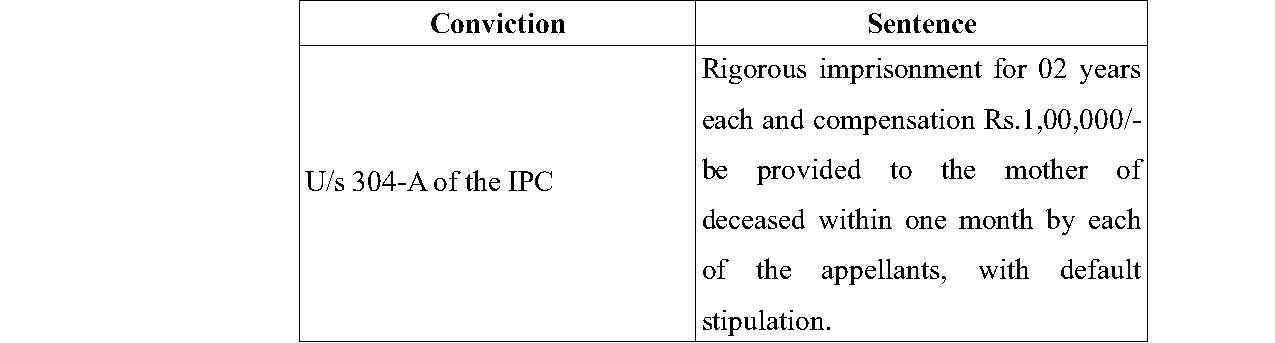
2. These criminal appeals preferred under Section 374(2) of the Cr.P.C are against impugned judgment of conviction and order of sentence dated 31.03.2016 passed in Sessions Trial No. 173/2014 by the learned Second Additional Sessions Judge Durg, C.G., whereby the appellants have been convicted and sentenced as under:-
3. Case of the prosecution in brief is that the construction work of Amrapali Vananchal City, Bhilai was being carried out under M/s Ultrahome Construction Pvt. Ltd. At the relevant time, accused S.K. Singh was working as the Project Head at Bhilai. The supervision of construction quality and monitoring of the work in accordance with rules was entrusted to Supervisor Jitendra Singh, while Satyendra Singh was working as Foreman, Ashish Singh as Site Engineer, and Ashish Shukla as Contractor. For the construction of the said building, mason Kailan, along with workers Bhagwat, Chhabi, Arun, and the deceased Lalit Chaturvedi, were present at the site on the date of incident, i.e., 04.02.2013. At about 9:30 A.M., centering work involving tying of iron rods was being carried out on the second floor of under construction building. At that time, mason Kailan was preparing mortar on the ground floor. The deceased Lalit Chaturvedi was carrying an iron rod of approximately 6 meters in length from the ground floor to the upper floor for centering purposes. At the same time, Rom Singh, Arun, Chhabi, and Bhagwat were engaged in tying the rods. At about 10:00 A.M., while Lalit Chaturvedi was lifting the iron rod upwards from the ground floor, the overhead electric line was live. One end of the iron rod came into contact with the live electric line, as a result of which Lalit Chaturvedi suffered an electric shock and fell headfirst on the slab, sustaining a severe head injury. He was immediately taken by Supervisor Ramkaran, mason Kailan, Contractor Ashish Shukla, and 10–15 labourers in the company vehicle of Amrapali Vananchal City to a nursing home in Bhilai for treatment; however, he was not admitted there. Thereafter, he was taken to Chandulal Chandrakar Memorial Hospital, where he succumbed to death at about 10:35 A.M. The hospital authorities kept the dead body in the mortuary. Thereafter, Contractor Ashish Shukla, Engineer Ashish Rangari, and Supervisor Ramkaran returned to Bhilai. It is stated that the General Manager of the company, the contractor, the supervisor, and the engineer were all aware about the fact that three overhead electric lines passing above the under- construction building were live and a serious accident could occur. Despite such knowledge, the work was continued by engaging labourers without taking necessary safety precautions. Due to such negligence and lack of due care, Lalit Chaturvedi died as a result of electrocution.
4. During investigation, Spot Map was prepared. Statements of the prosecution witnesses were recorded. Subsequently after completing the investigation, a charge-sheet was submitted before the competent jurisdictional Court. After framing the charges against the accused/ appellants, the charges were read out and explained to the appellants, they denied committing the crime and demanded trial.
5. In order to bring home the offence, the prosecution has examined 12 witnesses in its support. Statement of the accused/ appellants under Section 313 Cr.P.C was recorded, wherein they have pleaded their innocence and false implication in the matter.
6. The trial Court after ap
AI
Negligence leading to accidental death can attract liability under Section 304-A IPC when safety protocols are ignored despite known risks, as established by credible evidence.

(1) Discharge of accused – By its very nature, discharge is at a higher pedestal than acquittal – Acquittal is at end of trial process, may be for a technicality or on benefit of doubt or prosecution....
The central legal point established in the judgment is the distinction between culpable homicide and death by negligence, as defined in Section 304 and Section 304A of IPC, respectively.


The duty of care owed by the Electricity Board in hazardous activities and the application of the multiplier method for determining the quantum of compensation.

The judgment establishes the application of the doctrine of strict liability in cases of hazardous activities, the method for computing compensation under the Motor Vehicle Act, and the liability of ....

The court determined that insufficient evidence existed to justify the conviction for death due to electrocution, emphasizing the prosecution's failure in proving guilt beyond a reasonable doubt.

The central legal point established in the judgment is the application of strict liability and the doctrine of 'res ipsa loquitur' to hold the Defendants liable for compensation due to the foreseeabl....
The principle of strict liability and the doctrine of res ipsa loquitur were applied to establish the liability of the Defendants for the death of Braja Kishore due to electrocution.

Electricity suppliers are strictly liable for injuries caused by their infrastructure, regardless of negligence, and must compensate victims for losses incurred.



An indispensable Tool for Legal Professionals, Endorsed by Various High Court and Judicial Officers
Please visit our Training & Support
Center or Contact Us for assistance

Scan Me!
India’s Legal research and Law Firm App, Download now!


For Daily Legal Updates, Join us on :



 Back to top


