
 Back
Back





HIGH COURT OF CHHATTISGARH AT BILASPUR
RAVINDRA KUMAR AGRAWAL, J.
Dilip Uraon, son of Jogiyan Uraon – Appellant
Versus
Mangti Bai, D/o. late Chamra Uraon, wife of Somaru Uraon – Respondent
SA No. 284 of 2010
Decided On : 01-12-2025
| Table of Content |
|---|
| 1. plaintiffs filed for property partition. (Para 1 , 4) |
| 2. defendants' claims deny the applicability of hindu law. (Para 5 , 7) |
| 3. appellants argue misapplication of hindu law. (Para 8 , 9) |
| 4. scheduled tribes are exempt from hindu succession act. (Para 11 , 12) |
| 5. customs prevail over hindu law for scheduled tribes. (Para 13 , 14) |
| 6. evidence supports indeterminate status of tribal customs. (Para 15 , 16 , 17 , 18 , 19) |
| 7. justice, equity, and good conscience guide decision-making. (Para 20 , 21 , 22 , 23 , 24) |
| 8. equity warrants equal share for daughters despite customs. (Para 25 , 26 , 27) |
| 9. plaintiffs' entitlement confirmed. (Para 28) |
| 10. judgment and decree in favor of plaintiffs. (Para 29 , 30) |
JUDGMENT :
RAVINDRA KUMAR AGRAWAL, J.
1. This Second Appeal under Section 100 of Code of Civil Procedure, 1908 has been filed by the plaintiffs against the impugned judgment and decree dated 20.07.2010 passed by IIIrd Additional District Judge (FTC) Ambikapur, District Surguja, in Civil Appeal No.57-A/2008 whereby the First Appeal filed by the appellants/plaintiffs against the judgment and decree dated 25.04.2008 passed by Civil Judge Class-II Ambikapur, in Civil Suit No.88-A/2005 has been dismissed and the judgment and decree of the trial court has been affirmed.
2. For the sake of convenience, the status of parties shown in the Civil Suit are being taken in the present Second Appeal.
3. On 24.01.2012, the appeal was admitted by the court for hearing on the following substantial question of law:
“Whether both the courts below were not justified in holding Hindu Succession Act, 1956 is not applicable in the case, ignoring material admissions leading to inference that the parties, after being Hinduised, changed their customs to that what is followed by Hindus?”
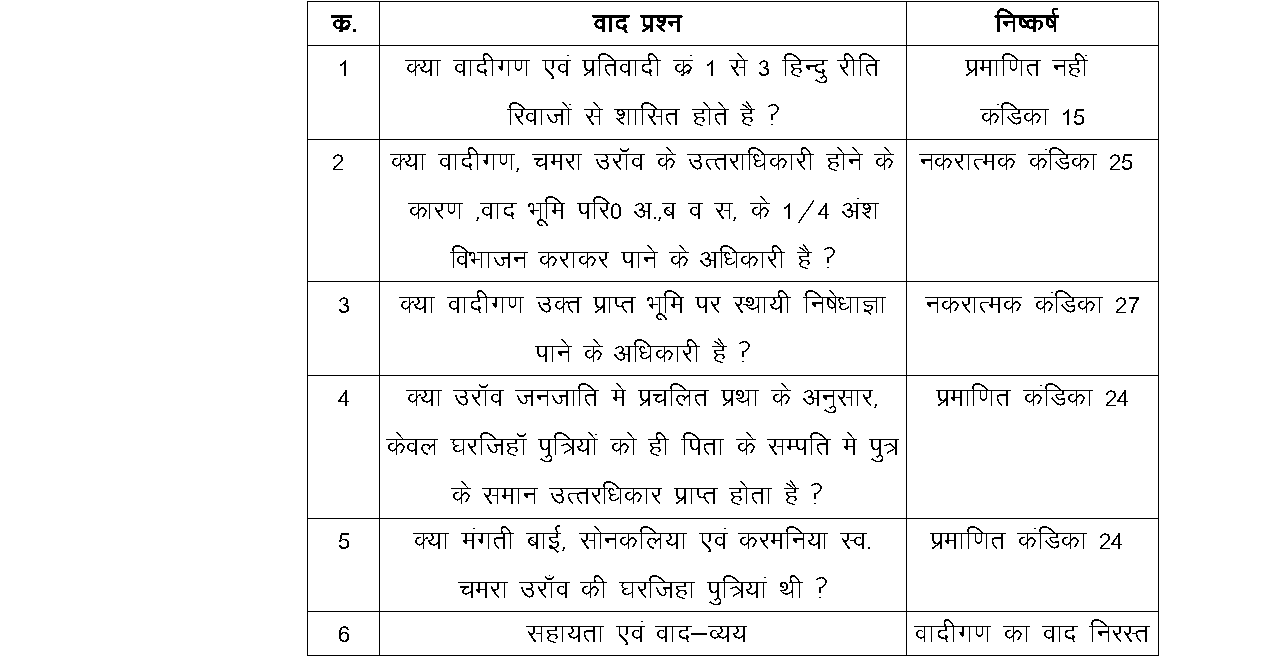
4. The plaintiff filed a civil suit for declaration of title, permanent injunction and partition of the suit property admeasuring 8.341 Hect. of village Ranta, Tehsil Lundra, District Surguja shown in Schedule-A, 1.562 Hect. of land of village Kardoni, Tehsil Lundra, District Surguja shown in Schedule-B and 0.632 Hect. of land situated at village Dakai, Tehsil Lundra, District Surguja shown in Schedule-C of the plaint. It is pleaded in the plaint that the suit property was originally held by one Chamra Uraon, who is an aboriginal Tribe, but they have adopted the Hindu customs and governed by the Hindu Law. Late Chamra Uraon was maternal grandfather of plaintiffs who performed marriage of his four daughters including the mother of plaintiffs late Kundal. She was married at village Ranta itself. Since late Chamra Uraon was not having any male member in his family, all the four daughters were taken care of Chamra Uraon and his lands were cultivated by all of them. After death of Chamra Uraon, the names of all four daughters came on revenue record as his LRs and all of them were cultivating the suit property. Since 6-7 years back, the mother of plaintiffs Kundal also died and names of plaintiff were also recorded in the revenue records as her legal heirs. The defendant No.2 filed an application for partition of the suit land and then the Naib Tehsildar Lundra passed an order on 09.03.2004 for partition of the suit property and in execution thereof, the defendant No.2 raised an objection in which the claim of defendant No.2 was denied vide order dated 03.11.2004. The plaintiff also filed an application under Section 32 of the Chhattisgarh Land Revenue Code, 1959 and then the Naib Tehsildar vide its order dated 30.07.2005 directed the parties to get their right and title decided by the competent civil court and then the present civil suit has been filed.
The plaintiff pleaded that they have 1/4th share over the suit property as the legal heir of late Chamra Uraon through their mother Kundal. Therefore, a decree may be passed in their favour that they are entitled for 1/4th share over the suit property and also for permanent injunction over their share of the property from interfe
AI
The Hindu Succession Act does not apply to aboriginal tribes; inheritance follows customary law unless proven otherwise, emphasizing the principle of justice, equity, and good conscience.

Hindu Succession Act, 1956 cannot apply to scheduled tribes – For a tribe to be notified as a scheduled tribe, notification to that effect has to be issued and vice versa.

The burden of proof for establishing a custom rests on the party asserting it, and clear and unambiguous evidence is required to prove the custom. The court emphasized the need for continuity, certai....


Custom – Custom evolves by conduct – Customs too, like law, cannot remain stuck in time and others cannot be allowed to take refuge in customs or hide behind them to deprive others of their right.
Section 2 (2) of Hindu Succession Act which is Notwithstanding anything contained in sub-section (1), nothing contained in this Act shall apply to members of any Scheduled Tribe within meaning of cla....

(1) Hindu Succession Act, 1956 do not apply on tribals.(2) Tribal Succession – Law by excluding daughter from participating in coparcenary ownership not only contributes to her discrimination on the ....

The main legal point established in the judgment is that the settlement deed was found to be valid and not hit by the Doctrine of Reserve, and the law applicable was only the Hindu Succession Act 195....
(1) Revenue records are not documents of title, but they are evidence of possession. (2) Succession—Customs are not fossilized structures, nor are they etched on stone but are living organism rooted ....



An indispensable Tool for Legal Professionals, Endorsed by Various High Court and Judicial Officers
Please visit our Training & Support
Center or Contact Us for assistance

Scan Me!
India’s Legal research and Law Firm App, Download now!


For Daily Legal Updates, Join us on :



 Back to top


