
 Back
Back





HIGH COURT OF CHHATTISGARH AT BILASPUR
Sanjay K. Agrawal, Deepak Kumar Tiwari, JJ.
Jitendra Singh Rajput, S/o Surendra Singh Rajput (In Jail) - Appellant
Versus
State of Chhattisgarh - Respondent
CRA No. 611 of 2019, CRA No. 609 of 2019, CRA No. 681 of 2019, CRA No. 705 of 2019, ACQA No. 676 of 2019
Decided On : 22-07-2025
| Table of Content |
|---|
| 1. legality and validity of conviction and sentencing (Para 1 , 2) |
| 2. custodial death and police responsibility (Para 3 , 4 , 5 , 6) |
| 3. arguments by the accused and the defence (Para 8 , 9 , 10 , 11 , 12) |
| 4. state's position regarding police culpability (Para 14 , 15 , 16 , 17 , 18) |
| 5. evidence and proof regarding custodial death (Para 19 , 20 , 21 , 22 , 23 , 24 , 25) |
| 6. determination of culpable homicide (Para 33 , 34) |
| 7. conclusion on altered conviction and acquittal (Para 35 , 36 , 37 , 38) |
JUDGMENT :
Sanjay K. Agrawal, J.
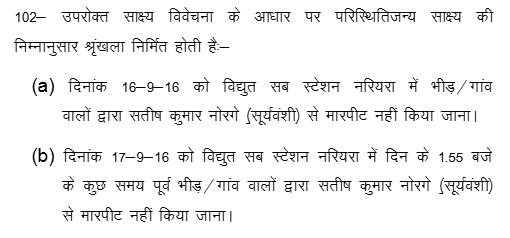
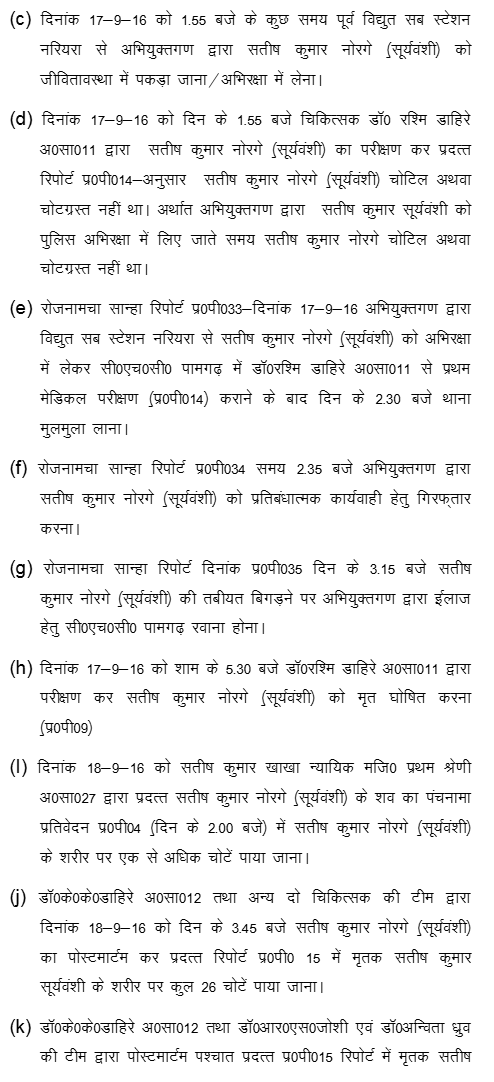
1.1) In this batch of criminal appeals and the acquittal appeal, we are tasked upon to decide legality, validity and correctness of the impugned judgment of conviction and order of sentence dated 26-2- 2019 passed by the Special Judge (Atrocities), District Janjgir-Champa in Special Sessions Trial No.27/2016 convicting and sentencing “Men in Khaki” namely, Jitendra Singh Rajput (A-1) – Sub-Inspector of Police, Sunil Dhruv (A-2) – Police Constable, Dilharan Miri (A-3) – Police Constable & Rajesh Kumar (A-4) – Sainik for custodial death of Satish Norge in police custody at Police Station Mulmula on 17-9-2016 at 5.30 p.m. in violation of the directives issued by their Lordships of the Supreme Court in the matter of D.K. Basu v. State of W.B. , (1997) 1 SCC 416
Conviction and Sentences
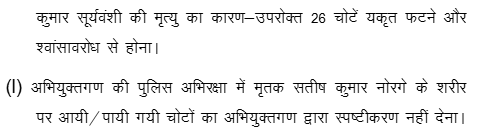
1.2) The trial Court while acquitting appellant Jitendra Singh Rajput (A-1) of the charges under Sections 3(1)(j) & 3(2)(v) of the Scheduled Castes and the Scheduled Tribes (Prevention of Atrocities) Act, 1989 (for short, 1‘the Act of 1989’), convicted all the appellants herein namely, Jitendra Singh Rajput (A-1), Sunil Dhruv (A-2), Dilharan Miri (A-3) & Rajesh Kumar (A-4) under Section 302 read with Section 34 of the IPC and sentenced them to undergo imprisonment for life & pay a fine ofRs.2,000/- each, in default of payment of fine to further undergo additional rigorous imprisonment for one month finding that on 17-9- 2016 at 5.30 p.m. at Police Station Mulmula, in furtherance of their common intention, A-1 to A-4 have assaulted Satish Norge (since deceased) knowing fully well that he is a member of Scheduled Caste by which he suffered 26 injuries over the body and died homicidal death against which these criminal appeals have been preferred by the accused persons (A-1 to A-4) invoking the criminal appellate jurisdiction of this Court under Section 374(2) of the Code of Criminal Procedure, 1973, whereas the acquittal appeal has been preferred by the wife of deceased Satish Norge under Section 372 of the CrPC for convicting the accused persons (A-1 to A-4) under Sections 3(1)(j) & 3(2)(v) of the Act of 1989.
2. Custodial Death
2.1) Custodial death represents the gravest transgression of human dignity and the highest degree of violation of fundamental and human rights. It is not merely a denial of life but an assertion of unlawful state power through violence and torture, executed behind the veil of authority. When the protectors of the law become perpetrators of such cruelty, it signals a systematic breakdown of constitutional values and accountability. In a democratic society governed by the rule of law, such deaths are not just tragic—they are intolerable betrayals of justice. The State, as a constitutional entity, must be held to the highest standards of accountability and moral responsibility.
2.2) In D.K. Basu (supra), their Lordships of the Supreme Court while declaring that the fundamental rights guaranteed under Articles 21 & 22(1) of the Constitution of India required to be jealously and scrupulously protected, held that life or personal liberty in Article 21 includes right to live with human dignity, and observed as under: -
“17. … The expression “life or personal liberty” in Article 21 has been held to include the right to live with human dignity and thus it would also include within itself a guarantee against torture and assault by the State or its functionaries. ...”
2.3) In the matter of Bhagwan Singh and anoth
AI
Custodial death constitutes a severe violation of rights, demanding accountability from police, reaffirming the presumption of police knowledge in such cases for justice.

Prosecution must establish identity and criminal culpability beyond reasonable doubt, especially in custodial death cases, where police accountability is critical.

In custodial death cases, all involved in the torture share liability under Section 34 IPC regardless of direct participation, as joint culpability is established by shared common intention.


Confessions made voluntarily and without pressure under Section 164 of Cr.P.C. are admissible as evidence.


The court reclassified the conviction for culpable homicide not amounting to murder due to lack of intent, emphasizing knowledge of likely death suffices under IPC Section 304 (Part-II).


To establish liability under Section 304-A IPC, a direct causal link between a negligent act and the death must be proven, which was absent as the death was determined to be suicide.



An indispensable Tool for Legal Professionals, Endorsed by Various High Court and Judicial Officers
Please visit our Training & Support
Center or Contact Us for assistance

Scan Me!
India’s Legal research and Law Firm App, Download now!


For Daily Legal Updates, Join us on :



 Back to top


