Back
Back





2025 Supreme(Del) 479
IN THE HIGH COURT OF DELHI AT NEW DELHI
ANIL KSHETARPAL, HARISH VAIDYANATHAN SHANKAR, JJ.
Rajesh Rajpal – Appellant
Versus
Rakesh Rajpal & Ors. - Respondents
FAO(OS) 86/2025, CM APPL. 47237/2025 and CM APPL. 47238/2025
Decided on : 18-08-2025
Advocate Appeared:
For the Appellant : Mr. P.D. Gupta, Sr. Adv. With Mr. Atul Gupta, Adv.
For the Respondent: Mr. Shivam Goel, Ms. Ramya S. Goel and Ms. Sanya Sharma,
Advs. for R-1.
Exclusion of properties in a partition suit requires demonstration of entitlements and cannot disregard valid transfers made via documented relinquishments; any challenge to such must follow proper procedural channels.
Headnote:(A) Delhi High Court Act, 1966 - Sections 10 - Transfer of Property Act, 1882 - Section 52 - Appeal against the interlocutory order concerning property claims in a partition suit - The court upheld the deletion of certain properties from the plaint and ruled that others were not subject to the rigours of Section 52 of the Act - The Appellant argued the propriety of the exclusion of property No.7 and the inapplicability of the said Section - It was found that an application under Order VII Rule 11 of the CPC was not necessary at this stage and that the Appellant failed to substantiate claims regarding fraudulent property transfers. (Paras 1, 8, 14, 18, 20)
(B) Civil Procedure Code, 1908 - Order VI Rule 16 - The court noted the inappropriateness of striking out pleadings without proper application and indicated a need for clarity in legal claims presented. (Paras 10, 12)
Facts of the case:
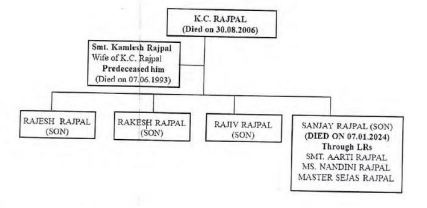
Dispute arose from the estate of the deceased, Mr. K.C. Rajpal, concerning the division of properties among his sons, where the Appellant contested the exclusion of specific properties and the application of Section 52 of the Act in a partition suit initiated by him.
Findings of Court:
The court confirmed that the learned Single Judge’s decision to strike certain properties from the plaint was appropriate, and the Appellant had not sufficiently contested the executed documents.
Issues: Whether property No.7 should have been included in the suit and the applicability of Section 52 of the Act to the disputed properties.
Ratio Decidendi: The court reaffirmed that the rights conferred by the transfer documents remain intact unless appropriately challenged, and an appeal cannot substitute judicial determination of primary issues at preliminary stages.
Result: Appeal dismissed.
JUDGMENT :
ANIL KSHETARPAL, J.
1. Through the present Appeal filed under Section 10 of the DELHI HIGH COURT ACT , 1966, the Appellant assails the correctness of paragraph nos.15 and 36 of an interlocutory order dated 20.05.2025[Hereinafter referred to as ‘Impugned Order’] passed by the learned Single Judge, in CS(OS) 324/2025 captioned Rajesh Rajpal vs. Rakesh Rajpal & Ors., [Hereinafter referred to as ‘the Civil Suit’]. Vide the Impugned Order, the learned Single Judge deleted the property mentioned at S.No.7 of paragraph no.8 of the Plaint from the scope of the Civil Suit. Additionally, it was declared that the properties enlisted in paragraph nos.3 and 5 of the Plaint shall not be governed by rigours of Section 52 of the Transfer of Property Act, 1882, [Hereinafter referred to as ‘the Act’]. The relevant paragraphs of the plaint are reproduced below:
―3. That in addition to the aforesaid properties/share therein, Late Mr. K.C. Rajpal also owned properties, detailed below:-
(i) bearing No.107, Sherawali Market, Sadar Bazar, Delhi and
(ii)bearing No. BG-5, Block-45A, Paschim Vihar, New Delhi-110063 The properties at S.No. (i) & (ii), were purchased in the name of Defendant No.2 and/or the wives of the Defendant Nos.1 & 2, with the consent of the family, though the sale consideration of the properties were being paid by Mr. K.C. Rajpal.
xxxxxxx xxxxxx xxxxx xxxxx
5. That thereafter, all other siblings i.e. the Plaintiff and the Defendant Nos. 2 and 3 acting on the asking & assurance and of the Defendant No.1 being the eldest of the sons of Late Mr. K.C. Rajpal that the entire estate left behind by Mr. K.C. Rajpal shall be distributed equally amongst all the legal heirs at the appropriate stage from time to time executed certain documents effecting the transfer of certain properties. The details of the properties transferred and the documents executed are as under:-
| S. No. | Description of Property | Beneficiary | Details of documents |
| 1. | B-5/44, Paschim Vihar, New Delhi-11063 admeasuring 250.84 Sq mtrs. (approx.) | First floor in favour of Defendant No.2 | Relinquishment Deed dated 25.03.2009 executed by Plaintiff, Defendant No.1 & 3 |
| 2. | 2760, Qutub Road, Sadar Bazar, Delhi – 110006 admeasuring 25.5 Sq Mtrs. (approx.) | Entire 50% of the father in favour of Defendant No.1 | Relinquishment Deed dated 03.03.2008 executed by Plaintiff No.2 & 3 (The other 50% was already owned by the Defendant No.1) |
| 3 | B-5/43, Paschim Vihar, New Delhi-110063 admeasuring 278 Sq Mtrs. (approx.) | Defendant No.1 | Relinquishment Deed dated 25.03.2009 executed by Plaintiff, Defendant No.2 & 3 |
| 4 | B-4/144, Paschim Vihar, New Delhi-110063 admeasuring 309.368 Sq. Mtr. (approx.) | Defendant No.1 | Relinquishment Deed dated 03.07.2007 for 1/3rd share of the father executed by Plaintiff, Defendant No.2 & 3 Gift Deed dated 03.07.2007 by the Plaintiff of 1/3rd share (The remaining 1/3rd was already owned by the Defendant No.1) |
| 5 | 1662-C, Govind Puri, New Delhi – 110019 admeasuring 95 Sq. Yrds. (approx.) | Defendant No.1 | Relinquishment Deed dated 04.07.2008 executed by Plaintiff, Defendant No.2 & 3 |
xxxxxxx xxxxxx xxxxx xxxxx
8. That unfortunately the youngest of the siblings i.e. the Defendant No.3 died on 07.01.2024. It was after his demise that the Plaintiff approached the Defendant No.1 and 2 number of times for the distribution of the estate, as was assured/promised and the execution of the documents to effect the same, considering his own needs as well as the needs of the legal heirs of the deceased Defendant No.3 The properties, the distribution whereof were still to be made amongst the Plaintiff and the Defendant Nos. 2 and 3, after the execution of the afore-detailed documents are as under:-
| S. No. | Description of Property |
| 1. | B-4/56, Paschim Vihar, New Delhi-11063 admeasuring 200 Sq Yards (approx.) |
| 2. | B-5/38, Paschim Vihar, New Delhi — 110063admeasuring 125 Sq Yards (approx.) |
| 3. | 55/4455, Reghar Pura, Karol Bagh, New Delhi – 110005admeasuring 50 Sq Yards (approx.) |
| 4. | Stall No. 52, Ghaffar Market, Karol Bagh, New Delhi -110 |