
 Back
Back





IN THE HIGH COURT OF DELHI AT NEW DELHI
PRATHIBA M. SINGH, MADHU JAIN, JJ.
Mohd. Shadab – Appellant
Versus
The State of NCT of Delhi – Respondent
Crl. Appeal Nos. 1427, 1497, 1499, 1512 of 2025, Crl. M. (Bail) Nos. 2188, 2091, 2193, 2207 of 2025
Decided On : 09-02-2026
| Table of Content |
|---|
| 1. conviction and sentencing overview. (Para 1 , 2) |
| 2. factual background of the incident. (Para 3 , 4 , 5 , 6 , 7 , 8 , 9) |
| 3. appellants denied the charges. (Para 10) |
| 4. arguments regarding medical evidence. (Para 11 , 12 , 13) |
| 5. analysis of injuries and pre-existing conditions. (Para 14 , 15 , 16 , 17 , 18 , 19 , 20) |
| 6. legal standards for culpability and intent. (Para 21 , 22 , 23 , 24 , 25) |
| 7. court findings on grievous hurt. (Para 26 , 27) |
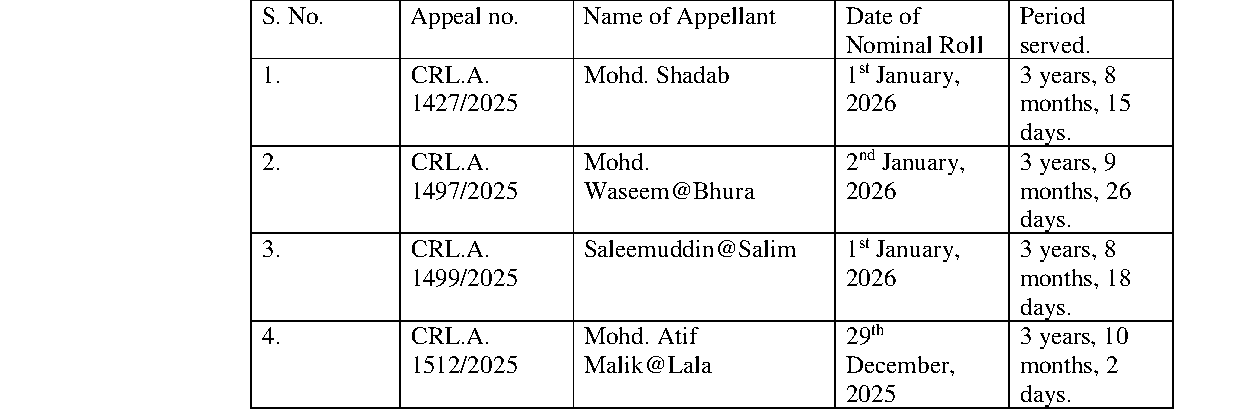
| 8. summary of appellant's incarceration. (Para 28 , 29) |
| 9. modification of conviction and sentencing. (Para 30 , 31) |
| 10. conclusion and direction for release. (Para 32 , 33) |
JUDGMENT :
MADHU JAIN, J.
BACKGROUND
1. Present appeals have been filed on behalf of the Appellants under Section 415 (2) of Bharatiya Nagarik Suraksha Sanhita, 2023 (hereinafter, ‘ BNSS ’) assailing the impugned judgment of conviction and order on sentence dated 6th September, 2025 and 12th September, 2025 respectively, passed by the ld. ASJ (FTC)-02, Central District, Tis Hazari Court, Delhi whereby the Appellants have been convicted in Sessions Case No. 28476/2016 arising out of FIR No. 224/2015 registered at P.S. Darya Ganj under Section 302 read with Section 34 of the Indian Penal Code, 1860 (hereinafter ‘ IPC ’).
2. By the impugned judgment of conviction and order on sentence, the appellants have been sentenced to undergo life imprisonment along with a fine of Rs. 5,000/-. In default of payment of the fine, they have been sentenced to undergo simple imprisonment for a period of two months for the offence punishable under Section 302 read with Section 34 of the IPC .
BRIEF FACTS:
3. Facts giving rise to the present appeals are that on 6th April, 2015, DD No. 2A was received in PS Darya Ganj regarding a quarrel near Turkman Gate, Delhi. On receiving the said information, PW-11 SI Ved Pal, along with PW-22 Ct. Girivar, reached at the spot. An agitated crowd was present there. On inquiry, it was learnt that a motorcycle had touched a car, which led to a quarrel. During the quarrel, the occupants of the car allegedly assaulted the motorcycle rider. The injured had already been taken to LNJP Hospital.
4. Thereafter, I.O. went to LNJP Hospital, where he was informed by Ct. Ajay that the injured had been declared dead by the doctor. The Investigating Officer collected the MLC of the deceased and seized the clothes of the deceased.
5. This led to registration of FIR No. 224/2015 under section 302/34 IPC . The post mortem of the dead body of the deceased was then conducted.
6. Vide order dated 6th July, 2015, a copy of the charge-sheet was supplied to the accused persons under Section 207 Cr.P.C. Vide order dated 20th July, 2015, the case was committed to the Court of Sessions under Section 209 Cr.P.C.
7. The charges were then framed in the matter before the sessions court vide order on charge dated 4th December, 2015 under Section 302 /34 IPC & read with 149 against all the five accused persons to which they pleaded not guilty and claimed trial.
8. During the trial, accused Sheikh Ameenuddin @ Ameenuddin Pehlwan expired, and the proceedings against him stood abated vide order dated 4th May, 2024.
9. The ld. Trial Court has mainly relied on the testimonies of PW-2, PW- 3, PW-4, PW-7 and PW-9, as, according to the prosecution’s case, they are the eyewitnesses to the incident. While believing the testimonies of these witnesses, the ld. Trial Court has discussed them as under:
“3. PW-2 Mohd. Fahad, the son of the deceased, is an alleged eyewitness to the incident. He deposed that on 05.04.2015, he, his younger brother PW-3 Mohd. Kaif, and their father Sh. Shahnawaj (since deceased) were returning to their house from their grandmother’s residence on a motorcycle bearing registration No. DL-1SR-5852. At about 11:30 p.m., when they reached near Turkman Gate, there was a traffic jam. At that time, a silver-grey i-20 car bearing registration No. DL-2CAE-8426 came from the side of Ramleela Ground. While his father was tryi
AI
The absence of intent to kill or knowledge that actions could likely cause death, alongside significant pre-existing health issues of the deceased, led to the alteration of conviction from murder to ....

Conviction for murder requires intent; if harm results from a pre-existing condition, and no intention to kill is proven, a conviction may be adjusted to grievous hurt under IPC.

The court ruled that the lack of intent to kill by the accused requires a conviction adjustment from murder to grievous hurt under Section 325 of the IPC.

Conviction requires reliable evidence and knowledge of victim's medical condition; lacking such knowledge limits liability to lesser offenses.

The court held that when a death occurs from a single blow in the heat of passion during a sudden quarrel, it may be classified under Section 304 IPC instead of Section 302 IPC.

The court ruled that injuries caused were not sufficient to lead to death, thus altering the conviction from culpable homicide to grievous hurt under Section 325 IPC.

The distinction between murder and culpable homicide hinges on intention and circumstances, with the court applying Exception-4 of Section 300 IPC in cases of sudden quarrel.

The court established that culpable homicide can be distinguished from murder based on the presence of intention and premeditation, particularly in cases of sudden provocation.

cCnduct of the appellant, from the evidence led by the prosecution itself, indicates that neither was there any premeditation nor an intention to kill the deceased.



An indispensable Tool for Legal Professionals, Endorsed by Various High Court and Judicial Officers
Please visit our Training & Support
Center or Contact Us for assistance

Scan Me!
India’s Legal research and Law Firm App, Download now!


For Daily Legal Updates, Join us on :



 Back to top


