
 Back
Back





IN THE HIGH COURT OF DELHI AT NEW DELHI
V. KAMESWAR RAO, MANMEET PRITAM SINGH ARORA, JJ.
Union of India and Others – Appellants
Versus
712071 SGT Birendra Kumar Retd. – Respondent
W.P. (C) No. 1224 of 2026, C.M. APPL. No. 5974, 5975 of 2026
Decided On : 29-01-2026
| Table of Content |
|---|
| 1. dismissal of the petition, affirming tribunal's ruling. (Para 1 , 2) |
| 2. details of respondent's disability and claims. (Para 3 , 4 , 5 , 6) |
| 3. legal precedents on entitlement to disability pension. (Para 7 , 10 , 11 , 12) |
| 4. arguments against tribunal's decision. (Para 8 , 9) |
| 5. court's rationale on medical board's opinion. (Para 13 , 14 , 15 , 16 , 17) |
JUDGMENT :
MANMEET PRITAM SINGH ARORA, J.
CM APPL. 5975/2026 (exemption)
1. Exemption is allowed, subject to all just exceptions.
2. The application stands disposed of.
W.P. (C) 1224/2026 & CM APPL. 5974/2026 (Stay)
3. This is a writ petition filed under Article 226 of the Constitution of India against the order dated 02.01.2024 passed by the Armed Forces Tribunal Principal Bench, New Delhi [‘Tribunal’] in Original Application [‘O.A.’] No. 1585/2019 titled asEx SGT Birendra Kumar v. Union of India & Ors., wherein the respondent has been granted the benefit of the disability element of pension for Paranoid Schizophrenia (Old) assessed at 40% for life, rounded off to 50% for life from the date of his discharge from the service i.e., 31.12.2018.
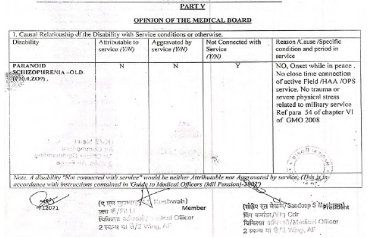
4. The facts giving rise to the present petition are that the respondent was discharged from the service on 31.12.2018 under clause ‘on fulfilling the conditions of his enrolment’. At the time of discharge, the Release Medical Board [‘RMB’] assessed his disability i.e., Paranoid Schizophrenia (Old) at 40% for life. The RMB opined that since the onset of the diseases was at the time when the respondent was serving at a peace station and there was no severe physical stress, the aforesaid disability was neither attributable to nor aggravated [‘NANA’] by the military service.
5. The respondent’s claim of disability pension was rejected by the Petitioner vide letter dated 29.06.2018 relying upon the aforesaid finding of the RMB. The respondent filed the first appeal, which was rejected vide letter dated 13.02.2020.
6. The respondent filed O.A. No. 1585/2019 before the Tribunal for grant of disability element of pension. The respondent claimed that though the RMB records the onset of the disease of Paranoid Schizophrenia was in the year 2010, at a time when the respondent was serving at a peace station in Bengaluru; however, the real onset commenced when the respondent was posted in Bhuj, immediately after the earthquake occurred in the year 2002. The respondent contended that during his service in Bhuj, his duties increased manifold times and no rest was given to him. He further contended that during this time, the respondent had sought leave for taking care of his sister; however, no leave was not granted to him due to service exigencies. He contended that during this time, his sister died due to lack of proper medical treatment. He finally contended that his disease was developed and aggravated due to the reason that he was one after the other, posted to different geographical locations and thus, the same is attributable to or aggravated by Air Force service.
7. By the impugned order, the Tribunal after referring to the judgments of the Supreme Court inDharamvir Singh v. Union of India and Ors. 2013 (7) SCC 361and Union of India v. Ram Avtar , 2014 SCC OnLine SC 1761 granted the relief of disability pension to the respondent.
7.1. The Tribunal at paragraph nos. 17, 20 and 22 has recorded reasons for holding that the onset of the disease may have been triggered during the petitioner’s posting in 2002 at Bhuj, when the area was hit by an earthquake as well as subsequent events, to conclude that the disease is attributable and aggravated by the military service.
8. The only submission made by the learned counsel for the petitioners is that the reliance placed by the Tribunal on the judgment of Dharamvir Singh v. Union of India and Ors. /b>. (supra) is totally misplaced as in the said case the Supreme Court was concerned with the Entitlement Rules for Casualty Pensionary Awards, 1982 [‘Entitlement Rules, 1982’], whereas the case of the responde
AI
The Medical Board's opinion on disability attributability must include cogent reasoning, and the burden to prove a causal link lies with the military, not the claimant.
The burden of proof regarding the attributability of disability to military service lies with the military establishment, not the claimant, under the Entitlement Rules for Casualty Pensionary Awards ....

The burden of proof concerning entitlement to disability pension lies with the military establishment, which must provide cogent reasons for denying claims.



An indispensable Tool for Legal Professionals, Endorsed by Various High Court and Judicial Officers
Please visit our Training & Support
Center or Contact Us for assistance

Scan Me!
India’s Legal research and Law Firm App, Download now!


For Daily Legal Updates, Join us on :



 Back to top


