
 Back
Back





IN THE HIGH COURT OF DELHI AT NEW DELHI
V. KAMESWAR RAO, MANMEET PRITAM SINGH ARORA, JJ.
Union of India and Others – Appellants
Versus
692688 Ex HFL Ram Kumar Retd. – Respondent
W.P. (C) No. 1094 of 2026, C.M. APPL. No. 5335 of 2026
Decided On : 29-01-2026
| Table of Content |
|---|
| 1. writ petition challenging disability pension order. (Para 1 , 2 , 3 , 4) |
| 2. tribunal relied on supreme court precedents. (Para 5) |
| 3. arguments regarding misapplication of rules. (Para 6) |
| 4. court disagrees with petitioners' submission. (Para 7) |
| 5. court cites precedents on onus of proof. (Para 8 , 9) |
| 6. rmb's opinion lacks sufficient reasoning. (Para 10 , 11) |
| 7. rejection of lifestyle disorder argument. (Para 12 , 13 , 14) |
| 8. entitlement to pension affirmed, petition dismissed. (Para 15 , 16 , 17) |
JUDGMENT :
MANMEET PRITAM SINGH ARORA J.
1. This is a writ petition filed under Article 226 of the Constitution of India against the order dated 24.09.2024 passed by the Armed Forces Tribunal Principal Bench, New Delhi [‘Tribunal’] in Original Application [‘O.A.’] No. 3280/2023 titled asEx HFL Ram Kumar v. Union of India & Ors. wherein the respondent has been granted the benefit of the disability element of pension for Primary Hypertension assessed at 30%, rounded off to 50% for life, from the date of his retirement from the service i.e., 31.03.2023.
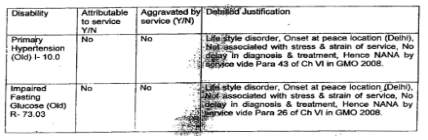
2. The facts giving rise to the present petition are that the respondent was retired from the service on 31.03.2023 under clause ‘on attaining superannuation with permanent low medical category A4G4 (P)’. The Release Medical Board [‘RMB’] held on 24.11.2022 assessed the disabilities i.e., Primary Hypertension (Old) 10.0 at 30% for life and Impaired Fasting Glucose (Old) R-73.03 at 15% for life, compositely assessed at 40.5% for life. The RMB opined that since the onset of the disease was at the time when the respondent was serving at the peace station i.e., AFCAO, New Delhi and was due to the lifestyle disorder, the aforesaid disabilities were neither attributable to nor aggravated [‘NANA’] by the military service.
3. The respondent’s claim of disability pension was rejected by the petitioner vide letter dated 26.07.2023, as the disability was held to be NANA. The respondent’s first appeal challenging the said rejection was rejected.
4. In these facts, the respondent filed O.A. No. 3280/2023 before the Tribunal for the grant of disability element of pension. It is pertinent to note that in the proceedings before the Tribunal, the respondent claimed for disability element of pension qua one ailment, i.e., Primary Hypertension (Old) 10.0 and gave up his claim for the other ailment.
5. By the impugned order, the Tribunal after referring to the judgments of the Supreme Court inDharamvir Singh v. Union of India and Ors. /b>. 2013 (7) SCC 361 and Union of India v. Ram Avtar , 2014 SCC OnLine SC 1761 granted the relief of disability pension to the respondent.
6. The only submission made by the learned counsel for the petitioners is that the reliance placed by the Tribunal on the judgment of Dharamvir Singh v. Union of India and Ors. /b>. (supra) is totally misplaced as in the said case the Supreme Court was concerned with the Entitlement Rules for Casualty Pensionary Awards, 1982 [‘Entitlement Rules, 1982’], whereas the case of the respondent needs to be considered under the Entitlement Rules for Casualty Pensionary Awards to Armed Forces Personnel, 2008 [‘Entitlement Rules, 2008’].
6.1. He contends that the Tribunal has overlooked the Entitlement Rules, 2008, which govern attributability and aggravation and no longer permit a blanket presumption in favour of the claimant/officer; and since the RMB has opined the disease to be NANA, the Tribunal could not have presumed a causal connection between the disease and the service. He states in the facts of this case, respondent was retired on 31.03.2023 and therefore, the respondent would be governed by Entitlement Rules, 2008. He states that the impugned order incorrectly applies the presumption under the repealed Entitlement Rules, 1982, ignoring the amended regime under Entitlement Rules, 2008. He states that the Entitlement Rules, 2008, have done away with the general presumption to be drawn to ascertain the principle of ‘attributable to or ag
AI
The burden of proof concerning entitlement to disability pension lies with the military establishment, which must provide cogent reasons for denying claims.

The burden of proof regarding the attributability of disability to military service lies with the military establishment, not the claimant, under the Entitlement Rules for Casualty Pensionary Awards ....

The Medical Board's opinion on disability attributability must include cogent reasoning, and the burden to prove a causal link lies with the military, not the claimant.



An indispensable Tool for Legal Professionals, Endorsed by Various High Court and Judicial Officers
Please visit our Training & Support
Center or Contact Us for assistance

Scan Me!
India’s Legal research and Law Firm App, Download now!


For Daily Legal Updates, Join us on :



 Back to top


