
 Back
Back





IN THE GAUHATI HIGH COURT, (THE HIGH COURT OF ASSAM, NAGALAND, MIZORAM AND ARUNACHAL PRADESH), KOHIMA BENCH
ROBIN PHUKAN, J.
Marsanen Ozukum, S/o. Late Toshimanen Ozukum – Petitioner
Versus
The State of Nagaland, Represented by the Commissioner & Secretary, Department of Urban Development – Respondent
WP(C) No. 241 of 2022
Decided On : 06-04-2026
| Table of Content |
|---|
| 1. procedural background and factual origin of the eviction dispute. (Para 1 , 2 , 3) |
| 2. parties' conflicting contentions regarding land ownership and unauthorized occupation. (Para 4 , 5 , 6 , 7) |
| 3. evidentiary analysis of unregistered sale deeds and prior admissions of occupation. (Para 8 , 9 , 10 , 11 , 12 , 13 , 14 , 15) |
| 4. scope of judicial review in administrative decisions under article 226. (Para 16 , 17 , 18 , 19 , 20) |
| 5. dismissal of petition due to failure to approach court with clean hands. (Para 21 , 22) |
JUDGMENT :
ROBIN PHUKAN, J.
Heard Mr. L. Iralu, learned counsel for the petitioners and also heard Mr. I. Imsong, learned Additional Advocate General, Govt. of Nagaland, appearing for the State respondents.
2. In this petition, under Article 226 of the Constitution of India, the petitioners have challenged two Eviction Notices, dated 17.03.2021 (Annexure-P6) and dated 19.10.2022 (Annexure-P21) also the order dated 08.07.2022 (Annexure-P20). Alternatively, the petitioners also prayed for issuing direction to the respondent Nos.4 and 5, to conduct proper survey and verification as directed by the respondent No.3, in the order dated 08.07.2022.
3. The background facts leading to filing of the present petition are briefly stated as under:-
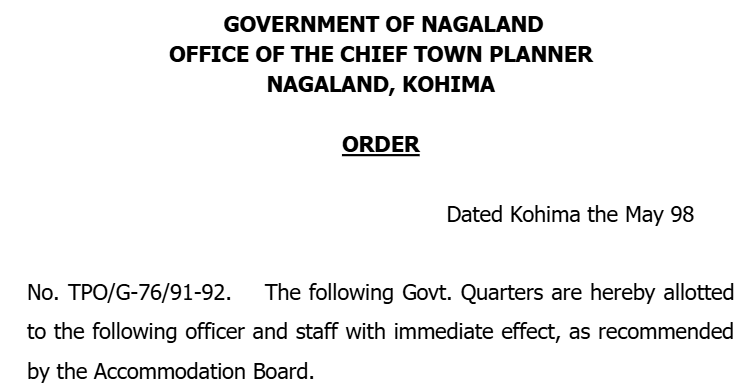
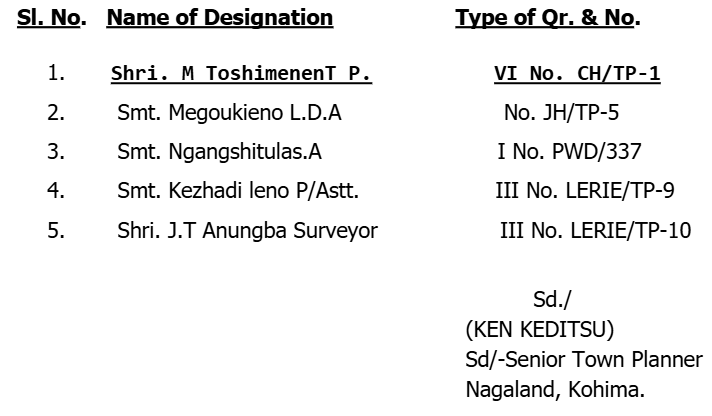
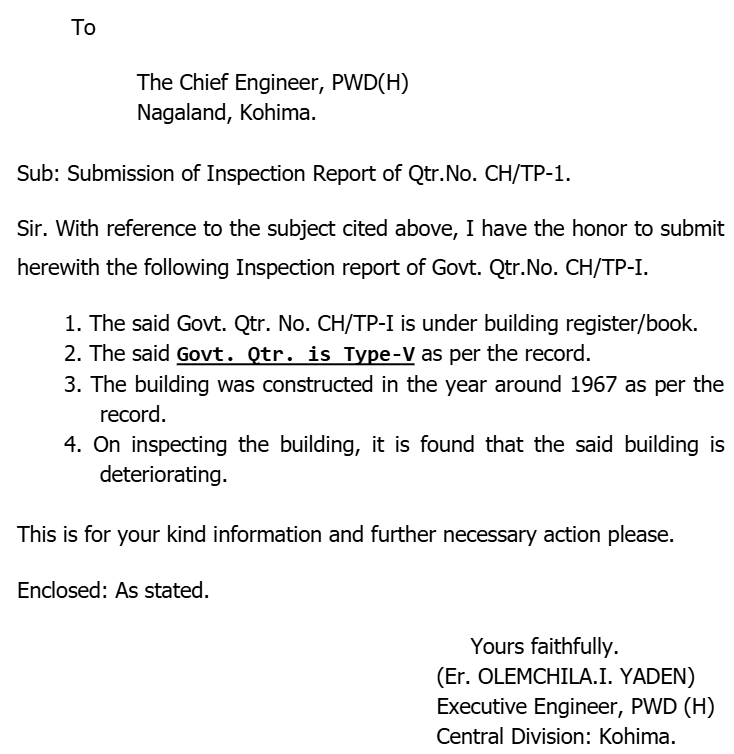
“The present petitioners are the legal representatives of the deceased employee, namely, Late Toshimanen Ozukum. While the predecessor of the present petitioners, namely, Late Toshimanen Ozukum was serving as the Town Planner, under the erstwhile Office of the Chief Town Planner, had purchased two plots of land in the year 1998 located on the opposite side of a building at Lower Chandmari, Kohima. Later on, he was told that the building was a quarter belonging to the Town Planning Department, now re-designate as Urban Development Department. As such, the predecessor of the petitioners had occupied the quarter on the basis of an allotment order. The said quarter was identified as Quarter No.CH/TP-1. There was no electricity or water supply connection in the said quarter and the predecessor of the present petitioners, had at his own expense, connected both power as well as water supply, to the said quarter and also he had renovated and refurbished the said quarter at his own expense and constructed brick fencing wall, around the entire premises and also constructed RCC porch and RCC room adjoining the quarter and paid the electricity and water bills himself.
Thereafter, he retired on superannuation and after his retirement he received a show-cause notice under Section 5 of the Nagaland Eviction of Persons in Unauthorized Occupation of Public Land Act, 1971, asking him to show-cause as to why he should not be evicted for illegally occupying the quarter belonging to the Directorate of Urban Development, Nagaland, Kohima.The predecessor of the present petitioners then submitted his reply on 30.09.2020, stating that he had purchased the land from the ancestral landowners as there was no record of the Government acquiring the land and thereafter, an eviction notice was issued to him on 17.03.2021, without any material particulars to show how he was in unauthorized occupation of public land.
Thereafter, the predecessor of the present petitioners and the landowner had submitted RTI applications to the concerned authorities on 26.03.2021. And while they were awaiting for the RTI replies, the predecessor of the present petitioners filed an appeal against the eviction notice under Section 12 of the Act. Then, during the pendency of the appeal, the petitioner as well as the landowner had received the replies on the RTI queries and in the said replies it was disclosed that the respondent No.2 i.e. the Directorate of Urban Development, had categorically stated that there was no such quarter as CH/TP-1 in their building inventory list. The Deputy Commissioner, Kohima had also replied to one of the queries stating that there was no land allotment or patta issued to the Urban Development Departme

AI

Eviction of occupants from government quarters requires adherence to due process and respect for constitutional rights, as per Articles 14 and 21.

The main legal point established in the judgment is that the dispute between the petitioners' claim as landholders and the claim of unauthorized occupation by the Estate Officer should be decided by ....

The judgment emphasizes the importance of adhering to principles of natural justice and providing a reasonable opportunity for the parties to present their case.

The Court ruled that public authorities must provide reasons for their decisions, and failure to do so violates Article 14 of the Constitution.


The court ruled that eviction orders should be reconsidered after trial to avoid multiplicity of proceedings, emphasizing the need for clarity on property ownership.




An indispensable Tool for Legal Professionals, Endorsed by Various High Court and Judicial Officers
Please visit our Training & Support
Center or Contact Us for assistance

Scan Me!
India’s Legal research and Law Firm App, Download now!


For Daily Legal Updates, Join us on :



 Back to top


