
 Back
Back





IN THE HIGH COURT OF KERALA AT ERNAKULAM
Easwaran S., J.
N.P.Rajani and ors. – Petitioners
Versus
Radha Nambidi Parambath And Ors. – Respondents
RSA No. 436 of 2018
Decided On : 07-07-2025
(A) Hindu Succession Act, 1956 - Section 6 - Hindu Succession (Amendment) Act, 2005 - Kerala Joint Family System (Abolition) Act, 1975 - The court addressed the conflict between the Kerala Act and the Central Act regarding daughters' rights to inheritance. The Kerala Act denies rights by birth, while the Central Act affirms them. The court found that the Kerala Act is repugnant to the Central Act, declaring that daughters are entitled to equal shares in ancestral property post the 2005 amendment. (Paras 3 - 4 , 16, 61)
(B) Repugnancy - Article 254(1) of the Constitution - The court ruled that the provisions of the Kerala Act conflict with the Central Act, leading to the latter's supremacy in matters of inheritance rights for daughters. (Paras 37 - 52 )
(C) Judicial Evaluation - The court emphasized the importance of recognizing daughters as coparceners by birth, aligning with the Supreme Court's ruling in Vineeta Sharma v. Rakesh Sharma. (Paras 34 - 36 )
(D)
Result: Appeals allowed, and a preliminary decree for partition was ordered, granting equal shares to the plaintiffs.
Based on the provided legal document, the key points are as follows:
The conflict between the Kerala Joint Family System (Abolition) Act, 1975, and the Hindu Succession (Amendment) Act, 2005, is central to the case. The court found that the Kerala Act conflicts with the Central Act and is therefore inapplicable in the context of inheritance rights for daughters, affirming that daughters are entitled to equal shares in ancestral property following the 2005 amendment (!) (!) .
The court clarified that the Kerala Act does not abolish the joint family system outright but recognizes a deemed partition among members, transforming joint tenancy into tenancy-in-common, which effectively alters the nature of the family property (!) (!) .
The amendments introduced by the Hindu Succession (Amendment) Act, 2005, grant daughters the same rights as sons in coparcenary property by birth, including rights to partition and disposal of property, with the rights accruing from the date of the amendment, i.e., 9th September 2005 (!) (!) .
The court emphasized that the law recognizes a daughter’s right by birth to coparcenary interest, regardless of whether her father or other coparceners are alive on the date of the amendment, thereby affirming her status as a coparcener (!) .
The concept of a single coparcener does not negate the existence of a joint family or coparcenary; rather, even if the family is reduced to a single coparcener temporarily, the property remains joint property unless explicitly partitioned through a registered deed or decree (!) (!) (!) .
The court held that the provisions of the State Act and the Central Act are in direct conflict, with the latter taking precedence due to the doctrine of repugnancy under constitutional law, especially when the State Act does not receive the necessary presidential assent for amendments aligning with the Central law (!) (!) (!) .
The court reaffirmed that the law declared by the Supreme Court regarding the rights of daughters as coparceners is retrospective and applies to cases where the rights accrued after the amendment date, reinforcing gender equality in inheritance rights (!) .
The court concluded that the amendments to the Hindu Succession Act, 2005, occupy the entire field of succession and joint family law, rendering the State’s earlier enactments in conflict null and void to the extent of inconsistency (!) (!) .
As a result, the court reversed previous decisions that held the joint family system was abolished in Kerala, affirming that the joint family system still exists but with altered rights and obligations, especially concerning inheritance and partition (!) (!) .
The ultimate decision grants the plaintiffs an equal share in the ancestral property, ordering a partition by metes and bounds, and clarifies that the rights of daughters as coparceners are recognized from the date of the 2005 amendment, with the possibility of applying for a final decree (!) (!) .
The court acknowledged the valuable assistance of legal counsel and emphasized that the legal reasoning was well-founded and aligned with constitutional principles, ensuring clarity in the resolution of complex issues related to family law and inheritance rights (!) .
These points collectively highlight the court’s reasoning and the legal principles applied in resolving the conflict between state and central legislation regarding inheritance rights and the status of the joint family system in Kerala.
JUDGMENT :
Easwaran S., J.
“In a daughter, the goddess of prosperity resides always. She is established in her always. A daughter is glorious, endowed with all that is good, to be honoured at the beginning of every good work.”
This verse underscores the revered status of daughters in ancient Indian society, likening them to Lakshmi, the goddess of wealth and prosperity.
The ‘Skanda purana’ Chapter 23 Verse 46 -depicts the importance of a daughter in our society.
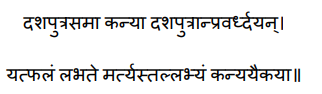
Meaning thereby, ‘One daughter is equal to ten sons. Whatever phala (merits, good results) a person attains by siring and upbringing ten sons, the same phala is attained by begetting a single daughter’.
The statement, however, does not always stand as a true reflection of a daughter’s right when it comes to the right of inheritance to her father’s property. In the ancient customary law like “Mitakshara Law” daughters are not entitled to any right by birth on the ancestorial property. When the Hindu Succession Act, 1956 was enacted, the position was the same. However, the law underwent a radical change when the Parliament enacted the Hindu Succession (Amendment) Act, 2005 . However, in State of Kerala, we are faced with a peculiar situation wherein the Kerala Joint Family System (Abolition) Act, 1975 stands in the way of a daughter claiming the benefit of Hindu Succession (Amendment) Act, 2005 . This Court is called upon to pronounce its views on certain intricate questions including the question of repugnancy of Kerala Joint family System(Abolition) Act 1975 qua the Hindu Succession (Amendment) Act 2005
Facts of the case
The plaintiffs in OS No.231 of 2009 on the files of the Third Addl. Sub Court, Kozhikode, a suit for partition, against the concurrent non-suit by the trial court, have come up before this Court raising the questions of substantial importance. The plaintiffs and defendant No.3 are siblings born out of the wedlock of defendants 1 and 2. The plaint schedule properties originally belonged to one Nambidi Parambath Tharawad by a registered deed. The properties of the Tarvad were partitioned among its then members, including the 1st defendant. The plaint schedule properties with certain other items were allotted to the 1st defendant and on behalf of his branch. The 2nd defendant being his wife has no right over the plaint schedule properties, except maintenance. It is contended that after the Hindu Succession (Amendment) Act, 2005 , the plaintiffs being the daughters of the deceased 1st defendant are also entitled to equal share in the plaint schedule property. Though the 1st defendant had executed a Will, he does not have a right to bequeath the properties in favour of the 3rd defendant Son. Thus, the Will is valid only to the extent of the share, the 1st defendant inherited over the property which was allotted to him as per the registered partition deed.
2. The defendants entered appearance and contested the case. The 1st defendant, who was alive at the time of filing of the suit, stated that he was in sound mind and the Will which was in question was executed by him. It was further contended that since the plaintiffs were married away by spending his own money, they are not entitled for partition. The 3rd defendant supported the1st defendant. On behalf of the plaintiffs, Exts.A1 to A3 were marked and PW1 was examined and on behalf of the defendants, Exts.B1 to B19 were marked and DW1 and DW2 were examined. Based on the rival contentions, the following issues were framed by the trial court:
“1. Whether plaint schedule properties are co-ownership properties available for partition?
2. Whether plaintiffs have got any form of right over plaint schedule property?
3. Whether plaintiffs’ right if any is lost by adverse possession and ouster?
4. Whether plaintiffs have got any cause of action?
5. Whether plaintiffs are entitled to the reliefs sought?
6. Reliefs and costs?”
3. The trial court, on appreciation of the oral and documentary evidence, found that the Will is genuine an


The main legal point established in the judgment is the binding effect of the settlement between the parties, the waiver of the right to seek re-employment by the workmen, and the entitlement of the ....

A lockout is justified if it is declared in response to an illegal strike or a strike that is in breach of a settlement or award.

The combination of eyewitness testimonies, recovery of the weapon used, and forensic examination results can establish guilt in criminal cases, even based on circumstantial evidence.


The conviction of an accused person under Section 27(3) of the Arms Act is not permissible in law if the accused is also charged with committing murder under Section 302 of the Indian Penal Code.

The court can enhance compensation based on the deceased's income and family dependency, and adjust the multiplier used by the Tribunal if found unjustified.



An indispensable Tool for Legal Professionals, Endorsed by Various High Court and Judicial Officers
Please visit our Training & Support
Center or Contact Us for assistance

Scan Me!
India’s Legal research and Law Firm App, Download now!


For Daily Legal Updates, Join us on :



 Back to top


