
 Back
Back





IN THE HIGH COURT OF KERALA AT ERNAKULAM
C.S. SUDHA, J
Manager, National Insurance Company Limited – Appellant
Versus
Rajan K.K. S/o Kunjan – Respondent
| Table of Content |
|---|
| 1. introduction of appeal and background of accident. (Para 1 , 2) |
| 2. identification of parties and their stances in the case. (Para 3) |
| 3. claimants' perspective on negligence and evidence. (Para 4 , 5) |
| 4. court's analysis of evidence and negligence. (Para 6 , 9 , 10) |
| 5. discussion on the admissibility and reliability of documents. (Para 11 , 12 , 13) |
| 6. conclusion and final decision regarding negligence claims. (Para 14) |
JUDGMENT :
C.S. SUDHA, J.
1. This appeal under Section 173 of the Motor Vehicles Act, 1988 (the Act) has been filed by the third respondent/insurer in O.P. (MV) No.919/2016 on the file of the Motor Accidents Claims Tribunal, Ernakulam (the Tribunal), aggrieved by the Award dated 14/11/2018. The respondents herein are the claim petitioners and respondents 1 & 2 respectively in the petition. Cross Objection No.40 of 2021 has been filed by the claim petitioners. In this appeal and the cross objection, the parties and the documents will be referred to as described in the original petition.
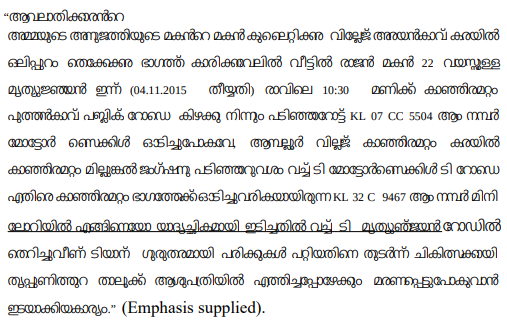
2. The claim petitioners are the parents and sister of the deceased. According to the claim petitioners on 04/11/2015 at about 10:30 a.m., while the deceased was riding motor
Establishing negligence in motor vehicle accidents requires clear evidence; the burden shifts to opposing parties when a police charge sheet is produced.
Negligence in vehicle accidents is established primarily by police charge sheets unless effectively rebutted by credible evidence suggesting otherwise.
Once a charge-sheet is filed, it is not justifiable for the Tribunal to find negligence contrary to the findings in the charge-sheet merely because of some material in the scene mahazar

Accident claim – Proof - Negligence on the part of the driver or rider, and person alleged to have sustained injuries in a motor accident died in consequence of the accidental injuries to be proved.

In civil proceedings under the Motor Vehicles Act, the standard of proof is based on the preponderance of probability, and claimants are not required to prove the accident beyond reasonable doubt. Th....
The court upheld the Tribunal's finding that the claimant's own negligence caused the accident, affirming the dismissal of the compensation claim.
The court established that negligence must be evaluated based on the preponderance of probabilities, upholding claims when sufficient evidence supports the victim's account.

The standard of proof in motor accident claim cases is one of the preponderance of probabilities rather than principles beyond a reasonable doubt.

The evidence presented before the Tribunal should be given more weight than the contents of the First Information Report, and the deposition of a party who did not file a counter cannot be relied upo....

In claims under Section 166 of the Motor Vehicles Act, the burden of proof lies on the claimant to establish negligence, which must be supported by cogent evidence.



An indispensable Tool for Legal Professionals, Endorsed by Various High Court and Judicial Officers
Please visit our Training & Support
Center or Contact Us for assistance

Scan Me!
India’s Legal research and Law Firm App, Download now!


For Daily Legal Updates, Join us on :

 Back to top


