
 Back
Back





IN THE HIGH COURT OF KERALA AT ERNAKULAM
EASWARAN S., J.
Varghese C. Philip Kutty, S/o. Varghese Chalakuzhy Malickal – Appellant
Versus
C. Varghese Mathai and Ors. – Respondents
R.S.A No.900 of 2013
Decided On : 12-06-2025
| Table of Content |
|---|
| 1. background of the property dispute between brothers over a will. (Para 2 , 3) |
| 2. court's examination of the evidentiary issues surrounding the will. (Para 4 , 6) |
| 3. legal validation of will execution and implications of remarriage for succession. (Para 22 , 26) |
| 4. order for appeal resolution in favor of will validity. (Para 29) |
JUDGMENT :
EASWARAN S., J.
The 1st defendant in O.S No.793 of 1998 on the the Munsiff Court, Thiruvalla is the appellant herein.
2. The facts in brief for the disposal of the appeal are as follows:-
The plaintiff and the 1st defendant are brothers and children of Sri.Mathew Varghese and Smt.Annamma. Mathew Varghese and his wife Annamma jointly possessed certain extent of land as per Ext.A2 document dated 07.09.1959. Annamma died on 23.02.1973. Subsequently, Mathew Varghese executed Ext.B1 deed dated 10.11.1997 bequeathing his 1/2 share over the properties held by him under Ext.A2 and 1/3 share over 1/2 share of Annamma. Later, Mathew Varghese remarried on 13.02.1992. The plaintiff was also allotted separate share over the property of Mathew Varghese covered by Ext.A2 in the Will dated 10.11.1997. However, claiming that Mathew Varghese could not bequeath 1/3rd of the share held by him over 1/2 share of Annamma, the plaintiff filed OS No.793 of 1998 seeking partition of 1/14 share over the entire extent of property held by the mother Annamma. According to the plaintiff, Mathew Varghese executed the Will dated 10.11.1997 and the bequeath in favour of the 1st defendant over the 1/3rd share held by him consequent to the death of Annamma is legally invalid. The 1st defendant entered appearance and contested the case, whereas the other defendants remained ex-parte. The defendant contended that Mathew Varghese was perfectly entitled to bequeath the 1/3rd share held by him over the 1/2 share of Annamma over the properties comprised in Ext.A2. In support of their contention, relied on the provisions of the Indian Succession Act, 1925 (for short, ‘the Act’), and further contended that, going by the provisions, there is no divestation of the right of a widow or widower, if they remarry. Based on the oral and documentary evidence, the trial court framed the following issues for consideration:-
“1. Is the plaint schedule property partitionable?
2. Is the suit bad for partial partition?
3. Is the plaintiff entitled for injunction sought?
4. Relief and cost.”
3. The trial court basically went out to test the validity and genuineness of Ext.B1 Will and found that the 1st defendant was unable to clear the suspicious circumstances around the execution of Ext.B1 Will. The prime reason given by the trial court for disbelieving Ext.B1 Will was that, the scribe was examined as an attesting witness, which is impermissible under law and that there is no indication as regards the presence of the scribe as an attesting witness in the body of the Will. Accordingly, ignoring the admission of the plaintiff, the trial court held that the entire property of Mathew Varghese and Annamma opens up for succession and accordingly, allowed the suit and passed a decree directing the plaint schedule property to be partitioned by metes and bounds and further declaring that the plaintiff is entitled to 1/7 share in the plaint schedule property. Though the 1st defendant preferred an appeal, it was unsuccessful and by judgment dated 12.04.2013, the appeal was dismissed by the sub court, Thiruvalla. Against that judgment, the present appeal is preferred.
4. While admitting the appeal, this Court framed the following question of law:-
“a) When there is unchallenged the evidence tendered by DW3 that he put his signature in Ext.B1 Will witnessing the execution by the testator as an attesting witness as well as the scribe, are the courts below proper in discarding the evidence and hold that the Will is invalid?
b) Are not the courts below committed illegality in not following the judgment of the Supreme Court reported in Mathew Oommen Vs.Suseela Mat
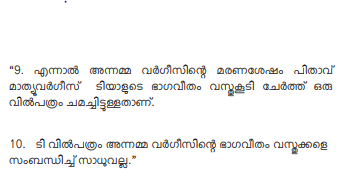
A scribe can be an attesting witness for a Will, and a remarriage does not revoke established rights of intestate succession.

The burden of proof for the execution of a Will lies with the propounder, who must establish compliance with statutory requirements, including the testimony of attesting witnesses.
The burden to prove the validity of a Will lies with the propounder, and failure to meet statutory requirements results in its invalidation.

Single attesting witness's testimony proving both attestations suffices for Will proof under Sections 63(c), Succession Act and 68, Evidence Act.
The appellant successfully argued that a will can be validly proved by examining at least one attesting witness under the Indian Succession Act and Evidence Act.


The main legal point established in the judgment is that the proof of execution of a registered Will requires the examination of attesting witnesses in court or their summoning under Order 16 Rule 10....

The propounder of a Will must prove its execution and attestation in accordance with law, and any suspicious circumstances surrounding the Will must be dispelled for it to be considered valid.



An indispensable Tool for Legal Professionals, Endorsed by Various High Court and Judicial Officers
Please visit our Training & Support
Center or Contact Us for assistance

Scan Me!
India’s Legal research and Law Firm App, Download now!


For Daily Legal Updates, Join us on :



 Back to top


