


 Back
Back





2025 Supreme(Ker) 2548
IN THE HIGH COURT OF KERALA AT ERNAKULAM
JOHNSON JOHN, J.
O.Gangadharan, S/o. Kelappan – Appellant
Versus
T.Sajith Kumar, S/o. Gangadharan – Respondent
Crl.A No. 1828 of 2008
Decided on : 26-08-2025
For the Appellant : ADV SHRI.SUNNY MATHEW
For the Respondent: ADV SHRI.P.V.ANOOP, SRI. HASNAMOL N.S., PUBLIC PROSECUTOR
Service of statutory notice under Section 138 of the Negotiable Instruments Act is crucial, and failure to prove proper service results in the acquittal of the accused.
Headnote:(A) Negotiable Instruments Act, 1881 - Section 138 - Acquittal of accused in a case of dishonoured cheque - Complainant alleged that accused borrowed Rs.1,50,000/- and issued a cheque that was dishonoured due to insufficient funds. Trial court found insufficient evidence to establish guilt, noting deficiencies in statutory notice service and obligation to rebut presumptions. (Paras 2, 4, 10, 18)
(B) Presumptions under N.I Act - The court reiterated the rebuttable presumption under Section 139, emphasizing that the burden of proof lies on the accused to establish a probable defense. It distinguished the differences in service of statutory notice and the necessity for the complainant to prove financial capacity when challenged. (Paras 13, 14)
Facts of the case:
The appellant complained that the accused borrowed money and issued a cheque that bounced. The trial court acquitted the accused due to lack of proof regarding service of notice and the execution of the cheque.
Findings of Court:
The trial court acquitted the accused, having found the evidence unreliable and insufficient to establish the case.
Issues: The key issues included the proper service of statutory notice and whether the presumption of liability under Section 138 was effectively rebutted.
Ratio Decidendi: The court upheld the trial court's findings, emphasizing that the burden to rebut the presumption rests on the accused and reiterating the need for clear evidence of notice service.
Result: Appeal dismissed.
JUDGMENT :
JOHNSON JOHN, J.
This appeal by the complainant is against the acquittal of the accused under Section 138 of the Negotiable Instruments Act, 1881 (‘N.I Act’ for short).
2. The allegation in the complaint is that the accused borrowed Rs.1,50,000/- from the complainant during April, 2002 and towards discharge of the said liability, he issued cheque dated 25.7.2002 for Rs.1,50,000/-. Subsequently, when the complainant presented the cheque for collection, the same was dishonoured due to insufficiency of funds in the account of the accused and in spite of issuance of statutory notice, the accused failed to pay the cheque amount to the complainant.
3. Before the trial court, from the side of the complainant, PWs 1 and 2 were examined and Exhibits P1 to P5 were marked and from the side of the accused, DW1 examined and Exhibit D1 marked.
4. After considering the oral and documentary evidence on record and hearing both sides, the trial court found that the complainant has not succeeded in proving the offence under Section 138 of the N.I Act against the accused and hence, the accused was acquitted.
5. Heard Smt. Bhavana K.K., the learned counsel representing the learned counsel for the appellant on record, Sri. P.V. Anoop, the learned counsel representing the learned counsel for the 1st respondent/accused on record and Smt. Hasnamol N.S., the learned Public Prosecutor appearing for the second respondent.
6. The learned counsel for the appellant argued that the trial court ought to have found that the accused has not rebutted the statutory presumptions in favour of the complainant. It is argued that the finding of the trial court that there is no proper service of statutory notice as contemplated under Section 138 (b) of the N.I Act is not legally sustainable.
7. But, the learned counsel for the accused/first respondent argued that the complainant has not disclosed the date of execution and issuance of the cheque in the complaint or in the chief affidavit of PW1 and that the evidence of DW1 and Exhibit D1 agreement would clearly show that Exhibit P1 cheque bearing No.2599 was one among the cheques entrusted by the accused as security in connection with Exhibit D1 transaction to one Manoharan on 10.06.1999. It is also argued that the specific case of the accused is that he has not received statutory notice or any intimation and that during the relevant period, he was not residing at the address in Exhibit P4 notice.
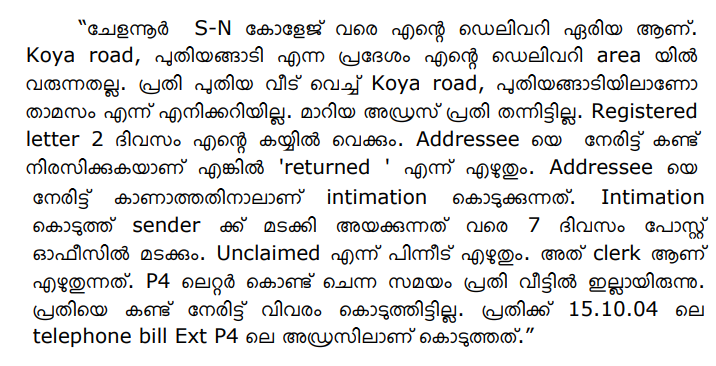
8. The evidence of PW1 in cross examination shows that the accused is residing on the side of Koya road at Puthiyangadi. In Exhibit P4 notice, the address of the accused is shown as Thiruvoth Gayathri, P.O. Chelannur, Kozhikode. Even though, PW2, postman, deposed in chief examination that he informed the accused about the notice, he admitted in cross examination that he has not given any direct intimation to the accused regarding the notice. In cross examination, PW2 deposed as follows:
9. In C. C. Alavi Haji v. Palapetty Muhammed and Another [2007 (2) KHC 932], a three member Bench of the Honourable Supreme Court held that giving notice to the drawer before filing a complaint under Section 138 of the N.I Act is a mandatory requirement and if the accused is able to prove that the notice was not received by him and he has no knowledge about such notice, there is a violation of the provision. In the said decision, it was also observed that in a case where the notice is returned with the endorsement that the premises has always been found locked or the addressee was not available at the time of postal delivery, it will be open to the complainant to prove at the trial by evidence that the endorsement is not correct and that the addressee, namely the drawer of the cheque, with knowledge of the notice had deliberately avoided to receive notice. The Honourable Apex Court also held that the question as to whether the service of notice has been fraudulently refused by unscrupulous means is a question of fact to be decided on the basi














