
 Back
Back





IN THE HIGH COURT OF KERALA AT ERNAKULAM
Gopinath P., J.
Manoj - Appellant
Versus
State Of Kerala, Represented By Public Prosecutor – Respondent
CRL.A NO. 1938 OF 2024
Decided On : 18-08-2025
JUDGMENT :
Gopinath P., J.
This appeal has been filed challenging the conviction and sentence imposed on the appellant in S.C.No.184/2021 on the file of the Fast Track Special Court, Mattannur.
2. S.C.No.184/2021 arises out of Crime No.20/2020 of Kolavallur Police Station, Kannur district, which was registered alleging commission of offence under Section 376(2)(l) of the Indian Penal Code , 1860 (hereinafter referred to as ‘the IPC’), on the allegation that, on 24.12.2019, between 9 PM and 10 PM, the appellant/accused committed rape on PW1, a deaf and dumb lady, in the courtyard on the eastern side of the house of CW13, bearing No. TP V1/2017 at Poyiloor in Thrippangottur Amsom. On the final report being filed, the Chief Judicial Magistrate, Thalassery took the matter on file as CP 09 of 2020. After compliance with all formalities, the matter was committed to the Sessions Court, where charges were framed for the offence punishable under Section 376(2)(l) of the IPC.
3. It is the case of the prosecution that a few days after the alleged incident, PW2 (niece of PW1) found PW1 in a sad and sorrowful mood, and on enquiry, PW1 divulged the case of sexual assault and rape committed by the appellant/accused, and thereafter, based on the information given by PW2, the FIR was lodged at the Kolavallur Police Station, Kannur district. The prosecution examined PWs 1 to 10 and marked Exts. P1 to P8 documents. On closure of prosecution evidence, the appellant/accused was questioned under Section 313 of the Code of Criminal Procedure (hereinafter referred to as ‘the Cr.P.C.’). Thereafter, both sides were heard under Section 232 Cr.P.C and on finding no reason to acquit the accused at that stage, the defence was called upon to adduce evidence, if any. On the side of the defence, DW1 was examined primarily to show that there was previous enmity between the family of the victim and the family of the appellant/accused and that the victim was continuously following the accused, asking him to marry her.
4. On consideration of the materials and the deposition of the witnesses, the trial court concluded that the prosecution had succeeded in proving that the appellant/accused had committed the offence punishable under Section 376(2)(l) of the IPC and convicted him for the said offence. After hearing the appellant/accused on the question of sentence, the trial court sentenced the appellant/accused to undergo rigorous imprisonment for 10 years and to pay a fine of Rs. 75,000/- and in default to undergo rigorous imprisonment for a further period of 3 months for the offence punishable under Section 376(2)(l) of the IPC.
5. Sri. Vishnuprasad Nair, the learned counsel for the appellant, contends that the appeal has to be allowed on a short point. He submits that this is a case where the victim was a deaf and dumb person. It is submitted that, going by the mandate of the provisions contained in Section 164 the Cr.P.C (as amended by Act 13/2013 with effect from 03.02.2013), the statement of the victim recorded under Section 164 Cr.P.C. was treated as the examination- in-chief. It is submitted that the statement of the victim recorded under Section 164 Cr.P.C. indicates that the victim was unable to answer even the basic questions, such as the name of her father, the name of her house, etc. It is submitted that the statement of the victim recorded under Section 164 Cr.P.C. also indicates that though the services of an interpreter were available, the interpreter was not able to decipher what the victim was saying, and the Court then proceeded to record the statement of the victim by seeking the help of PW2, who was none other than the first informant in the case. This, it is submitted, is clearly against the mandate of the judgment of the Supreme Court in State of Rajasthan v. Darshan Singh , (2012) 5 SCC 789 . It is submitted that Darshan Singh (supra) arises from the judgment of the Rajasthan High Court entitled Darshan Singh v. State of Rajasthan, 2006 KHC 2644.
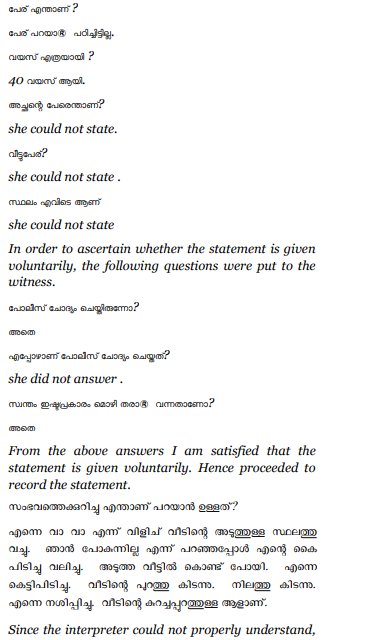
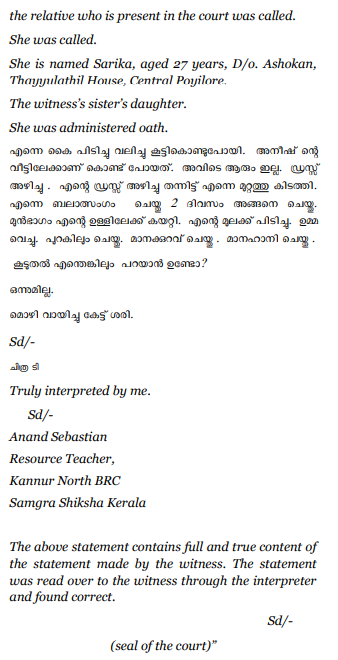
A trial must adhere to specific protocols when dealing with vulnerable witnesses, such as deaf and dumb individuals, ensuring competent interpretation and proper recording to uphold justice.

Compliance with the mandatory procedure under Section 119 of the Indian Evidence Act and the need for the evidence to inspire confidence.

Conviction cannot be recorded on the basis of shaky evidence.

The prosecution failed to prove its case beyond reasonable doubt, leading to the acquittal of the appellant in a rape case involving a mentally weak victim.


The court established that proper procedures must be followed when recording statements of witnesses unable to communicate verbally, including the use of qualified interpreters and videography.


Mandatory compliance with Section 164(5A) Cr.P.C. is required for recording statements of mentally disabled individuals; failure to follow this procedure renders the statement inadmissible as examina....

Point of law: Imposition of maximum punishment – Rape case - victim, a deaf and dumb girl was subjected to sexual assault by way of outraging her modesty by the accused taking advantage of her disabi....



An indispensable Tool for Legal Professionals, Endorsed by Various High Court and Judicial Officers
Please visit our Training & Support
Center or Contact Us for assistance

Scan Me!
India’s Legal research and Law Firm App, Download now!


For Daily Legal Updates, Join us on :



 Back to top


