Back
Back





2025 Supreme(Ker) 2658
IN THE HIGH COURT OF KERALA AT ERNAKULAM
A. MUHAMED MUSTAQUE, SHOBA ANNAMMA EAPEN, S. MANU, JJ.
State Of Kerala, Represented By The Secretary Higher Education Department, Government Secretariat, Thiruvananthapuram and Ors. – Appellants
Versus
Anas N. Assistant Professor, Department Of Political Science, M.S.M College, Kayamkulam, Kollam and Ors. – Respondents
ICR (WA) No.4 of 2025 in W.A. No.1814 of 2022 & W.A. No.1768 of 2022 & ICR (WA) No.5 of 2025 in W.A. No.201 of 2023 & W.A No. 201 of 2023
Decided On : 27-08-2025
For the Appellants : Senior Government Pleader, Shri A.J. Varghese.
For the Respondents: Sri. S. Muhammed Haneeff, Sri. C.V. Alexander, Shri. Thomas Abraham, Sc, University Of Kerala, Smt. Nisha George, Sri. George Poonthottam (Sr.), Sri. A.L. Navaneeth Krishnan, Sri. Babu Varghese (Sr.).
Government sanction is mandatory to create new posts in aided colleges post-2005 amendment, while approval of appointments for existing posts remains with the University, reaffirming that previous posts are valid unless explicitly abolished.
Headnote:(A) Mahatma Gandhi University Act, 1985 - Kerala University Act, 1974 - Appointment of teachers in private aided colleges - Government sanction becomes mandatory for creating new posts after 2005 amendment - The appointment and approval authority rests with the University based on workload assessment - Posts created before the amendment do not require further government sanction for appointments, provided they exist legally. (Paras 2, 11, 16, 20)
(B) Legal principle - Distinction between creation of posts and approval of appointments - Creation of posts lies with the Government post-2005, while approval rests with the University; thus, past posts remain valid unless expressly abolished. (Paras 10, 11, 17)
Facts of the case:
The State Government's sanction was queried concerning appointments in private colleges for those established before the 2005 amendment. The dispute centers on the requirement of governmental approval based on workload assessments pertinent to staffing while differentiating posts' creation/deletion processes.
Findings of Court:
The court affirmed that existing posts before the amendment do not necessitate new governmental sanction for appointment approvals by the University.
Issues: Whether government sanction is required for posts in private aided colleges established before the 2005 amendment and the validity of appointments made without such sanction.
Ratio Decidendi: The court clarified that governmental sanction is limited to the creation of new posts post-amendment, with prior posts remaining valid for approval without additional sanction.
Result: The appeals were dismissed; appointment approval of Mr. Anas was upheld.
Certainly. Based on the provided legal document, the key points are as follows:
-
The law distinguishes between the creation of posts and the approval of appointments. Post creation authority rests with the Government, while approval of appointments is the responsibility of the University, based on workload assessments. Posts created before the 2005 amendment remain valid unless explicitly abolished, and no further government sanction is required for appointments to these posts unless they exceed the existing sanctioned strength (!) (!) .
-
The 2005 amendment to the relevant laws made the creation of new posts in aided colleges subject to prior sanction from the Government. However, posts that existed prior to the amendment, and were created with approval of the University, do not require subsequent government sanction for appointment approval, provided they are still legally valid and have not been expressly abolished (!) (!) .
-
The approval process for appointments involves verification of compliance with the staff pattern and workload assessment carried out by the University. The approval authority remains with the University, but the creation of new posts beyond the existing sanctioned posts after 2005 is exclusively within the domain of the Government (!) (!) .
-
The law emphasizes that workload assessments are necessary for the approval of appointments, and such assessments should be conducted strictly according to prescribed regulations. These assessments do not automatically create or abolish posts; they are meant to determine the necessity and justification for appointments within the existing staff strength (!) (!) .
-
In cases where appointments are made to posts that are found surplus or non-existent following workload assessments, the appointment can still be valid if the post was not expressly abolished by the competent authority before the appointment. The absence of an explicit abolition means the post continues to exist, making appointments to such posts legal (!) (!) .
-
The court reaffirmed that appointments made in accordance with the existing posts and workload assessments, without requiring new government sanction, are valid. The approval of appointments in posts that are within the existing sanctioned strength and not expressly abolished remains within the jurisdiction of the University (!) .
-
The decision clarified that the introduction of new courses or programs does not automatically require the creation of new posts unless the workload assessment indicates the need for additional staffing. The process of creating or abolishing posts involves conscious decisions by the competent authorities, and workload assessments alone do not alter the status of existing posts (!) (!) .
-
The court dismissed the appeals and confirmed the validity of the appointments in question, emphasizing that appointments made to posts that are still legally in existence and not expressly abolished are lawful, even if the posts were considered surplus in earlier assessments, provided there was no formal abolition (!) (!) .
These points summarize the legal principles and findings relevant to the creation and approval of posts and appointments in aided colleges, especially concerning the impact of the 2005 amendments and workload assessments.
ORDER :
A. Muhamed Mustaque, J.
In both references, the main issue is the same, namely, whether Government sanction is required for the approval of appointments in private aided colleges affiliated to Universities. Accordingly, we have considered this larger legal question in ICR(WA) No. 4/2025, as we consider that ICR(WA) No. 5/2025 can be disposed of based on our discussion on the law in ICR(WA) No. 4/2025. ICR (WA) No. 4/2025:
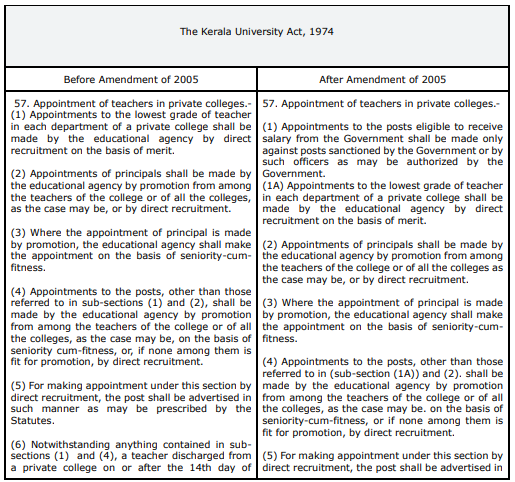
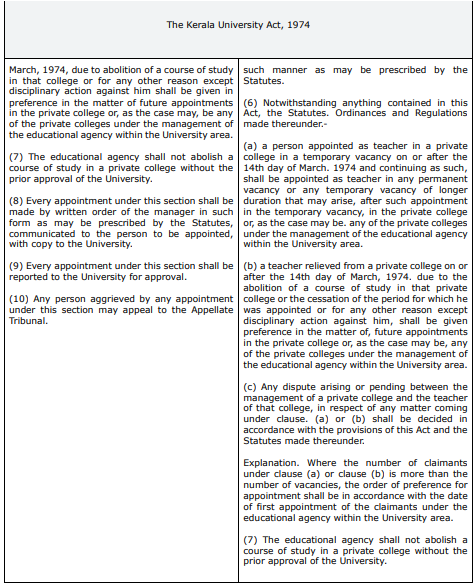
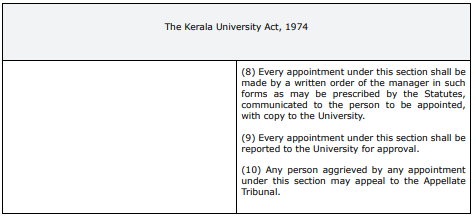
2. The Mahatma Gandhi University Act , 1985, and the Kerala University Act , 1974, were amended in 2005. These amendments made it mandatory to obtain Government sanction for the appointment of teachers in private aided colleges who are entitled to receive salary from the Government under the direct payment scheme. The impact of these amendments forms the core issue to be considered in the present reference made by the Division Bench. The amendments were necessitated in light of the judgment of this Court in Cherian Mathew v. Principal, S. B. College, Changanassery [1998 KHC 336], wherein the Division Bench held that the Government cannot sit in judgment over the decision of the University regarding the number of teachers to be appointed in a department of a private aided college. Before the amendments, approval of posts in private aided colleges rested with the University, based on workload and staff pattern as provided in the University Ordinances. With the implementation of the UGC Regulations on Minimum Qualifications for Appointment of Teachers and Other Staff in the Universities and Colleges and Measures for the Maintenance of Standards in Higher Education, 2010 and 2018 (hereinafter referred to as the “UGC Regulations”), however, the determination of staff pattern is now governed by the norms prescribed therein.
3. Under the University Ordinances regarding workload and staff pattern of teaching staff, workload assessment is carried out as of the 1st of November of the preceding year. Before the 2005 amendments, if, based on such an assessment, the University was of the view that a post required approval, it would accord the same. No mechanism was provided either under the University Statutes or the Ordinances for obtaining prior sanction from the State Government before the year 2005. It was for this reason that, in Cherian Mathew (supra), the Division Bench held that the State Government cannot sit in judgment over the decision of the University in the matter of approval of staff pattern.
4. The scope and impact of the 2005 amendment, in its application to colleges that were already in existence before its incorporation, forms the subject matter of the present dispute. On a plain reading of the amendment, there can be no doubt that Government sanction is mandatory in the case of new aided colleges established after the 2005 amendment. The real controversy, therefore, is whether the said requirement also applies to appointments in private colleges that had already been established before the amendment came into force, in respect of posts that were created by the operation of law before the amendment.
5. A Division Bench of this Court in State of Kerala and Others v. Dr. Poornima C.C. and Others [2022 (5) KLT 547] elaborately considered the impact of the amendment and came to a definite conclusion that without sanctioning of the post by the State Government, no appointment can be made in private aided colleges and no appointee can seek retrospective approval of the appointment. We note that a Special Leave Petition filed against Poornima (supra) has been dismissed.
6. The Division Bench, in its reference order dated 04/03/2024 in W.A. Nos. 1814/2022 and connected case, noted earlier judgments in Amina v. State of Kerala [2004 (1) KLT 657], Shalini Racheal v. Manager, Christian College [2007 (3) KLT 355] and State of Kerala and Others v. Dr. Sina A. R. and Others [2007 (3) KHC 96], and opined that the judgment in Poornima (supra) conflicts with the above cited judgments. The learned Senior Government