
 Back
Back





IN THE HIGH COURT OF KERALA AT ERNAKULAM
SATHISH NINAN, P. KRISHNA KUMAR, JJ.
Rahila beevi, w/o. Mohammed basheer – Appellant
Versus
A.Mohammed Basheer, S/O.Abdul Rahim – Respondent
MAT.APPEAL NO. 450 OF 2018
Decided on : 13-11-2025
| Table of Content |
|---|
| 1. property purchase and respective contributions (Para 1 , 2 , 3) |
| 2. trial court's hold on petition maintainability (Para 4 , 5) |
| 3. evaluating evidence on property claim (Para 6 , 10 , 15) |
| 4. admissions in evidence affecting burden of proof (Para 7 , 8 , 9 , 12 , 13) |
| 5. contradiction of sale deed provisions (Para 14 , 17) |
| 6. declaration of joint ownership and injunction (Para 16 , 18) |
JUDGMENT :
P. Krishna Kumar. J
1. The appellant filed a petition before the Family Court, Kollam, seeking declaration of her right over 8 cents of land and the two-storied building standing thereon, and a consequential injunction restraining the respondent, her husband, from interfering with her possession. The Family Court, by the order impugned in this appeal, rejected her claim.
2. The parties shall hereinafter be referred to as they were arrayed in the original petition. The petitioner was married to the respondent on 09.06.1974. According to her, the respondent hailed from a very poor family, whereas she came from affluent circumstances. The respondent began his career as a bus conductor, subsequently joined the Police Department as a Sub-Inspector, and retired as a Deputy Superintendent of Police. The petitioner and the respondent had intended to purchase the scheduled property from the Kollam District Development Authority, and for that purpose, the petitioner arranged a sum of ₹1.53 lakh from her father and brothers. The total sale consideration of the property was ₹2,00,000/-, of which approximately ₹50,000/- was contributed by the respondent. As the petitioner was a pardanashin lady, she could not appear before the registration authority at the time of execution of the sale deed. Consequently, the property was purchased in the respondent’s name alone, for namesake. The petitioner further contended that a two-storied building was subsequently constructed on the said land by utilising the sale proceeds of her gold ornaments. During the construction of the residence, all the necessary timber was supplied by her father. It is further contended that, notwithstanding the respondent’s subsequent pronouncement of talaq, she has continued in possession of the property.
3. The respondent contended that the land was purchased and the building was constructed entirely from his own earnings, and also by availing a housing loan, bidding a chit from the KSFE, and taking a loan from his provident fund account. He further claimed that, during his service as Circle Inspector of Police, Paravur, he had purchased 1½ acres of rubber estate and 3 acres of landed property in the names of the petitioner and their children. He also asserted that he had purchased new gold ornaments for the petitioner after exchanging her old ones, and at that time, he had sold 62½ sovereigns of gold. It is further contended that those 62½ sovereigns were later stolen from the petitioner’s custody while the respondent was working in Kosovo with the United Nations. The timber used for the construction of the house, he maintained, was procured by him from the Government Timber Depot at Pathanapuram as well as from a private individual residing at Kadakkal.
4. During the trial, the petitioner and the respondent were examined as PW1 and RW1, respectively. The evidence in the case comprises the oral testimonies of PW1 to PW3 and RW1 to RW6, and the documentary evidence marked as Ext.A1 series, Exts.B1 and B2, and Exts.X1 to X3. After considering the rival contentions, the trial court held that a petition seeking a declaration of right over an immovable property purchased in the name of the husband is not maintainable under Section 45 of the Transfer of Property Act, 1882.
5. We have heard Sri. R.T. Pradeep, the learned counsel appearing for the petitioner, and Sri. B. Suresh Kumar, the learned counsel appearing for the respondent.
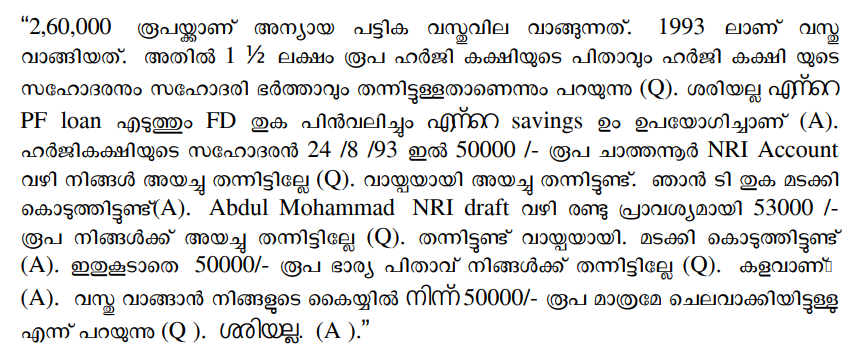
6. The petitioner contends that the scheduled property was purchased using funds provided by her father and brothers on her behalf, for the advancement
AI


The main legal point established in the judgment is the binding effect of the settlement between the parties, the waiver of the right to seek re-employment by the workmen, and the entitlement of the ....

A lockout is justified if it is declared in response to an illegal strike or a strike that is in breach of a settlement or award.

The combination of eyewitness testimonies, recovery of the weapon used, and forensic examination results can establish guilt in criminal cases, even based on circumstantial evidence.


The conviction of an accused person under Section 27(3) of the Arms Act is not permissible in law if the accused is also charged with committing murder under Section 302 of the Indian Penal Code.

The court can enhance compensation based on the deceased's income and family dependency, and adjust the multiplier used by the Tribunal if found unjustified.



An indispensable Tool for Legal Professionals, Endorsed by Various High Court and Judicial Officers
Please visit our Training & Support
Center or Contact Us for assistance

Scan Me!
India’s Legal research and Law Firm App, Download now!


For Daily Legal Updates, Join us on :



 Back to top


