
 Back
Back





IN THE HIGH COURT OF KERALA AT ERNAKULAM
JOHNSON JOHN, J.
Suresh @ Sura, S/o. Kannan - Appellant
Vs.
State Of Kerala - Respondent
Crl. Appeal No. 749 of 2006 & Crl. R.P. No. 2153 of 2006
Decided On : 11-12-2025
Based on the provided legal document, here are the key points regarding the case of Suresh @ Sura v. State Of Kerala:
Case Overview and Parties * The appellants (Accused Nos. 1, 3, 5, 6, 11, and 12) were convicted by the trial court for offences under Sections 143, 147, 148, 341, 427, and 452 IPC. * The revision petitioner (de facto complainant) challenged the acquittal of the appellants for serious charges including outraging modesty (S.354), robbery (S.395), and attempted rape (S.511 of S.376 IPC), as well as the acquittal of other co-accused. (!) * The original first accused, Binu, died before committal, and the 8th accused was absconding, leading to a trial only against the remaining accused. (!)
Prosecution Case and Allegations * The prosecution alleged that an unlawful assembly of 14 persons trespassed into the victim's house at 5:30 p.m. on 15.01.2001, broke open doors, restrained family members, attempted to rape the victim and her daughter, and looted valuables. (!) * Key prosecution witnesses (PWs 1, 2, and 5) identified specific accused persons for various acts, including the attempted rape and the looting of ornaments. (!) (!) * The motive was alleged to be group rivalry and enmity stemming from previous communal riots and political affiliations. (!)
Defence Arguments and Evidence Gaps * The defence argued the absence of medical or scientific evidence to corroborate the eyewitness testimony regarding the rape and assault. (!) * A significant delay in lodging the First Information Report (FIR) was highlighted; the FIR was recorded the day after the incident after discussions with political leaders, raising doubts about the veracity of the story. (!) (!) (!) * The prosecution failed to examine material witnesses (CWs 3 and 6), leading to an adverse inference against the prosecution. (!) * There was no proper dock identification of the accused by the witnesses in court, which is substantive evidence. (!) (!) * The prosecution could not conclusively prove the robbery of specific amounts (Rs. 25,000 and gold ornaments) despite the initial allegation in the FIR. (!) * Material contradictions were noted between the prosecution's case and the evidence regarding the identity of accused who committed specific acts (e.g., who took the children out of the house). (!) (!) (!) * The second accused (Vinodan) sustained severe injuries (amputation of left palm) in a bomb explosion earlier on the same day, and there were allegations that the prosecution suppressed this fact. (!)
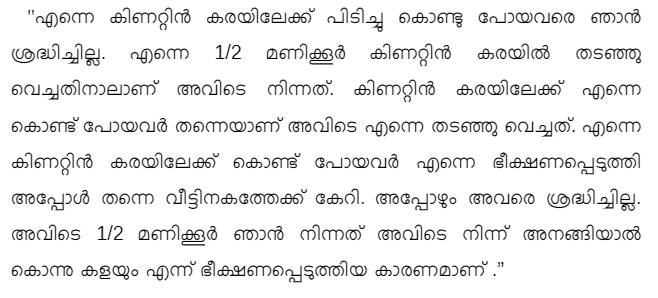
Court's Findings and Reasoning * The court found that the serious charges (outraging modesty, attempted rape, robbery) lacked corroboration from medical evidence (no semen or spermatozoa detected) and eyewitness testimony. (!) (!) (!) * The delay in filing the FIR and the subsequent discussions with others before recording the statement created a reasonable suspicion of embellishment, especially in the context of group rivalries. (!) (!) (!) * The hostility of an independent witness (PW9), who denied that the victim and children reached his house as alleged, further undermined the prosecution case. (!) * The absence of scientific evidence and the presence of material contradictions rendered the prosecution case unsafe. (!) (!)
Judgment and Result * The court held that the burden of proof lies on the prosecution to establish guilt beyond reasonable doubt, which was not met in this case. (!) * The appeals were allowed, and the appellants were acquitted of the serious charges (S.354, 395, 511 of 376 IPC). (!) (!) * However, the appellants remained convicted and sentenced for the lesser offences of unlawful assembly, trespass, mischief, and criminal trespass (Sections 143, 147, 148, 341, 427, 452 IPC). (!) * The bail bonds executed by the appellants were cancelled, and they were set at liberty. (!)
| Table of Content |
|---|
| 1. overview of case and parties involved (Para 2) |
| 2. details of prosecution case and trial proceedings (Para 3 , 4) |
| 3. arguments for the appellants (Para 5 , 6 , 7) |
| 4. prosecution evidence presented (Para 8 , 9) |
| 5. witness testimonies and identifications (Para 10 , 11 , 12 , 13 , 14) |
| 6. expert and medical evidence overview (Para 15 , 16 , 17 , 18) |
| 7. background information on property and value (Para 19 , 20 , 21) |
| 8. legal standards for evidence and identification (Para 22 , 23 , 30) |
| 9. conclusion on evidence reliability and acquittal (Para 39 , 47) |
JUDGMENT :
JOHNSON JOHN, J.
The appellants are accused Nos. 1, 3, 5, 6, 11 and 12 in S.C. No.170 of 2003 convicted and sentenced for the offences under Sections 143, 147, 148, 341, 427 and 452 r/w 149 IPC as per judgment dated 06.03.2006 of the Additional District and Sessions Judge, Fast Track, (Adhoc-I), Kozhikode. The revision petitioner is the de facto complainant and she is challenging the acquittal of the appellants for the offences under Sections 354 , 395 and 511 of 376 IPC and the acquittal of accused Nos. 2, 4, 7, 8, 9 and 10 of all the charges levelled against them.
2. A perusal of the committal order dated 21.10.2002 in C.P No.67 of 2002 of the Judicial First Class Magistrate, Nadapuram and the proceedings of the Magistrate would show that the original first accused, Binu, died before committal and the 8th accused, Raghavan, was absconding and therefore, only the case as against the other accused was committed for trial.
3. The prosecution case is that all the 12 accused, along with two others, formed an unlawful assembly, armed with deadly weapons and trespassed in to the house of PW1 at about 5.30 p.m., on 15.01.2001 by break opening the doors and thereafter, wrongfully restrained PW1 and other members of the house. The accused persons outraged the modesty of PW1 and also attempted to rape her in the presence of her children. The accused persons destroyed the utensils and other articles in the house and they also looted the valuables kept in the house and thus, committed the offences as aforesaid.
4. When the accused persons pleaded not guilty to the charge, PWs 1 to 17 were examined and Exhibits P1 to P39 and MOs 1 to 39 were marked from the side of the prosecution. From the side of the defence, DWs 1 to 6 were examined and Exhibits D1 to D21 marked.
5. The trial court, after analysing the evidence, found the appellants guilty only for the offences under Sections 143, 147, 148, 341, 427 and 452 r/w 149 IPC. The appellants are challenging the legality and correctness of the conviction and sentence and the de facto complainant is challenging the acquittal of the appellants for the offences under Sections 354, 395 and 511 of 376 IPC and the acquittal of the other accused persons of all the offences charged against them.
6. Heard Sri.Gilbert George Correya, the learned counsel for the appellants, Sri. Sunny Mathew, the learned counsel for the revision petitioner and Sri. Alex M. Thombra, the learned Senior Public Prosecutor.
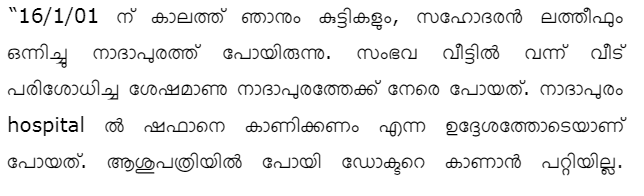
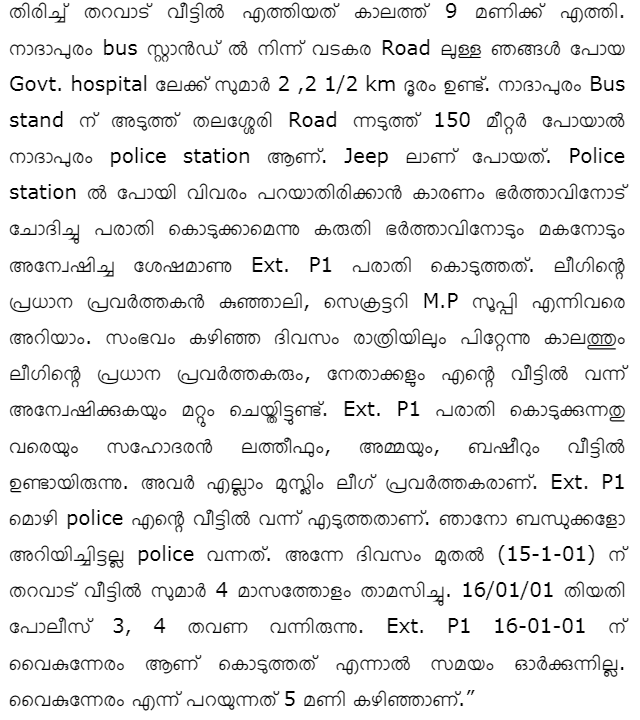
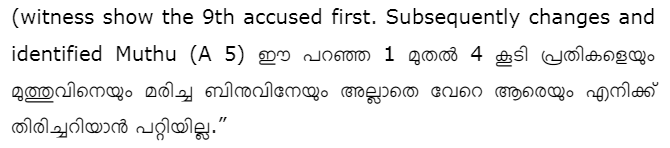
7. The learned counsel for the appellants argued that there is no medical or scientific evidence to corroborate the evidence of PWs 1, 2 and 5, who supported the prosecution case regarding the occurrence and the circumstances in which PW12, Sub Inspector of Kuttiyadi Police Station, reached the house of PW1 on 16.01.2001 for recording Exhibit P1, First Information Statement, is suspicious, especially in view of the problems in the locality in connection with the group rivalry and other connected incidents that occurred there. It is argued that there is no proper dock identification of the appellants and in view of the non- examination of the material witnesses and withholding of scientific evidence, the appellants are entitled for the benefit of reasonable doubt.
8. The learned counsel for the revision petitioner and the learned Senior Public Prosecutor argued that the evidence of PWs 1, 2 and 5 regarding the occurrence and the identity of the appellan
In prosecutions involving serious charges, the burden lies on the prosecution to establish guilt beyond reasonable doubt, and discrepancies in evidence or lack of corroboration can lead to acquittal.

The judgment underscores the principle that an acquittal should not be overturned without compelling evidence, emphasizing the importance of consistent and reliable witness testimonies in criminal ca....

The court affirmed the conviction of the accused for murder, finding sufficient evidence of an unlawful assembly and individual culpability amid claims of inconsistencies in prosecution testimony.

(1) While appreciating evidence in criminal cases, there cannot be a strait-jacket formula. Evidence must be appreciated from perception of a prudent common man.(2) Conduct of a stranger eyewitness t....


The court established that a conviction cannot rely on identification that lacks corroboration from earlier proceedings, particularly when witnesses could not confidently identify masked assailants.

Prosecution must substantiate charges with reliable evidence; significant discrepancies in witness statements and medical evidence warrant acquittal.

1. If two reasonable conclusions are possible on the basis of the evidence on record, the Appellate Court should not disturb the findings of acquittal. 2. The acquittal re-enforces and reaffirms the....

The court acquitted the Appellants due to material contradictions in the evidence of the prosecutrix, unsupported by medical evidence, and improper appreciation of evidence by the learned Sessions Co....
Eyewitness testimony, even from an interested witness, can sustain a conviction if corroborated by credible evidence and circumstances.



An indispensable Tool for Legal Professionals, Endorsed by Various High Court and Judicial Officers
Please visit our Training & Support
Center or Contact Us for assistance

Scan Me!
India’s Legal research and Law Firm App, Download now!


For Daily Legal Updates, Join us on :



 Back to top


