
 Back
Back





IN THE HIGH COURT OF KERALA AT ERNAKULAM
K.NATARAJAN, JOHNSON JOHN, JJ.
Union of India, Represented by its Secretary, New Delhi – Appellant
Versus
Mohanan Madathil Koliyat – Respondent
W.P. (C) No. 37473 of 2025
Decided On : 26-02-2026
| Table of Content |
|---|
| 1. challenge to disability pension order. (Para 1 , 5) |
| 2. arguments regarding burden of proof. (Para 3 , 4) |
| 3. regulations for disability pension grant. (Para 6 , 9) |
| 4. causal connection and medical opinion considerations. (Para 8 , 12 , 13) |
| 5. legal precedent on medical board opinions. (Para 10 , 11 , 14) |
| 6. requirement for medical board reasoning. (Para 15 , 16 , 17) |
| 7. judicial review in denial of fundamental rights. (Para 18 , 19) |
| 8. writ petition dismissal. (Para 20) |
JUDGMENT :
JOHNSON JOHN, J.
1. The order of the Armed Forces Tribunal, Regional Bench, Kochi allowing disability element of pension to the respondent is under challenge in this writ petition filed by the Union of India.
2. Heard Smt. Gayathri Krishnan, the learned Central Government Counsel appearing for the Union of India and Sri. Adi Narayanan, the learned counsel for the respondent.
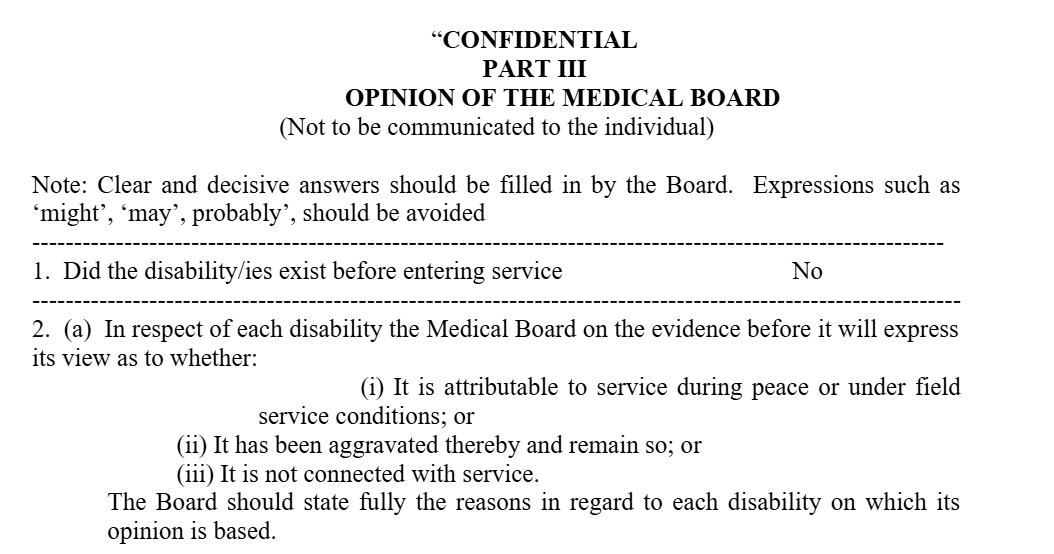
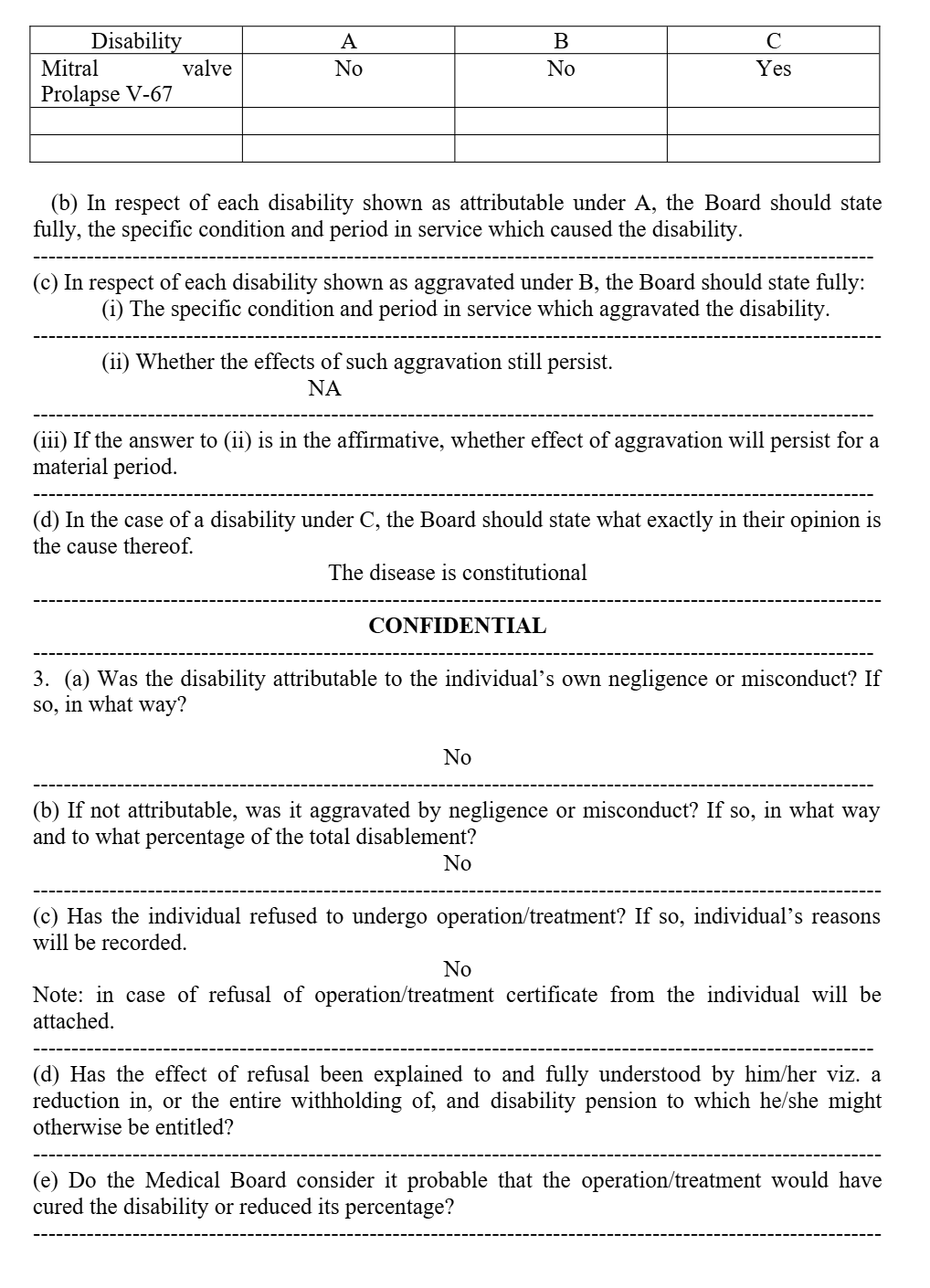
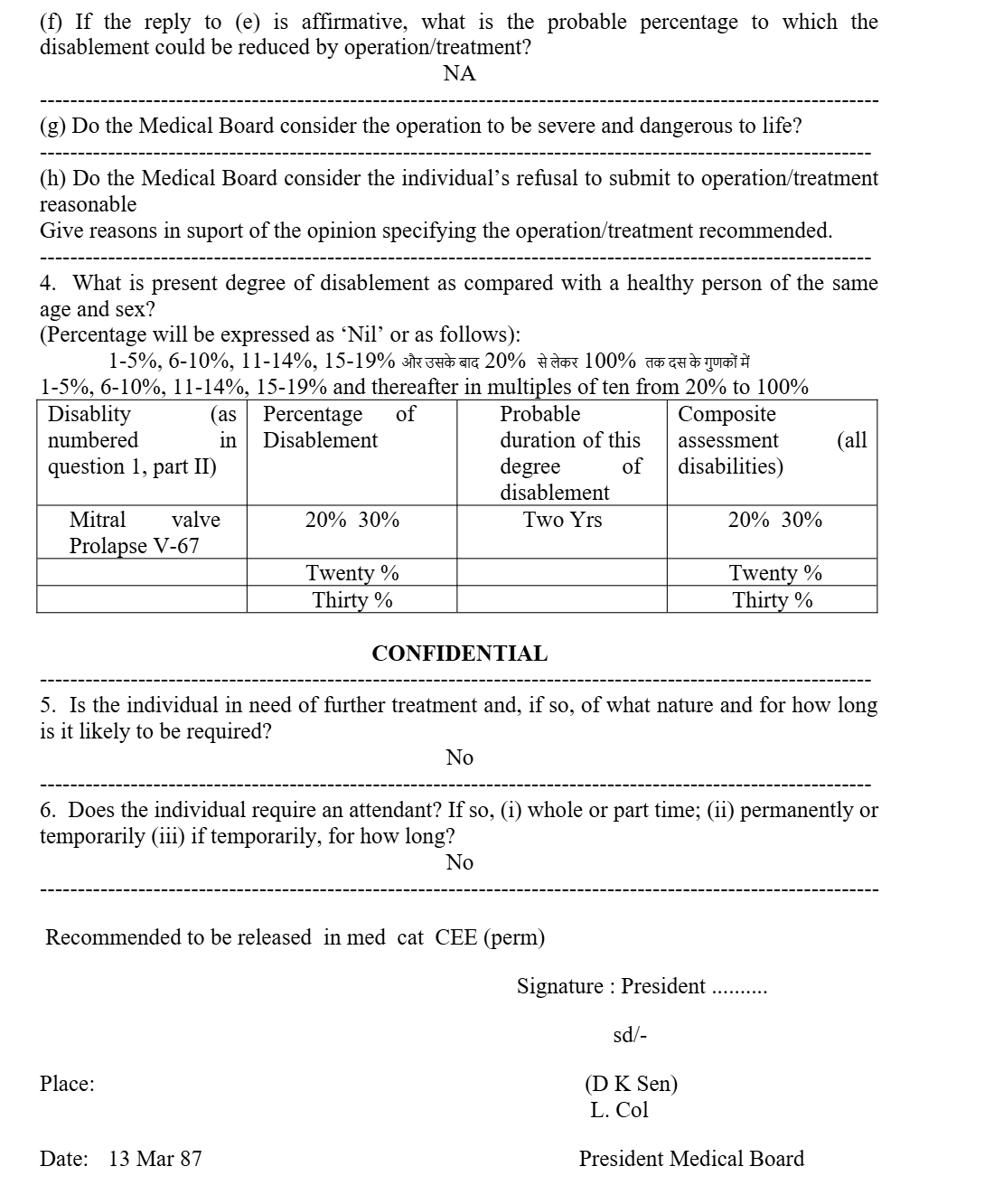
3. The learned Central Government Counsel argued that the opinion of the Release Medical Board would clearly show that the disability due to diagnosis (Mitral Valve Prolapse V-67) is neither attributable to nor aggravated by military service and in the absence of any causal connection between the disease or injury and the military service, the Tribunal is not justified in granting the disability element of pension to the respondent.
4. The learned counsel for the respondent argued that the onus of proving that the disability is not attributable to the military service, is on the authority, especially when an individual is physically fit at the time of enrolment and no note regarding adverse physical factor is made at the time of entering service and in this case, the Release Medical Board has not given any reason for the conclusion that the disease is constitutional even though the respondent is recommended to be released in medical category CEE (permanent).
5. The respondent was enrolled in the Regiment of Artillery on 15.12.1971 and was discharged from service on 01.06.1987 after completing 15 years and 168 days of service. The respondent was discharged before completion of his service as he was recommended to be released in medical category “CEE permanent”. According to the respondent, his repeated request for grant of disability pension was not allowed and subsequently during May, 2017, he filed Annexure A2 application seeking disability pension; but, the same was declined as per Annexure A3 on the ground that his disability was neither attributable to nor aggravated by military service.
6. Regulation 173 of the Pension Regulations for the Army, 1961 deals with the primary conditions for the grant of disability pension and the same reads thus:
“173. Primary conditions for the grant of disability pension. — Unless otherwise specifically provided a disability pension may be granted to an individual who is invalided from service on account of a disability which is attributable to or aggravated by military service and is assessed at 20 per cent or above.”
7. The relevant portions in appendix II to the said Regulations read as follows:
“2. Disablement or death shall be accepted as due to military service provided it is certified that—
(a) The disablement is due to wound, injury or disease which—
(i) is attributable to military service; or
(ii) existed before or arose during military service and has been and remains aggravated thereby;
(b) the death was due to or hastened by—
(i) a wound, injury or disease which was attributable to military service..
(ii) the aggravation by military service of a wound, injury or disease which existed before or arose during military service.
Note.—The rule also covers cases of death after discharge/invaliding from service.
3. There must be a causal connection between disablement or death and military service for attributability or aggravation to be conceded.
4. In deciding on the issue of entitlement all the evidence, both direct and circumstantial, will be taken into account and the benefit or reasonable doubt will be given to the claimant. This benefit wil
The absence of adequate reasoning by the Medical Board regarding disability attribution to military service invalidates denial of pension rights.


The medical board's failure to provide justified reasons for denying disability pension undermines the decision, necessitating the presumption of service-related attribution for the disability.
The court established that ex-servicemen with disabilities over 20% are entitled to disability pensions, emphasizing the presumption of service connection and the burden of proof on medical authoriti....



An indispensable Tool for Legal Professionals, Endorsed by Various High Court and Judicial Officers
Please visit our Training & Support
Center or Contact Us for assistance

Scan Me!
India’s Legal research and Law Firm App, Download now!


For Daily Legal Updates, Join us on :



 Back to top


