
 Back
Back





IN THE HIGH COURT OF KERALA AT ERNAKULAM
A.Badharudeen, J.
A.K.Shamsudhin, Deputy Chief Controller Of Explosives – Petitioner
Versus
C.B.I., Cochin Rep By Standing Counsel – Respondent
CRL.A NO. 1606 of 2006
Decided On : 06-02-2026
The core issues in this case primarily revolve around the following points:
Whether the prosecution has sufficiently proved that the accused demanded and accepted a bribe, which is a fundamental element for establishing the offence under the relevant sections of the Prevention of Corruption Act (!) (!) .
Whether the evidence presented, including witness testimonies and procedural conduct during the trap, meets the legal standards for corroboration and reliability necessary for conviction (!) (!) .
Whether the evidence of demand and acceptance of illegal gratification was established beyond reasonable doubt, including the adequacy of proof regarding the demand made by the accused and the subsequent acceptance of the bribe (!) (!) .
The legality and sufficiency of the procedural conduct in the trap operation, including the roles of independent witnesses and the proper collection and handling of evidence, to support the conviction (!) (!) .
Whether the evidence supports the findings of criminal misconduct by the accused under the specified sections of the Prevention of Corruption Act, including the necessary ingredients such as demand, acceptance, and the manner of proof (!) (!) .
The appropriateness of the sentence imposed and whether it aligns with statutory requirements and judicial discretion, especially considering the minimum prescribed punishment and the court’s authority to modify sentences (!) (!) (!) .
The validity of the legal principles applied regarding proof standards for demand and acceptance of bribes, including the necessity for corroborative evidence and the inference of guilt from circumstantial evidence when direct evidence is unavailable (!) (!) (!) .
These issues collectively determine the legality and correctness of the conviction and the appropriateness of the sentencing in the context of the alleged offences under the Prevention of Corruption Act.
| Table of Content |
|---|
| 1. criminal appeal against conviction under pc act. (Para 1 , 2 , 5) |
| 2. accused demanded and accepted bribes. (Para 3 , 4 , 27) |
| 3. arguments against demand and acceptance of bribes. (Para 7 , 8 , 10 , 24) |
| 4. judicial precedents concerning proof of bribery. (Para 9 , 11 , 12 , 13 , 14 , 22 , 40) |
| 5. essentials for proving bribery under pc act. (Para 38 , 39 , 41) |
| 6. no interference with conviction (Para 42 , 43) |
| 7. order dismissing appeal and upholding sentences. (Para 44 , 45 , 46 , 47 , 48 , 50) |
JUDGMENT :
A. Badharudeen, J.
The sole accused in C.C.No.4/2003 on the files of the Enquiry Commissioner and Special Judge (SPE/CBI)-II, Ernakulam has filed this criminal appeal. He impugns the verdict in the above case dated 09.08.2006 whereby he was found guilty for commission of offences punishable under Sections 7 and 13(1)(d) r/w.13(2) of the Prevention of Corruption Act, 1988 (hereinafter referred to as ‘PC Act, 1988’ for short). The respondent herein is the Central Bureau of Investigation represented by the Special Public Prosecutor.
2. Heard the learned Senior Counsel appearing for the appellant as well as the learned Special Public Prosecutor in detail. Perused the verdict impugned and the relevant documents.
3. Here, the prosecution case is that the accused, while working as Deputy Chief Controller of Explosives in the office of the Deputy Chief Controller of Explosives, Cochin, during the period between June 2001 and October 2002, demanded and accepted Rs.5,000 as bribe from PW1, Sri.V.V.Mathew, to issue short firers permit, acting on the application put up by PW1. Thereafter, the accused had demanded and accepted Rs.3,000 as bribe on 17.10.2002. On this premise, the prosecution alleges commission of above offences by the accused.
4. In this case, when final report filed before the Special Court, the learned Special Judge took cognizance of the said offences and proceeded with trial. During trial, PW1 to PW10 were examined and Exts.P1 to P20 as well as MO1 to MO13 were marked on the side of the prosecution. On the side of the defence, DW1 was examined and Exts.D1 to D7 were marked.
5. On consideration of the evidence in detail, the learned Special Judge found that the accused committed offences punishable under Sections 7 and 13(1)(d) r/w 13(2) of the PC Act, 1988 and accordingly, he was sentenced as under:
“In the result, the accused is sentenced to undergo rigorous imprisonment for one year and to pay a fine of Rs.10,000/- each in default to undergo simple imprisonment for 3 months under each count of offence punishable u/s.7 and 13(1) (d) r/w Sec. 13(2) of the PC Act, 1988. The sentence shall run concurrently. Accused is also allowed to set off if any u/s.428 Cr.P.C.”
6. The learned Senior Counsel appearing for the appellant raised multiple contentions and the contentions are put into writing in the form of an argument notes and the same read as under:
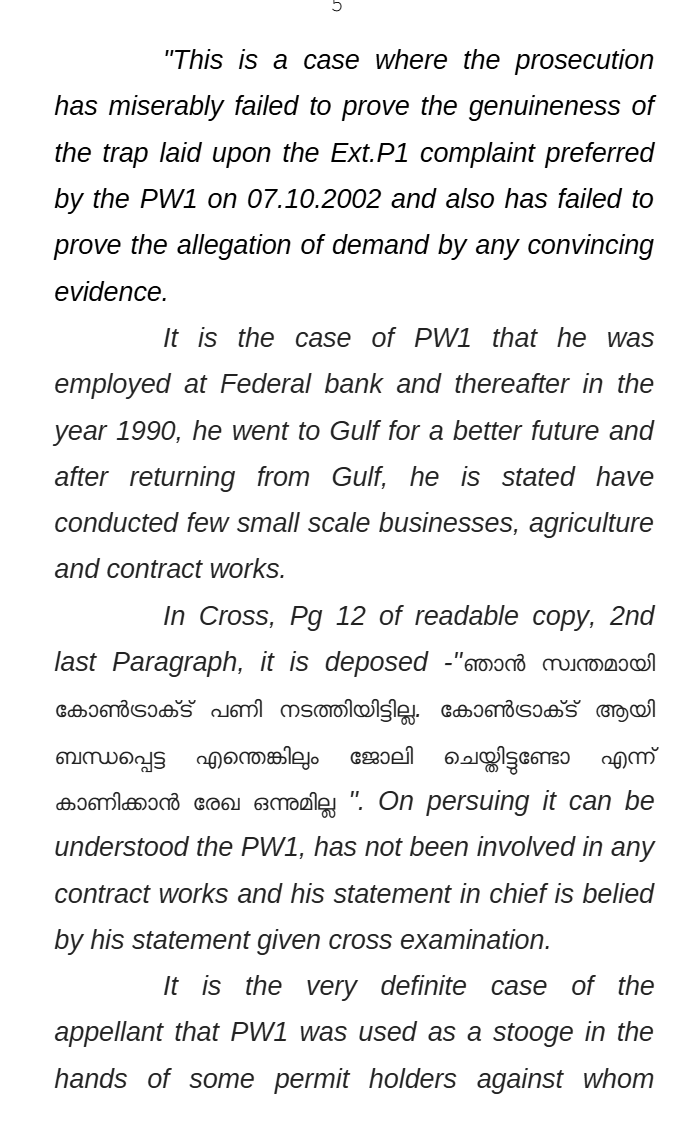
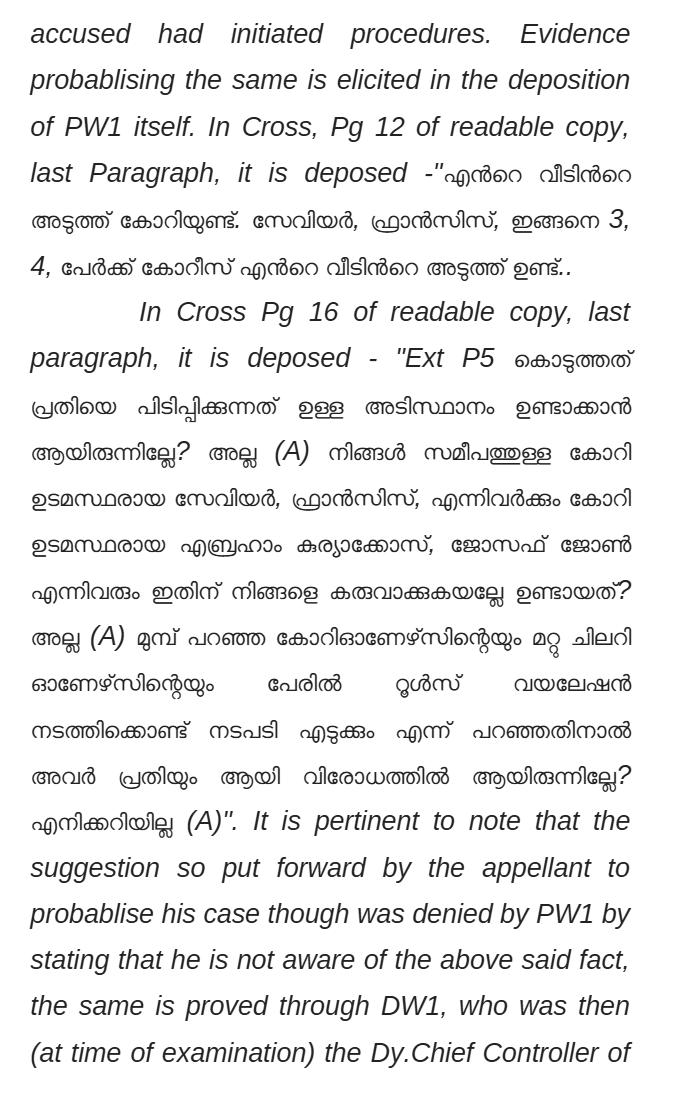
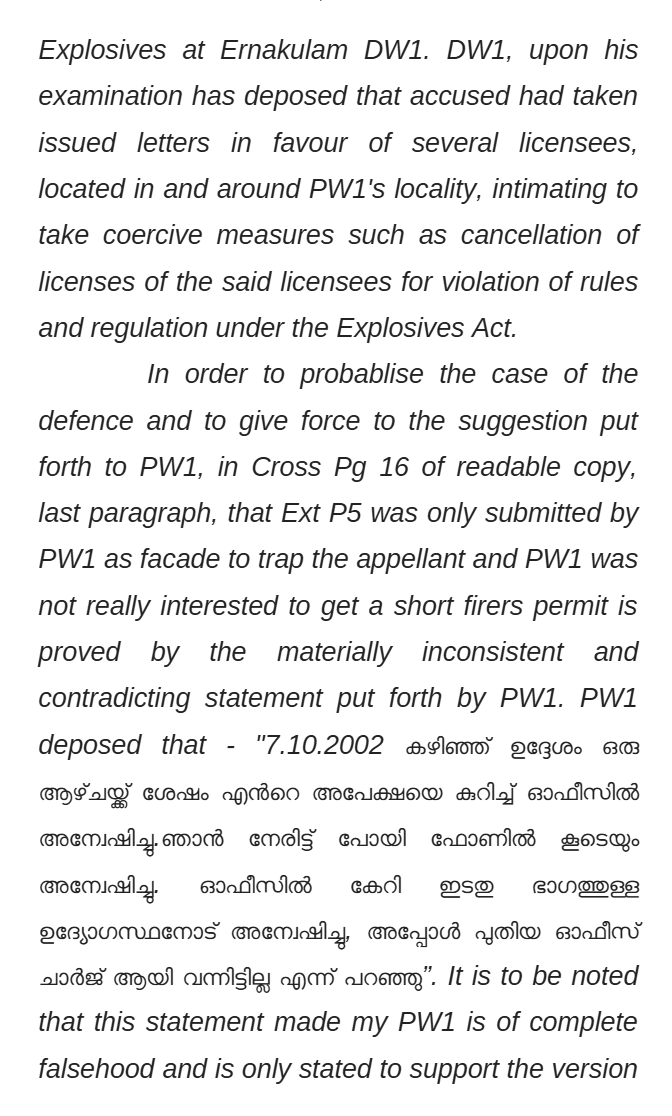
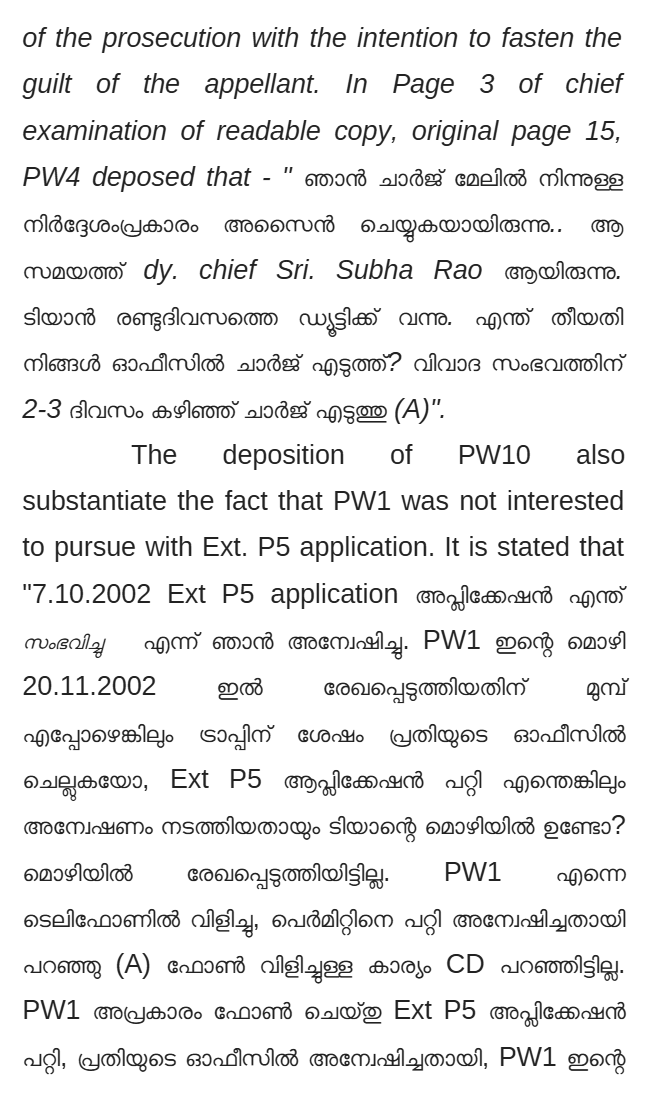
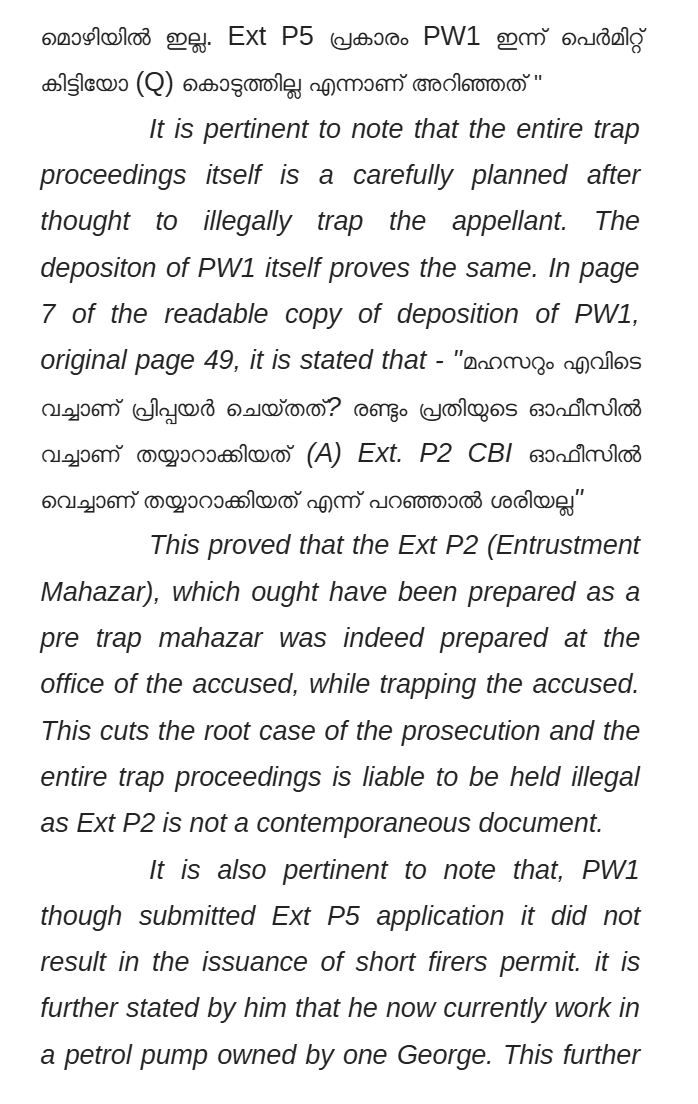
clarifies that PW1 is not a person who is not involved in the line of contracting work that requires a short firers permit under Explosives Act.
With regard to demand of Bribe
It is stated by PW1 that, the occasion for PW1 to meet the appellant for the first time was on 13.09.2002. It is further alleged that he was told to bring the required document along with the application on 27.09.2002. When PW1 met appellant on 27.09.2002, it is alleged that, for the first time, appellant had demanded an amount of Rs.5000/- and when told about the financial difficulties by PW1, appellant allowed the bribe amount to be reduced to Rs.3000/-. Thereafter on 4.10.2002, when PW1 telephoned appellant, he was directed to meet the appellant at his office alone on 7.10.2002 and that day the appellant was illegally trapped. There is absolutely no evidence other than the untrustworthy statement given by the PW1. No witness or material is before the court other than the solitary statement of PW1 who's statement is unbelievable and without
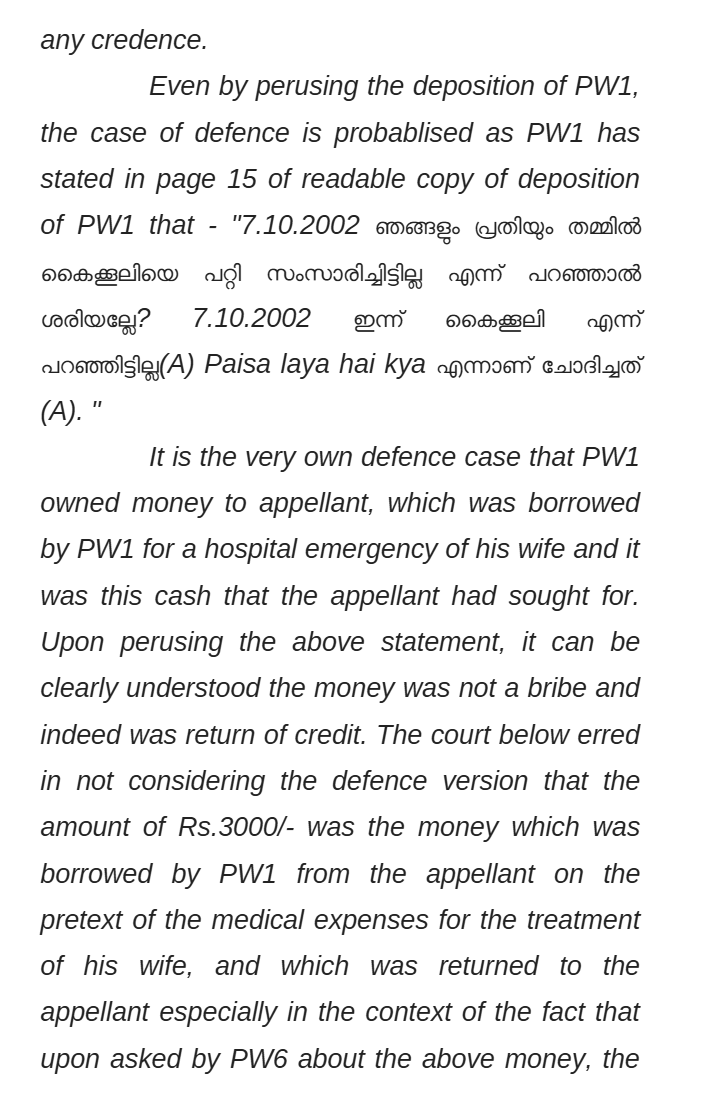
appellant had categorically stated to him it was his money.
T
Proof of demand and acceptance of bribe as a sine qua non for conviction under the Prevention of Corruption Act, emphasizing the necessity of corroborative evidence beyond the complainant's testimony....

The court established that proving demand and acceptance of bribe is essential to secure a conviction under the Prevention of Corruption Act, with particular attention to evidence during trap operati....
Proof of demand and acceptance of bribe is essential for conviction under Sections 7 and 13 of the Prevention of Corruption Act, 1988.
Proof of demand and acceptance of illegal gratification is essential to establish conviction under the Prevention of Corruption Act, 1988; mere receipt of bribe without evidence of demand is insuffic....
The conviction of a public servant for bribery requires proof of both demand and acceptance of illegal gratification under sections 7 and 13 of the Prevention of Corruption Act.

The prosecution must prove the demand and acceptance of bribe for conviction under the Prevention of Corruption Act, with circumstantial evidence sufficient to establish guilt.
The prosecution must prove the demand and acceptance of bribe beyond reasonable doubt for conviction under Sections 7 and 13(1)(d) of the Prevention of Corruption Act, 1988.
The conviction of the accused was upheld for demanding and accepting bribe, reinforced by testimony establishing guilt beyond reasonable doubt under the Prevention of Corruption Act.
The standard of proof for demand and acceptance of bribes under the Prevention of Corruption Act is met when evidence establishes exigent demands backed by corroborative testimony, with appropriate p....
Demand and acceptance of bribery must be proven for conviction under the Prevention of Corruption Act, which can be established through circumstantial evidence.



An indispensable Tool for Legal Professionals, Endorsed by Various High Court and Judicial Officers
Please visit our Training & Support
Center or Contact Us for assistance

Scan Me!
India’s Legal research and Law Firm App, Download now!


For Daily Legal Updates, Join us on :



 Back to top


