
 Back
Back





IN THE HIGH COURT OF KERALA AT ERNAKULAM
N.NAGARESH, J.
Anwar Hussain A., S/o. Late Ahemmed Hussain – Petitioner
Versus
The Tehsildar, Kollam Taluk, Kollam District – Respondent
WP(C) No. 5946 of 2025
Decided On : 13-02-2026
| Table of Content |
|---|
| 1. legal heirship certificate application. (Para 1 , 2 , 3) |
| 2. dispute over issuing of heirship certificate. (Para 4 , 5) |
| 3. arguments presented regarding legal heirs. (Para 6 , 7 , 8 , 9 , 10 , 11) |
| 4. legal framework for issuing heirship certificates. (Para 12 , 13 , 14 , 15 , 16 , 17 , 18 , 19 , 20) |
| 5. clarifications on scope and nature of heirship certificates. (Para 21 , 22) |
| 6. dismissal of the writ petition. (Para 23) |
JUDGMENT :
N. NAGARESH, J.
The petitioners, who are children of late Ahemmed Hussain and late Shereefa Beevi, seek to issue a writ of mandamus directing the 1st respondent-Tahsildar to issue legal heirship certificate as per Ext.P3 by effecting requisite notification in gazette in accordance with law and incorporating the names and relevant particulars of the writ petitioners and respondents 4 to 8 as the legal heirs of late Shereefa Beevi.
2. Petitioners 1 to 3 are the children of late Ahemmed Hussain and late Shereefa Beevi. They are brothers of late Abdul Salam. Father Ahemmed Hussain passed away in the year 1980. Mother Shereefa Beevi expired on 12.11.2023. Abdul Salam A., brother of the petitioners, died on 03.12.2023. The 4th respondent is the wife of the deceased brother. Respondents 5 to 8 are his children.
3. The 1st petitioner filed Ext.P3 application dated 29.07.2024 before the Tahsildar seeking issuance of legal heirship certificate in respect of the deceased mother. The details of legal heirs are provided in Ext.P3 application. They also submitted Ext.P4 application for legal heir certificate in respect of the deceased brother.
4. The petitioners state that they have produced necessary documents to enable the Tahsildar to verify and issue legal heir certificate. Statements of the petitioners and neighbours were also given. The respondents made requisite verification. However, the 1st respondent did not issue legal heirship certificate.
5. The 1st petitioner therefore filed W.P.(C)No.31257/2024. This Court delivered Ext.P5 judgment directing the respondents to process the applications and take a decision in accordance with law within one month. Respondents 4 to 8 had filed W.A. (Filing) No.1791/2024 challenging Ext.P5 judgment. The writ appeal did not question the relationship between the parties. The appellants do not have a case that they are not legal heirs of the deceased persons. The writ appeal was disposed of as per Ext.P7 judgment holding that it is not necessary to entertain the appeal.
6. The 1st respondent, however, rejected the applications for legal heirship certificates as per Exts.P8 and P9 orders. The applications are rejected on the ground that there are disputes between the legal heirs concerned and in order to ascertain who are the legal heirs, civil court has to be approached to obtain a Succession Certificate or that Administrator General's office has to be approached to obtain Administration Certificate. The petitioner states that the reasons given by the Tahsildar are unsustainable and are not sufficient to reject application for legal heirship certificate.
7. The counsel for the petitioners argued that Exts.P8 and P9 are based on incorrect understanding and ipse dixit interpretation of the Kerala Village Office Manual . The 1st respondent has mechanically rejected the application. There is no serious dispute that the writ petitioners and respondents 4 to 8 are the legal heirs. Exts.P8 and P9 are issued without hearing the petitioners. The 1st respondent is therefore compellable to issue legal heirship certificates as requested by the 1st petitioner, contended the counsel.
8. The 1st respondent filed counter affidavit. The 1st respondent stated that the petitioners filed application for legal heirship certificate of deceased brother A. Abdul Salam and their mother Shereefa Beevi. The petitioners stated that late Abdul Salam has only daughters. He asserted that as per Shariyat law, the brother of the deceased should also be included as legal heir along with daughters.
9. The
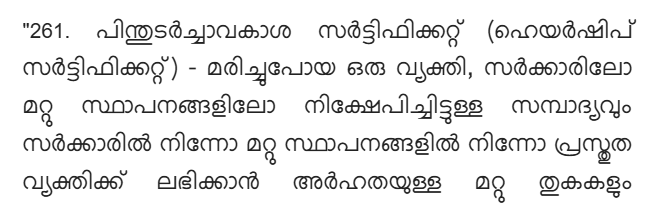
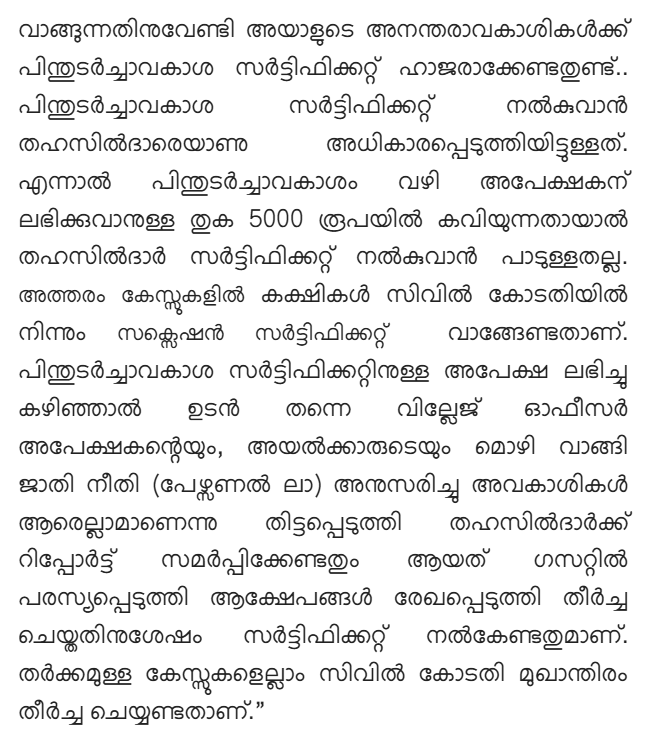
Legal heirship certificates cannot be issued for claims exceeding ₹5,000 when disputes among heirs exist; certification must align with applicable laws and guidelines.

A Tahsildar can issue legal heirship certificates to Class - II heirs without requiring them to go to Civil Court if there are no rival claims.

Legal heirship is determined by personal law; administrative guidelines limit the issuance of legal heir certificates, and courts cannot expand the scope of delegated powers. Rights of predeceased si....
Legal heir certificates cannot be issued by administrative authorities based solely on presumption; a judicial declaration of death is required under the law.



An indispensable Tool for Legal Professionals, Endorsed by Various High Court and Judicial Officers
Please visit our Training & Support
Center or Contact Us for assistance

Scan Me!
India’s Legal research and Law Firm App, Download now!


For Daily Legal Updates, Join us on :



 Back to top


