Back
Back





2026 Supreme(Ker) 252
IN THE HIGH COURT OF KERALA AT ERNAKULAM
A.BADHARUDEEN, J.
A.P. Benoy – Appellant
Versus
State of Kerala, Through The Deputy Superintendent of Police, VACB, Kottayam Represented By The Public Prosecutor – Respondent
Crl. A. No. 1252 of 2018
Decided On : 07-04-2026
For the Appellant : Sri. Sooraj T. Elenjickal, Smt. Helen P.A., Smt. Stephanie Sharon, Shri. Athul Roy
For the Respondent: Spl PP – Rajesh A., Sr PP – Rekha S.
Public servants must not misuse their position; misappropriation established through evidence confirms legal accountability under the Prevention of Corruption Act and IPC.
Headnote:(A) Prevention of Corruption Act, 1988 - Sections 13(1)(c), 13(1)(d) and 13(2) - Indian Penal Code - Sections 409, 477A - Misappropriation by a public servant - Accused was convicted for misappropriating Rs.1,74,979/- while working as a cashier - The Special Court's findings were upheld, establishing the accused's guilt for dishonestly misappropriating public funds and falsification of accounts. (Paras 4, 6, 39, 42)
(B) Legal Principles: The prosecution is required to establish misappropriation beyond reasonable doubt; an admission can infer guilt under Indian Evidence Act provisions; 'intention to defraud' must include deceit and injury. (Paras 37, 44)
Facts of the case:
The accused misappropriated funds collected from consumers during his tenure from March to May 2007, falsifying records in the process.
Findings of Court:
The evidence presented sufficed to prove the accused's acts of misappropriation and falsification of accounts, justifying conviction under relevant sections of law.
Issues: Whether the accused's conviction under the specified sections was justified based on the evidence presented.
Ratio Decidendi: The court emphasized that evidence indicated the accused's dishonest actions and misappropriation, while the prosecution satisfactorily proved the allegations beyond a reasonable doubt, upholding the trial court’s judgment.
Result: The appeal was partially allowed, affirming conviction and modifying the sentence to one year of rigorous imprisonment along with fines.
| Table of Content |
|---|
| 1. introduction to the case context. (Para 1 , 2 , 3) |
| 2. details of allegations and initial court findings. (Para 4 , 5 , 6) |
| 3. arguments from the accused's counsel regarding evidence. (Para 7 , 8 , 9 , 10 , 11 , 12) |
| 4. prosecution's rebuttal and evidence presentation. (Para 13 , 14 , 15 , 16) |
| 5. court's examination of factual evidence. (Para 19 , 20 , 21 , 22 , 23) |
| 6. analysis of essential legal conditions for offenses. (Para 26 , 27 , 28 , 29 , 30 , 31 , 32) |
| 7. concluding interpretation of prosecution claims. (Para 34 , 37) |
| 8. final decision on the appeal and sentencing. (Para 42 , 43) |
JUDGMENT :
A.BADHARUDEEN, J.
The sole accused in C.C. No.1/2011 on the files of the Court of the Enquiry Commissioner and Special Judge, Kottayam, has filed this appeal, under Section 374 (2) of the Code of Criminal Procedure, 1973 [hereinafter referred as ‘Cr.P.C.’ for short], challenging the conviction and sentence imposed by the Special Judge, against him as per the judgment dated 29.09.2018. The State of Kerala, represented by the Special Public Prosecutor is arrayed as the respondent herein.
2. Heard the learned counsel for the appellant and the learned Special Public Prosecutor, in detail. Perused the verdict under challenge and the records of the Special Court.
3. Parties in this appeal shall be referred as ‘accused’ and ‘prosecution’, hereafter.
4. The prosecution case is that, the accused, while working as the cashier of K.S.E.B. Section Office at Manimala in Kottayam District, during the period from 1-3-2007 to 2-5-2007, dishonestly and fraudulently misappropriated a total amount of Rs.1,74,979/-, which was collected by him from the consumers. Further, the accused has falsified records for misappropriating the above amount. Thus, the accused by illegal means and by abusing his position as public servant, obtained pecuniary advantage to the extent of said amount. On this premise, the prosecution alleges commission of offences punishable under Sections 13 (1)(c) and 13(1)(d) read with 13(2) of the Prevention of Corruption Act, 1988 [hereinafter referred as ‘P.C. Act, 1988’ for short] and under Sections 406, 420 and 477A of Indian Penal Code [hereinafter referred as ‘ IPC ’ for short], by the accused.
5. After framing charge for the offences punishable under Sections 13 (1)(c) and 13(1)(d) read with 13(2) of the P.C. Act, 1988 and under Sections 409 and 477A of IPC, the Special Court recorded evidence and completed trial. During trial, PWs 1 to 24 were examined and Exts.P1 to P81 were marked on the side of the prosecution. Exts.D1 to D7(a) were marked on the side of the defence, out of which, Exts.D1 to D4 were the contradictions recorded as that of PW4, PW5 and PW14.
6. On appreciation of evidence, the Special Court found that the accused was guilty for the offences punishable under Sections 13 (1)(c) and 13(1)(d) read with 13(2) of the P.C. Act, 1988 and under Sections 409 and 477A of IPC . Accordingly, the accused was convicted for the said offences and sentenced as under:
“Considering all these facts and circumstances, I sentence the accused to undergo Rigorous Imprisonment for three years each and to pay a fine of ₹25,000/- (Rupees twenty five thousand only) each for the offence under Secs.13(1)(c) and 13(1) (d) r/w Sec.13(2) of the Prevention of Corruption Act, 1988 and Secs.409 and 477A of IPC, in default of payment of fine the accused has to undergo Simple Imprisonment for a period of six months each. The substantive sentences shall run concurrently. The set off for the period of detention which the accused had undergone in the jail during the investigation is allowed under Sec.428 Cr.P.C.”
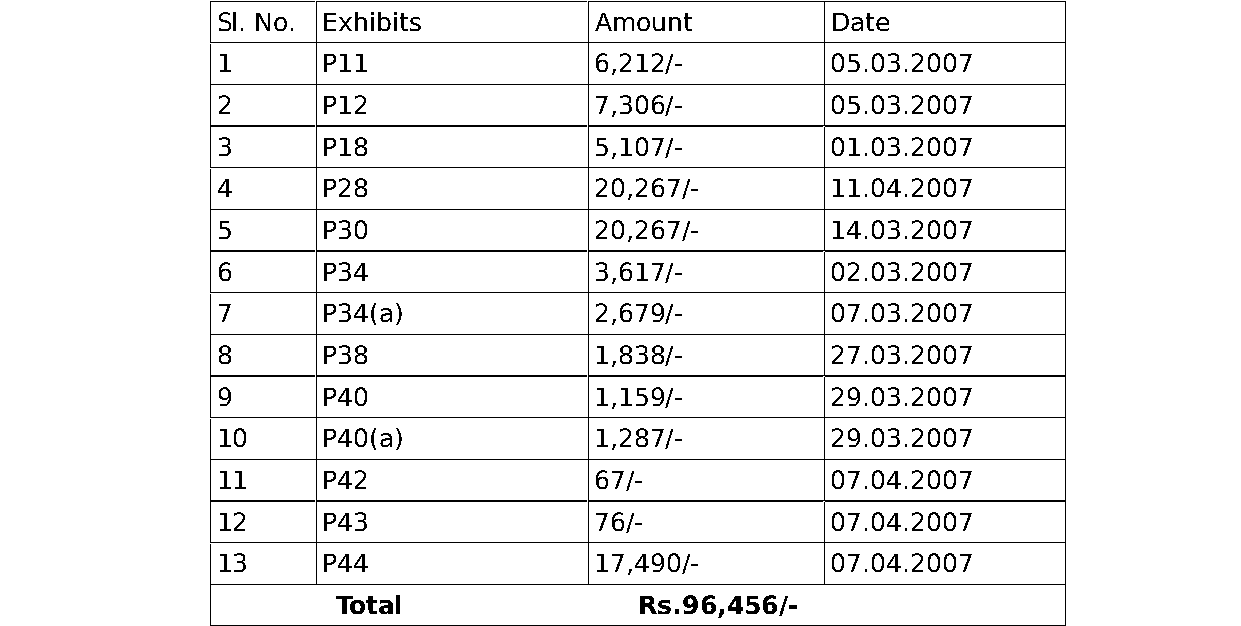
7. The learned counsel for the appellant/accused argued that, the prosecution broadly divided the alleged misappropriation under two heads viz. ‘shortage in the cash chest’ to the tune of Rs.78,520/- and ‘broken collection’ amounting to Rs.96,459/-. Thus, the total amount alleged to be misappropriated by the accused would come to Rs.1,47,979/-