
 Back
Back





IN THE HIGH COURT OF KERALA AT ERNAKULAM
A. Badharudeen, J.
C.M.Kelu – Petitioner
Versus
Deputy Superintendent Of Police Vigilance And Anti-Corruption Bureau – Respondent
CRL.A NO. 896 OF 2012
Decided On : 11-03-2026
Key Points: - The judgment reiterates that guilt must be established beyond reasonable doubt in criminal cases under the Prevention of Corruption Act and IPC (!) . - The appellate court acquits the accused of the offences under IPC Sections 471 and 477A, noting lack of proven misappropriation and suggesting clerical errors rather than deliberate fraud (!) , (!) . - The final order is that the verdict of the Special Court is set aside; the appellant is acquitted and set at liberty; bail bond cancelled and fine amounts to be released (!) . - The case involves a public teacher accused of falsifying Provident Fund entries to obtain undue pecuniary advantage; evidence included trial testimony, bank records, and forensic handwriting analysis supporting misappropriation was not proven beyond reasonable doubt (!) , (!) , (!) , (!) . - Forensic handwriting analysis (PW-13) supports that questioned writings could be by the accused; however, the appellate court still found insufficient proof of misappropriation beyond reasonable doubt, emphasizing clerical errors rather than deliberate fraud (!) , (!) , (!) . - The original conviction and sentences under IPC 471 and 477A were set aside; accused acquitted and discharged, with set-off and other procedural directions noted (!) .
| Table of Content |
|---|
| 1. the accused's conviction for corruption (Para 1 , 3 , 4 , 5) |
| 2. contentions raised by the defense (Para 6 , 7) |
| 3. the court's considerations of evidence (Para 8 , 9 , 18 , 19 , 20 , 21) |
| 4. testimonies from prosecution witnesses (Para 10 , 11 , 12 , 13 , 14 , 15 , 16 , 17) |
| 5. the court's final judgment and reasoning (Para 22 , 23 , 24) |
JUDGMENT :
A. Badharudeen, J.
Sole accused in C.C.No.14/2004 on the files of the Enquiry Commissioner and Special Judge, Kozhikode, has filed this appeal under Section 374 of the Code of Criminal Procedure, 1973 (for short, ‘Cr.P.C.’ hereinafter), challenging the conviction and sentence imposed against him in the above case, dated 02.07.2012.
2. Heard the learned counsel for the appellant/accused as well as the learned Special Public Prosecutor. Perused the judgment under challenge.
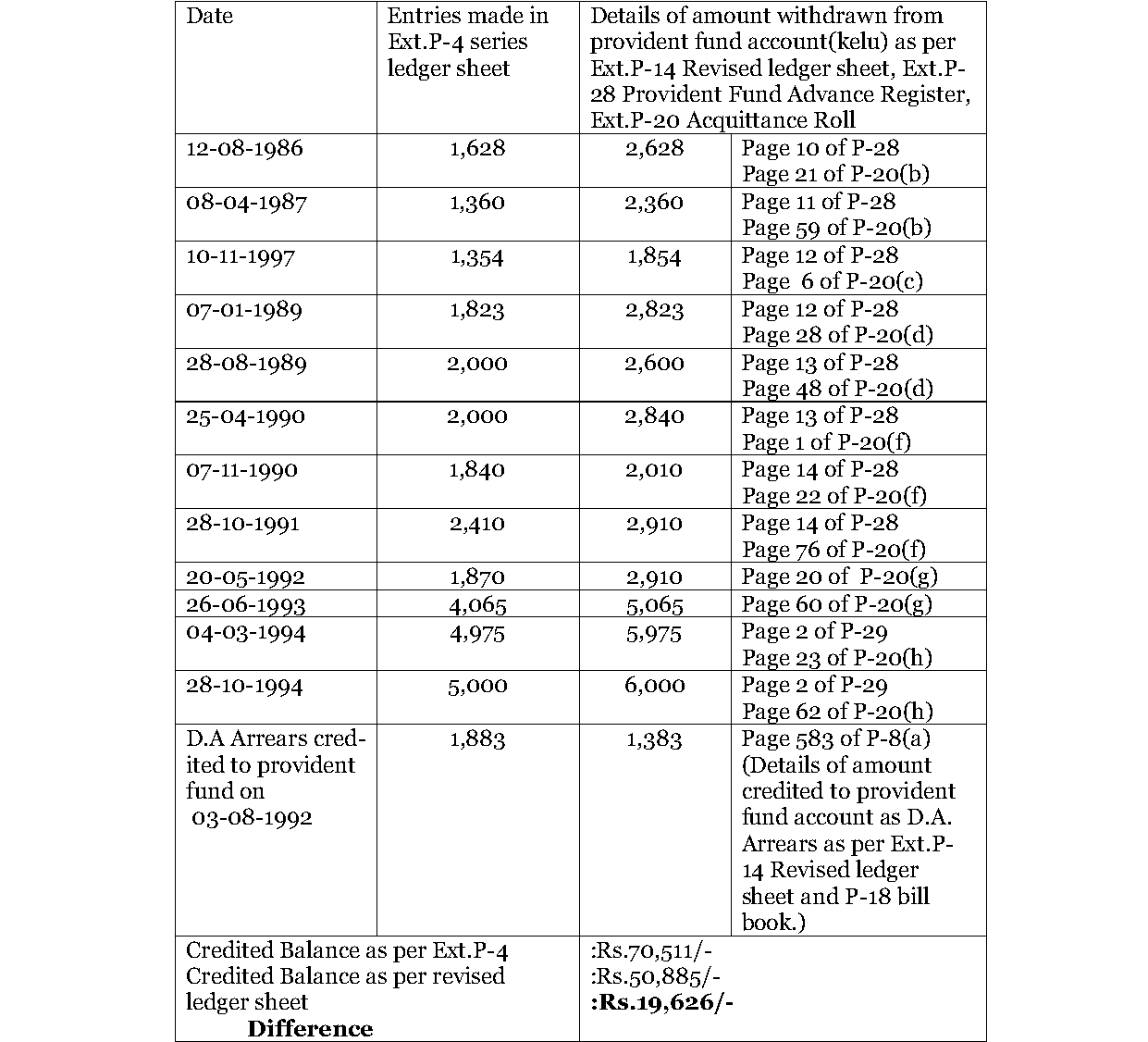
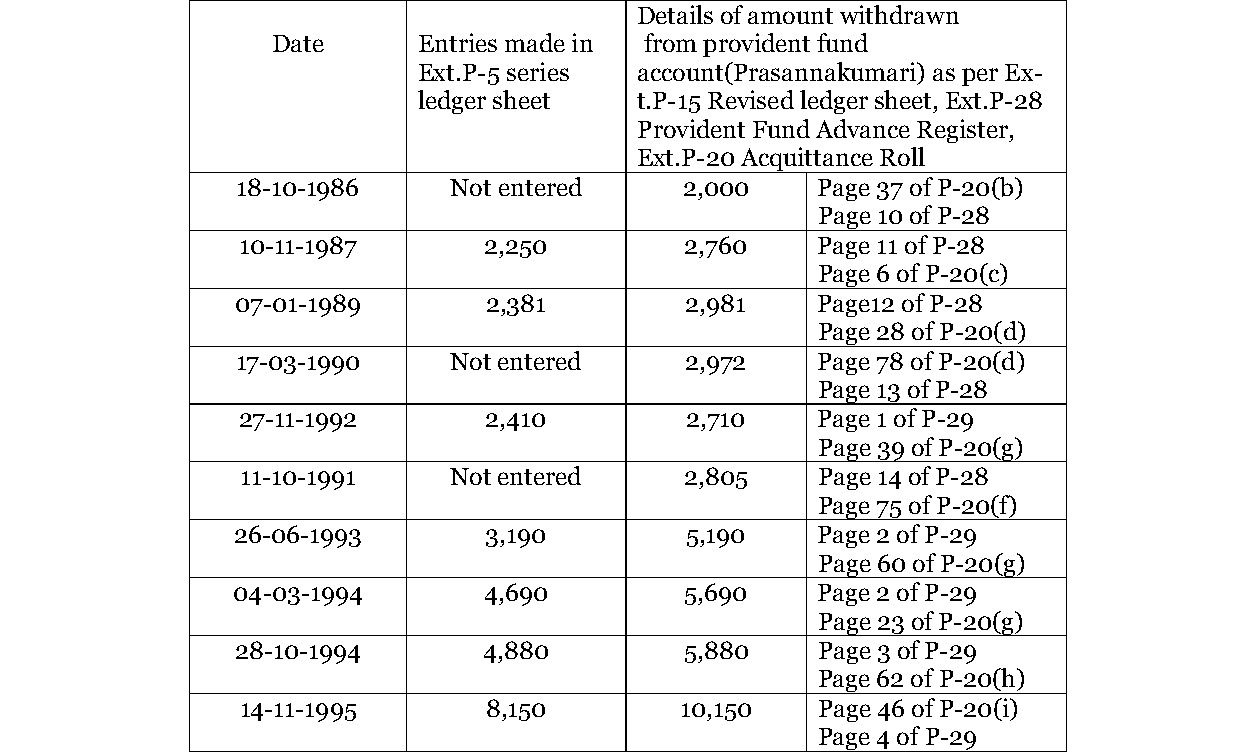
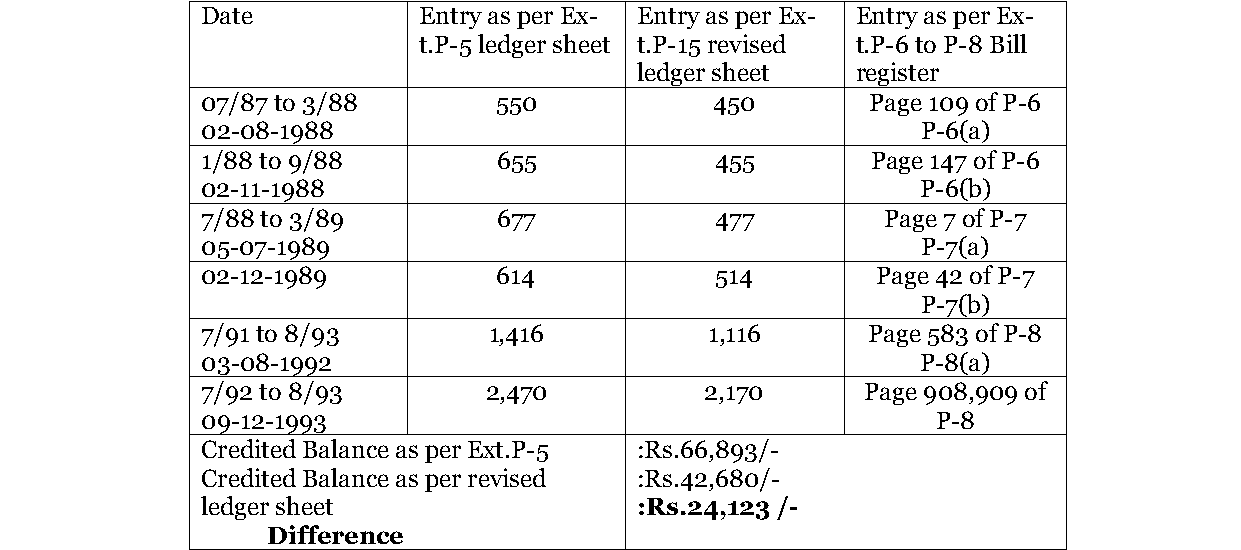
3. The case of the prosecution is that the accused, being a public servant while working as an Assistant Teacher in A.U.P. School, Perambra, abused his position as a public servant and committed criminal misconduct by making false entries in the withdrawal columns and subscription columns of the ledger sheets of Provident Fund Account bearing K.A.S.E. P.F. No.D-13004 and also in the account of his wife, Prasannakumari, bearing K.A.S.E. P.F.No.D-16798. These ledger sheets were prepared by him at the Credit Slip Preparation Camp held at N.I.M.L.P. School, Perambra, during the periods from 22-10-1996 to 29-10-1996 and from 05-12- 1996 to 09-12-1996. By doing so, he allegedly attempted to obtain undue pecuniary advantage of Rs.19,626/- in his Provident Fund Credit Card and Rs.24,213/- in his wife’s Provident Fund Credit Card for the year 1995-96 by falsification of accounts and by adopting fraudulent methods. It is further alleged that he attempted to obtain undue pecuniary advantage of the said amounts by submitting an application for Provident Fund Advance, and he forged documents and falsified accounts with the intention to defraud the Government. He also attempted to cheat the Government and committed criminal breach of trust. Thereby, the prosecution alleges commission of offences punishable under Section 13 (1)(c), Section 15 r/w 13 (1)(d) and (2) of the Prevention of Corruption Act, 1988 , and under Sections 471 , 477A, 409 and 511 r/w 420 of the Indian Penal Code (for short, ‘the IPC ’ hereinafter), by the accused.
4. In this matter, the learned Special Judge recorded evidence and proceeded with trial. During trial, PW1 to PW15 were examined and Exts.P1 to P57 were marked from the side of the prosecution. No evidence was adduced by the defence.
5. On appreciation of evidence, the learned Special Judge found that the appellant/accused committed offences punishable under Sections 471 and 477A of the IPC while acquitting him of the other offences. Accordingly, he was sentenced as under:
“In the result, the accused is sentenced to undergo Rigorous Imprisonment for a period of one year and to pay a fine of Rs.1,000/- and in default of payment of fine he is sentenced to undergo Simple Imprisonment for one month for the offence punishable under Section 471 of Indian Penal Code and to undergo Rigorous Imprisonment for a period of two years and to pay a fine of Rs.1.000/- and in default of payment of fine, to undergo Simple Imprisonment for one month for the offence punishable under Section 477(A) of . The substantive portion of the sentences shall run concurrently. Accused is entitled to get set off regarding the period of detention, if any, under Section 428 Criminal Procedure Code. Bail bond executed by the accused stands cancelled.”
6. While assailing the verdict impugned, it is submitted by the learned counsel for the appellant/accused that in this case, the Special Court acquitted the accused of all other offences except Sections 471 and 477A of the IPC and the allegation is confined to the attempt made by the accused to obtain Rs.19,626/- in his Provident Fund account and Rs.24,213/- in the Provident Fund acco
The accused's conviction was overturned due to insufficient evidence proving guilt beyond a reasonable doubt for alleged financial misconduct and clerical errors were noted instead.

Misappropriation of funds by public servants can be established through consistent witness testimony and circumstantial evidence, even without handwriting expert corroboration.

Public servants found guilty of misappropriating funds by fabricating documents in a criminal conspiracy, invoking sections of the Prevention of Corruption Act and IPC.
Fraud committed by a public bank officer through manipulation of loan accounts constitutes significant breaches of trust and results in affirmations of conviction under corruption and fraud statutes.

The main legal point established in the judgment is that suspicion cannot replace proof beyond reasonable doubt. The prosecution must prove its case beyond reasonable doubt, and the trial court must ....
Public servants are criminally liable for misappropriation of entrusted property through forgery, supported by identification of handwriting, fulfilling requirements of the Prevention of Corruption A....


Conviction for forgery and misappropriation requires clear proof of entrustment and intent to defraud, which was lacking, leading to acquittal.

The prosecution failed to prove the charges of forgery and conspiracy beyond reasonable doubt due to irregularities in evidence collection.
The conviction under the Prevention of Corruption Act was confirmed based on sufficient evidence of misappropriation by the accused, emphasizing statutory minimum sentencing.



An indispensable Tool for Legal Professionals, Endorsed by Various High Court and Judicial Officers
Please visit our Training & Support
Center or Contact Us for assistance

Scan Me!
India’s Legal research and Law Firm App, Download now!


For Daily Legal Updates, Join us on :



 Back to top


