
 Back
Back





IN THE HIGH COURT OF KERALA AT ERNAKULAM
A. Badharudeen, J.
R.Sasidharan Pillai, S/O.K.N.Ramakrishna - Petitioner
Versus
State of Kerala – Respondent
CRL.A No. 1547 of 2011, CRL.A No. 1546 of 2011, CRL.A No. 1548 of 2011, CRL.A No. 1549 of 2011, CRL.A No. 1550 of 2011, CRL.A No. 1551 of 2011, CRL.A No. 1552 of 2011, CRL.A No. 1553 of 2011, CRL.A No. 1554 of 2011, CRL.A No. 1555 of 2011, CRL.A No. 1556 of 2011, CRL.A No. 1557 of 2011, CRL.A No. 1563 of 2011, CRL.A No. 1565 of 2011, CRL.A No. 1566 of 2011, CRL.A No. 1567 of 2011, CRL.A No. 1568 of 2011, CRL.A No. 1569 of 2011, CRL.A No. 1570 of 2011, CRL.A No. 1571 of 2011, CRL.A No. 1572 of 2011, CRL.A No. 1573 of 2011, CRL.A No. 1574 of 2011, CRL.A No. 1575 of 2011
Decided On : 02-12-2025
| Table of Content |
|---|
| 1. summary of charges against accused. (Para 1 , 4 , 5 , 6 , 7 , 8 , 9 , 10) |
| 2. court's analysis and evaluation of evidence. (Para 2 , 3 , 11 , 19 , 20 , 21 , 22 , 23 , 24 , 25 , 26 , 28 , 29 , 30 , 31 , 32 , 33 , 34 , 35 , 36 , 38 , 40) |
| 3. arguments presented by the accused. (Para 12 , 13 , 14 , 15 , 16 , 17) |
| 4. conclusion on the sufficiency of conviction. (Para 39 , 42) |
| 5. final order and direction for lower court. (Para 43 , 44 , 45) |
JUDGMENT :
A. Badharudeen, J.
Crl.A. Nos.1563, 1565, 1566, 1567, 1568, 1569, 1570, 1571, 1572, 1573, 1574 and 1575 of 2011 and Crl.A. Nos.1547, 1546, 1548, 1549, 1550, 1551, 1552, 1553, 1554, 1555, 1556 and 1557 of 2011 have been filed under Section 374 of the Code of Criminal Procedure, 1973 [hereinafter referred as 'Cr.P.C' for short], by the 1st and 2nd accused respectively in C.C. Nos.43, 44, 45, 46, 47, 48, 49, 50, 51, 52, 53 and 57 of 2008 on the files of the Court of the Enquiry Commissioner and Special Judge, Kottayam, challenging the conviction and sentence imposed by the Special Judge against them as per the common judgment dated 27.07.2011. The State of Kerala represented by the Public Prosecutor is arrayed as the sole respondent herein.
2. Heard the learned counsel for the appellants and the learned Public Prosecutor, in detail. Perused the common verdict under challenge, the records of the Special Court as well as the decisions placed by the learned counsel for the appellants.
3. Parties in these appeals shall be referred as ‘accused’ and ‘prosecution’, hereafter.
4. In these matters, the prosecution alleges commission of offences punishable under Sections 13 (1)(c) and 13(1)(d) read with 13(2) of the Prevention of Corruption Act, 1988 [hereinafter referred as ‘P.C. Act’ for short] as well as under Sections 468, 471, 477A, 409 read with 120B of the Indian Penal Code [hereinafter referred as ‘IPC’ for short], by the accused.
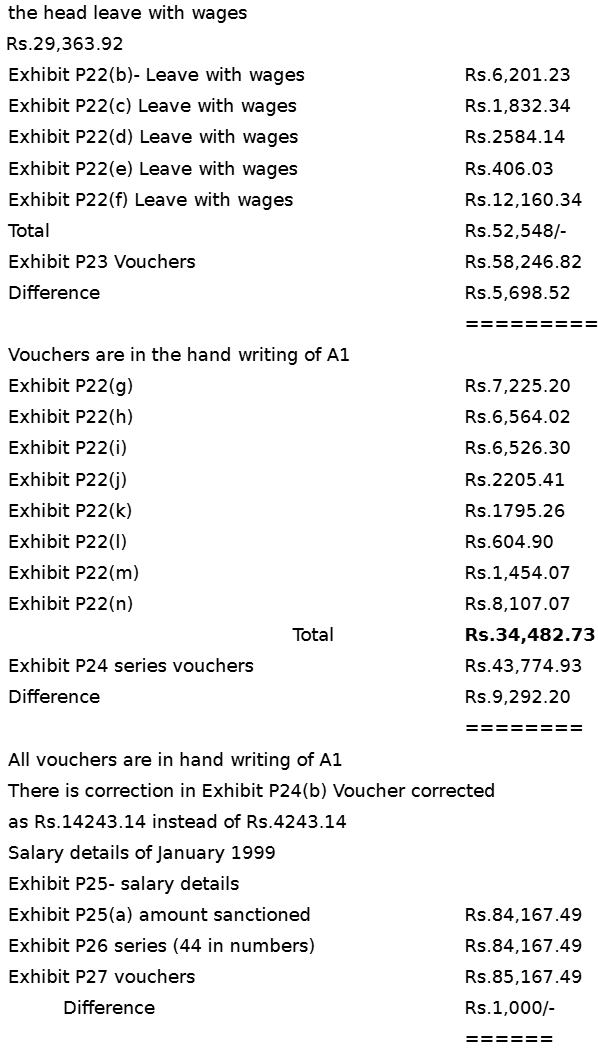
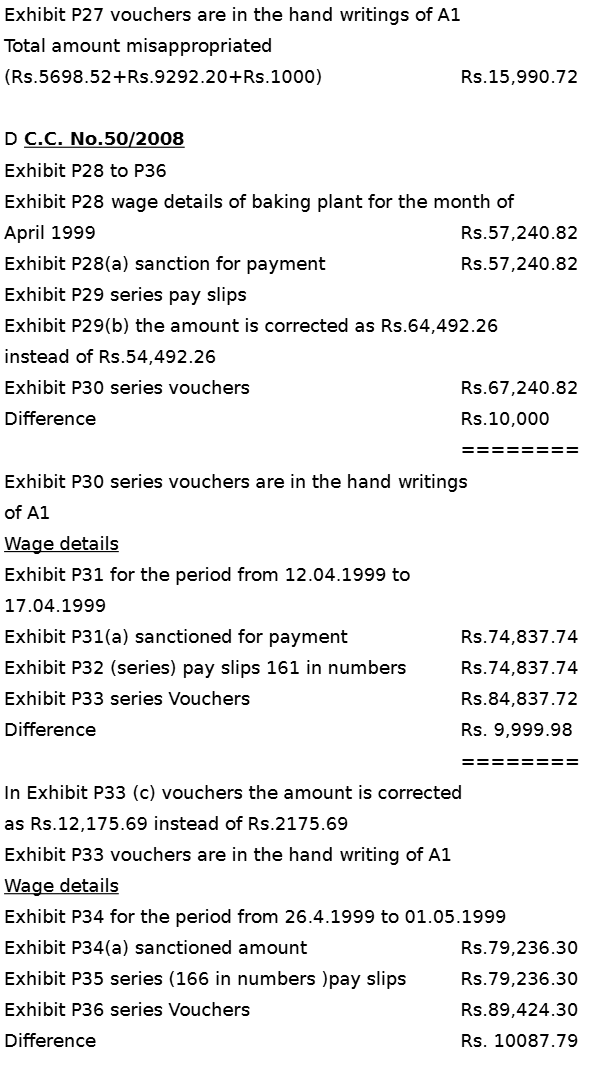
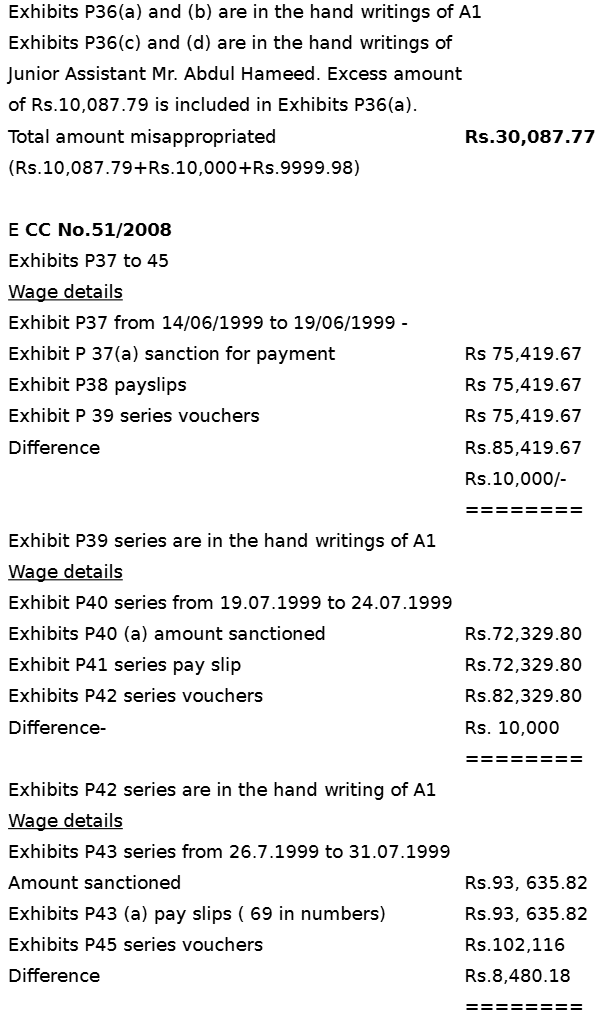
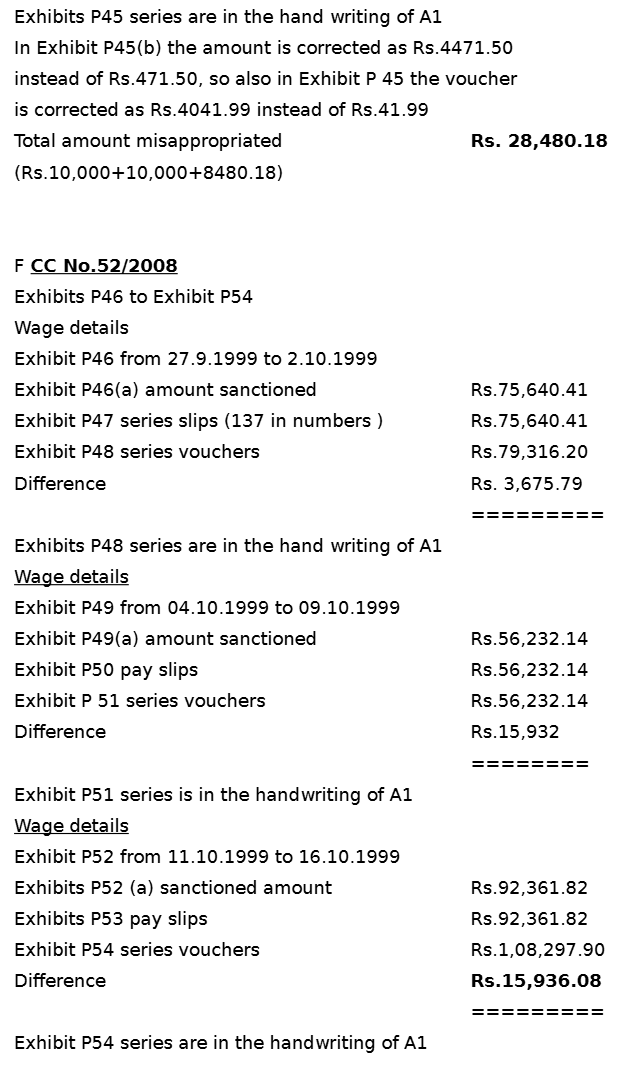
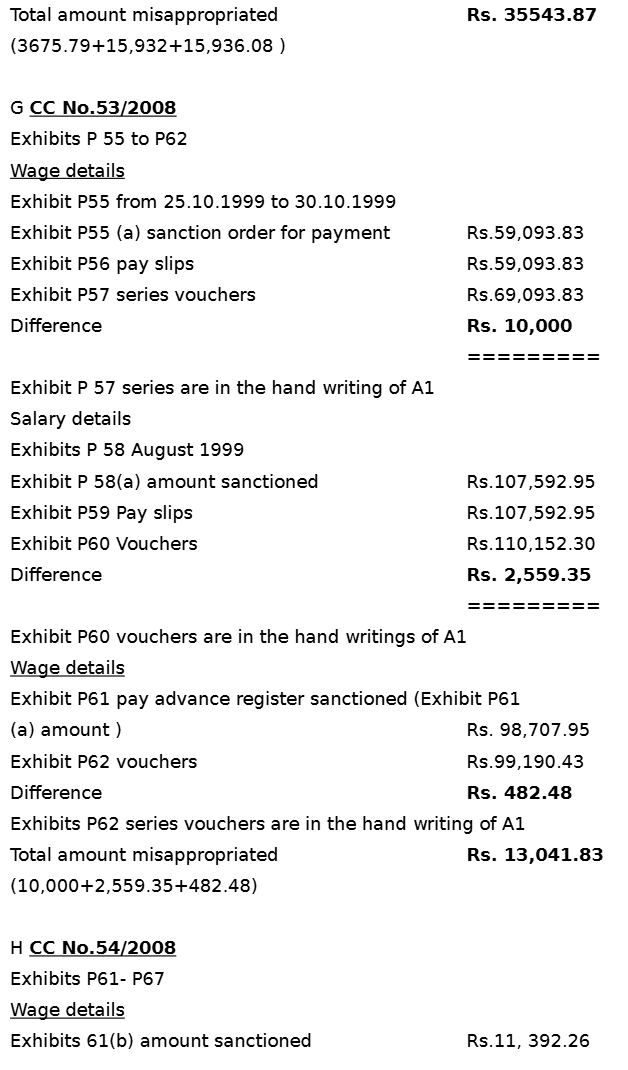
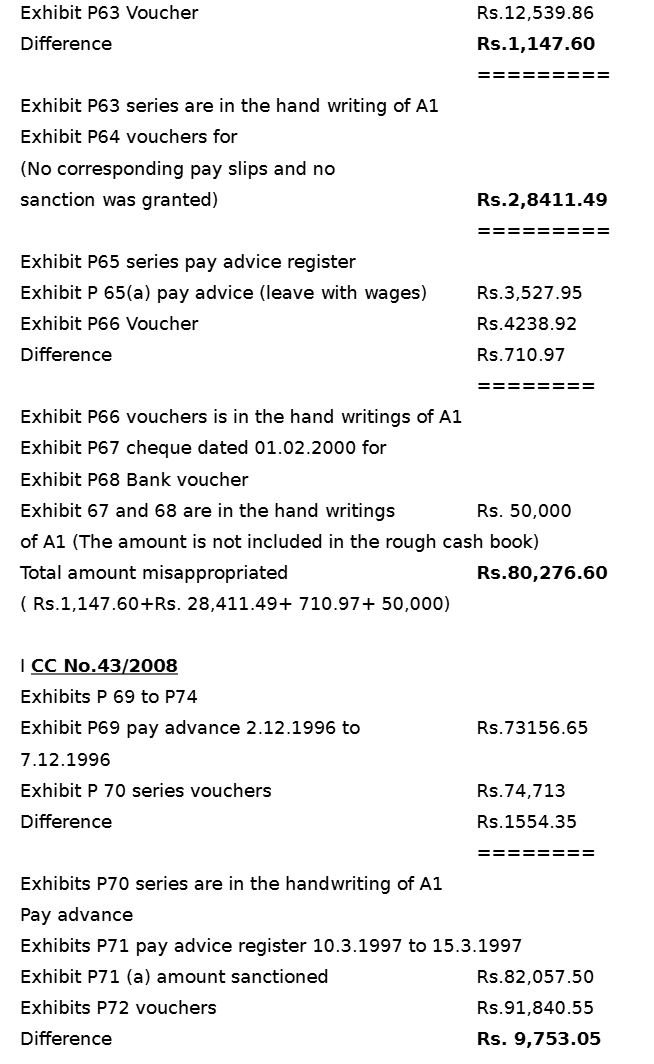
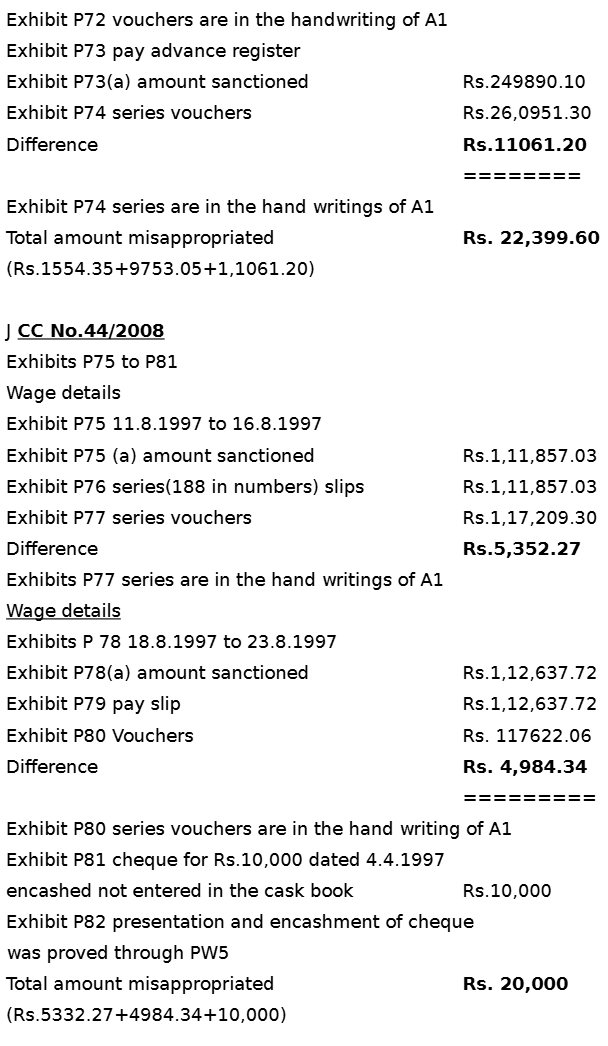
5. The prosecution case in C.C. No.43/2008 is that, accused Nos.1 and 2, who had been working as the cashier and accountant respectively in Foam Mattings (India) Limited, Alappuzha, as such being public servants, hatched criminal conspiracy to misappropriate money from the said Foam Mattings (India) Limited, Alappuzha and in furtherance of the said conspiracy, accused Nos.1 and 2 misappropriated an amount of Rs.22,398.60 during the period from 12-12- 1996 to 24-3-1997 from the fund of Foam Mattings (India) Limited, Alappuzha pertaining to the disbursement of wages to employees for the period from 02-12-1996 to 07-12-1996 and 10-3-1997 to 15-3-1997 and wage arrear vide pay advice No.1823 dated 13-2-1997 and accused Nos.1 and 2, who were entrusted with the cash for payment of wages and salary of employees entered into a criminal conspiracy on or before 12-12-1996 and in pursuance of that conspiracy accused No.1 manipulated and falsified cash voucher Nos.2294, 2296, 3023, 3036, 3051, 3062, 2912, 2913, 2929, 2930, 2938, 2939, 2948, 2953, 2771, 2772, 2781, 2795 and other records by claiming excess amount through cash vouchers than the amount sanctioned and made fictitious entries in the register and in Imprest Ledger and General Ledger and obtained the said amount by corrupt or illegal means.
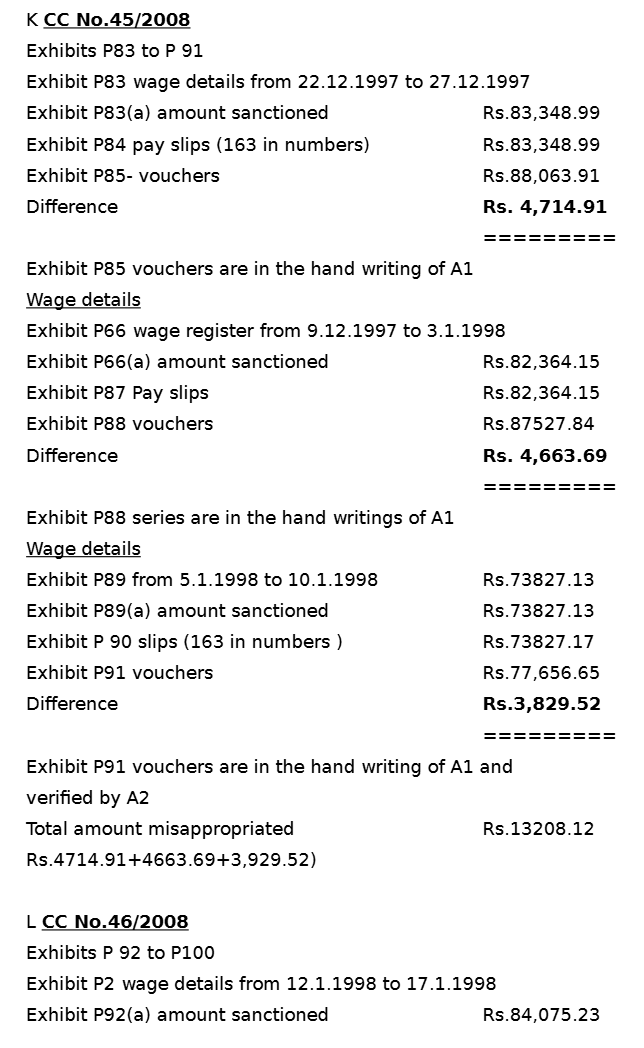
6. Similarly, in C.C. No.44/2008 the prosecution allegation is that an amount of Rs.10,000/- was misappropriated by falsifying cash voucher and an amount of Rs.10,000/- also was misappropriated during the period 4-4- 1997 to 30-8-1997 by the accused. C.C.No.45/2008 was registered alleging misappropriation of Rs.13,208.12 by manipulating and falsifying cash vouchers for the period commencing from 01-1-1998 to 17-1-1998, by the accused.
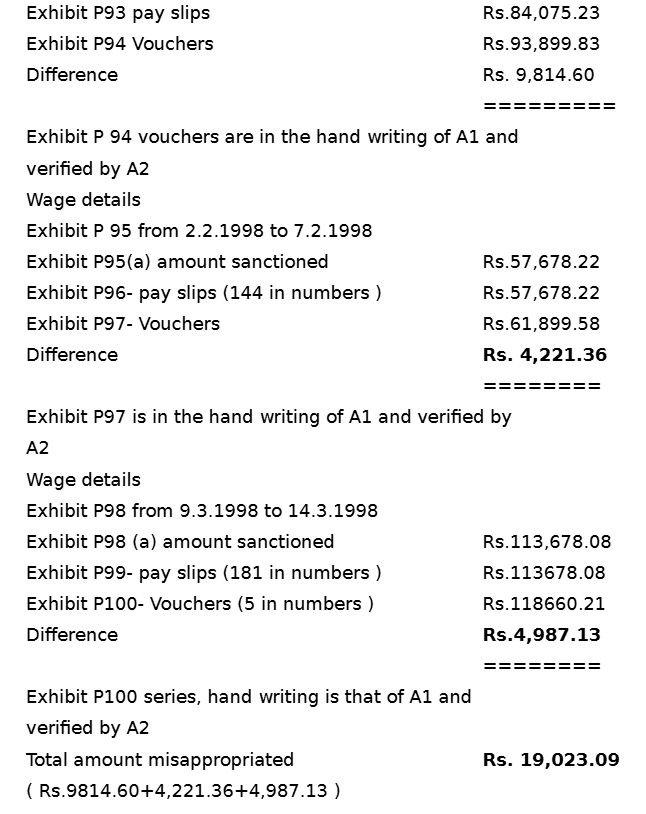
7. C.C.No.46/2008 was registered alleging misappropriation of Rs.19,023.09 for the period commencing from 22-8-1998 to 24-1-1998 and 2-2-1998 to 25-3-1998 by manipulating and falsifying cash vouchers by the accused. C.C. No. 47/2008 was registered pertaining to the period commencing from 05-11-1998 to 15-12-1998 under which an amount of Rs.32,03

Public servants found guilty of misappropriating funds by fabricating documents in a criminal conspiracy, invoking sections of the Prevention of Corruption Act and IPC.

Fraud committed by a public bank officer through manipulation of loan accounts constitutes significant breaches of trust and results in affirmations of conviction under corruption and fraud statutes.
Public servants misappropriating funds and failing to remit them can be convicted under the PC Act and IPC. The absence of documentation does not exempt accountability for the misappropriation.
The court confirmed the conviction for misappropriation and corruption, establishing that the accused alone managed funds, while her confessions were voluntary and credible.
The accused was convicted for misappropriating public funds by failing to account for money entrusted to her, establishing criminal breach of trust and corrupt practices under the relevant sections.

Conviction upheld for conspiracy and corruption based on evidence of fraudulent loan acquisition, while sentence modified to one year imprisonment.
Public servants must not misuse their position; misappropriation established through evidence confirms legal accountability under the Prevention of Corruption Act and IPC.
Public servants are criminally liable for misappropriation of entrusted property through forgery, supported by identification of handwriting, fulfilling requirements of the Prevention of Corruption A....
Misappropriation of funds by public servants can be established through consistent witness testimony and circumstantial evidence, even without handwriting expert corroboration.
The court confirmed the conviction under the Prevention of Corruption Act, emphasizing the admissibility of public documents and secondary evidence in proving misappropriation.



An indispensable Tool for Legal Professionals, Endorsed by Various High Court and Judicial Officers
Please visit our Training & Support
Center or Contact Us for assistance

Scan Me!
India’s Legal research and Law Firm App, Download now!


For Daily Legal Updates, Join us on :



 Back to top


