
 Back
Back





IN THE HIGH COURT OF KERALA AT ERNAKULAM
SOUMEN SEN, CJ, SYAM KUMAR V.M., J.
Sirajudheen – Appellant
Versus
Muhammed Abdul Akbar – Respondent
RCRev. Nos.306 of 2025, 308 of 2025, 309 of 2025, 310 of 2025 & 311 of 2025
Decided On : 07-04-2026
| Table of Content |
|---|
| 1. overview of the case and factual background. (Para 1 , 2) |
| 2. arguments presented by the tenants regarding landlords’ bona fide need. (Para 3 , 4 , 5 , 6 , 7 , 8 , 10) |
| 3. court's analysis and decision on the evidence presented. (Para 11 , 12 , 13 , 14 , 15 , 16) |
| 4. conclusion and directive to tenants regarding possession. (Para 17 , 18) |
ORDER :
Syam Kumar V.M., J.
[RCRev. Nos.306/2025, 308/2025, 309/2025, 310/2025 & 311/2025]
These Rent Control Revisions are filed by the different tenants challenging the concurrent findings rendered by the Rent Control Court and the Rent Control Appellate Authority, directing them to hand over vacant possession of the tenanted premises to the landlord, i.e., to the respondents. The Revision Petitions are considered and disposed of together by this common order as the issues involved are interconnected, and the subject building and the landlord are the same in all matters. The tenanted premises consist of different shop rooms situated on the ground floor of a building owned by the respondents.
2. The Rent Control Petitions were filed by the landlords invoking Sections 11 (2)(b), 11(3) and 11(4) (ii) of the Kerala Buildings (Lease and Rent Control) Act, 1965 (for short 'BLRC Act'). The Rent Control Court allowed the petitions with cost under (2)(b) and 11 (3) and the prayer under (4)(ii) and 11(4)(v) were disallowed directing the petitioners to hand over vacant possession of the petition schedule building within one month from the date of the order failing which the respondents landlords were at liberty to evict the petitioners resorting to execution proceedings. The tenants' appeals filed with the Rent Control Appellate Authority were of no avail, and they are now before us with these revisions.
3. We have heard of Mr.P.A.Harish, Advocate for the petitioners and Mr.S.Vinod Bhatt, Advocate for the respondents.
4. It is the contention of the learned counsel for the petitioners that the courts below had erred in appreciating the law, weight of evidence and circumstances of the case and had failed to consider the case put forth by the tenants in the proper perspective. It is submitted that the need as put forth by the landlords had not been substantially proved, and the bona fides were not clearly revealed or brought out in evidence. The sheet anchor of the landlords' case before both courts below was that the premises were needed for the 2nd petitioner in the RCP to commence a software development enterprise. According to the learned counsel, it was incumbent on the landlords to prove the said need as a bona fide one; however, no positive evidence had been tendered to substantiate the contentions in that respect. It was the specific case of the landlords that the 2nd petitioner in the RCP, for whom the need arose, had lost his job at ‘Yahoo’. It is contended that since the case of the 2nd petitioner was not that he wants to leave his existing job and then to start a business on his own in the petition schedule room and as it was his specific case that he has already lost his job and therefore, had to start a business of his own in the petition schedule rooms, it was the primary burden of the landlords to prove that the second petitioner had actually lost his job at ‘Yahoo’. Evidence in this respect never came to light, and, according to the learned counsel, this crucial aspect had been overlooked by the courts below.
5. In addition thereto, the learned counsel for the petitioners/tenants placed much emphasis on the contention regarding failure of the landlords to occupy rooms that were already lying vacant or were in one way or another available to the landlord for occupation, but were not chosen or availed and on the contrary proceeded to get the tenants evicted from the other shop rooms thus depriving them of their only livelihood. This, according to the learned counsel, pointed to the lack of bona fides of the landlords, which aspect had also been overlooked by the courts below.
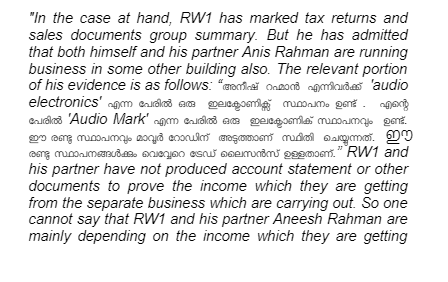
6. The le
Landlords must prove bona fide need for eviction; tenants' failure to substantiate claims regarding income and available premises supports eviction orders under the Rent Control Act.

Point of Law : Though the revisional power under Section 20 of the Act may be wider than Section 115 of the Code of Civil Procedure, 1908 it cannot be equated even with the second appellate power con....

The judgment emphasizes the importance of establishing a bona fide need for eviction, the burden of proof on tenants, and the limitations of revisional jurisdiction under Section 20 of the Act.
The landlord's bona fide need for eviction under the Kerala Buildings (Lease and Rent Control) Act must be recognized, and courts should not dictate the suitability of premises for the landlord's int....
Right to property, though not a fundamental right is still a constitutional right. Article 300 A of the Constitution of India proclaims that no person can be deprived of his property save by authorit....
Point of Law - Appellate Authority held that the finding of the Rent Control Court that the rent agreed by the landlord and tenant is by mutual consent cannot be sustained
Eviction under Section 11(3) necessitates proving a genuine and bona fide need, distinct from mere whimsy, emphasizing the burden of proof on landlords.



An indispensable Tool for Legal Professionals, Endorsed by Various High Court and Judicial Officers
Please visit our Training & Support
Center or Contact Us for assistance

Scan Me!
India’s Legal research and Law Firm App, Download now!


For Daily Legal Updates, Join us on :



 Back to top


