
 Back
Back





IN THE HIGH COURT OF JUDICATURE FOR RAJASTHAN AT JODHPUR
MADAN GOPAL VYAS, J.
Municipal Council Nagaur, Through Its Commissioner, Municipal Council, Nagaur (Raj.) - Appellant
Versus
Babulal, S/o. Mohanlal and Anr. - Respondents
S.B. Civil Misc. Appeal No. 449 Of 2024
Decided On : 29-05-2024
CIVIL PROCEDURE - APPEAL AND REMAND - ORDER 41 RULES 23, 23A, 24 CPC - The court discussed the provisions of Order 41 Rules 23, 23A, and 24 of the CPC, which govern the remand of cases by appellate courts. It emphasized that remand should only occur when necessary and that the appellate court has the authority to decide on issues if sufficient evidence is available. The court found that the appellate court failed to provide clear reasons for remanding the case and did not direct specific issues for retrial, leading to the conclusion that the remand was improper.
Fact of the Case:
The respondents-plaintiffs filed a suit for declaration and permanent injunction against the appellant-defendant, claiming that the defendant was attempting to sell their land. The trial court ruled in favor of the defendant, leading the plaintiffs to appeal. The appellate court quashed the trial court's decision and remanded the case for a fresh trial.
Finding of the Court:
The appellate court's decision to remand was found to be flawed as it did not specify issues for retrial or provide adequate reasoning for the remand. The court noted that sufficient evidence was available for the appellate court to make a determination.
Issues: Whether the appellate court properly exercised its discretion to remand the case under Order 41 CPC, and whether it was obligated to decide the case based on the evidence presented.
Ratio Decidendi: The court held that the appellate court must provide clear reasons for remanding a case and that it should only do so when necessary. If sufficient evidence exists, the appellate court is required to decide the case rather than remanding it.
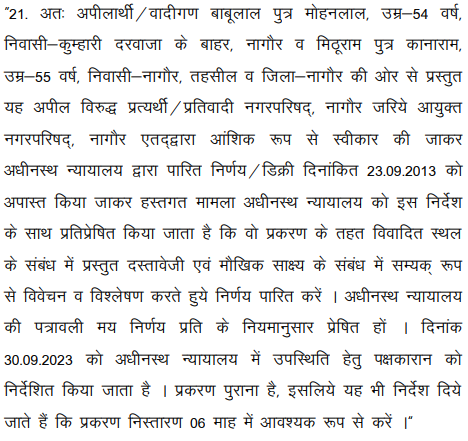
Final Decision: The appeal was allowed, the appellate court's judgment was quashed, and the appellate court was directed to decide the appeal on its merits.
JUDGMENT :
(Madan Gopal Vyas, J.) :
This civil misc. appeal under Order 43 Rule 1(u) read with Section 107 CPC has been preferred by the appellant-defendant against the impugned judgment dated 18.09.2023 passed by learned Additional District Judge No.1, Nagaur (for short, learned 'appellate Court') in regular appeal No.148/2013(14/2013), whereby learned appellate Court, while partly allowing the appeal, quashed and set aside the judgment and decree dated 23.09.2013 passed by learned Civil Judge (Jr. Division), Nagaur, (for short, 'learned trial Court'), in civil original suit No.68/2008, remanded the matter back to learned trial Court for deciding the suit afresh after considering the oral and documentary evidence.
2. The facts in nutshell are that the respondents-plaintiffs herein preferred a suit seeking decree of declaration and permanent injunction before the learned trial Court. In the suit, it was averred that the then Chairman of Municipal Board was trying to sell the pattasuda land of the plaintiffs to other persons and he wanted to dispossess the plaintiffs. Therefore, suit was preferred by the respondents-plaintiffs herein seeking the aforesaid reliefs. Thereafter, the appellant-defendant submitted written statement to the said suit denying the averments made therein and stated that the appellant-defendant is the sole owner of the disputed land and after procuring the required reports, removed the encrochees over the land of Khasra No.53.
3. On the basis of the pleadings of the parties, learned trial Court framed four issues for determination. The plaintiff examined as many as six witnesses and exhibited six documents and defendant examined three witnesses and exhibited nineteen documents. Thereafter, vide judgment and decree dated 23.09.2013, learned trial Court rejected the suit preferred by the plaintiffs. Thereafter, the respondents-plaintiffs herein preferred an appeal before the learned appellate Court. Learned appellate Court, vide judgment dated 18.09.2023, while partly allowing the appeal of the respondents-plaintiffs, quashed and set aside the judgment and decree dated 23.09.2013 and directed the learned trial Court to decide the suit afresh after taking into consideration the documentary and oral evidence with regard to disputed land. Aggrieved by the judgment and decree dated 18.09.2023 passed by learned appellate Court, the appellant-defendant has preferred the present civil misc appeal.
4. Arguing on the present appeal, learned counsel appearing for the appellant-defendant submits that the learned appellate Court has committed grave illegality while quashing and setting aside the judgment and decree of learned trial Court without reversing the findings recorded by it. It is further submitted that as per Order 41 Rule 23 CPC, a remand order requires that the appellate Court directs the learned trial Court specifically as to what issue or issues shall be tried in the case so remanded but in the present case, learned appellate Court without assigning any reason, straightway remanded the matter. It is further submitted that all the material was available with the learned appellate Court and the learned appellate Court could pass the order on merits. It is further submitted that a bare perusal of Rules 23, 23A and 24 of Order 41 CPC would make it clear that non-consideration, failure or mis-appreciation of an issue may not be a ground to order remand of the case, when the evidence on record is sufficient for determination of the issue by the appellate Court. Thus, it is submitted that it was within the permissibility of the learned appellate Court to take up and consider every issue and to determine the same when the evidence was available on record for its adjudication. However, learned appellate Court has wrongly remanded the matter back to learned trial Court. It is further submitted that learned appellate Court was under an obligation to decide the lis between the parties unless it came to a definite find
AI
The appellate court has the authority to decide cases based on available evidence and should only remand cases when necessary, providing clear reasons for such decisions.

The appellate court must provide cogent reasons for remanding a case, and it should decide based on existing evidence if sufficient, rather than remanding without due justification.


The appellate court's decision to remand a case is valid when the trial court has not addressed all relevant issues, ensuring proper judicial process.


The appellate court has the discretion to remand a case for a fresh trial when new evidence is introduced, ensuring fairness in the judicial process.

The main legal point established in the judgment is that the appellate court should not remit the case to the trial court if the evidence on record is sufficient to decide the matter, and it should i....
The appellate court should not remit the case to the trial court if the evidence on record is sufficient to decide the matter, and the decision to remand should be in accordance with the relevant pro....



An indispensable Tool for Legal Professionals, Endorsed by Various High Court and Judicial Officers
Please visit our Training & Support
Center or Contact Us for assistance

Scan Me!
India’s Legal research and Law Firm App, Download now!


For Daily Legal Updates, Join us on :



 Back to top


